Chapter 1 — Running the World
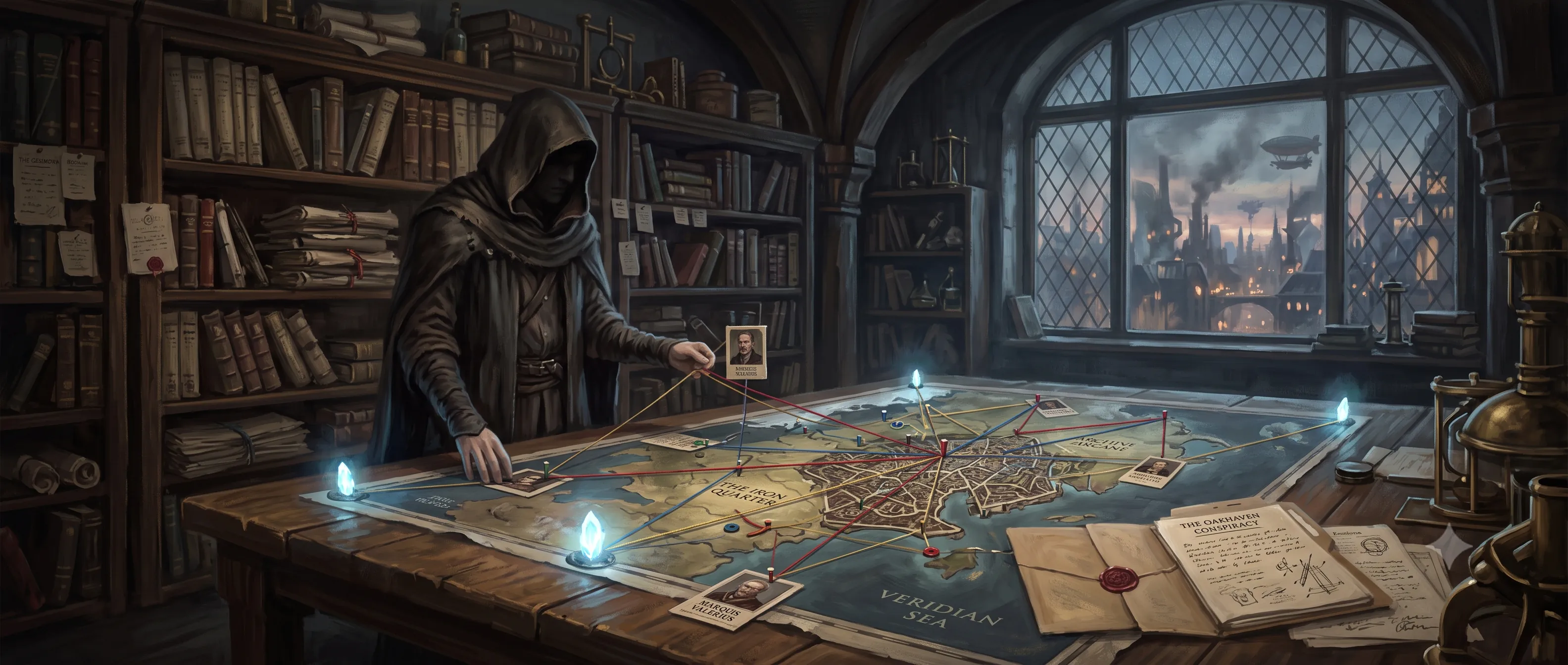
You are about to run a world that most of its own people do not understand. That is the first thing to hold onto. In Merretia you are not merely the referee of a ruleset — you are the keeper of a set of truths that no character, and almost no god, fully holds. How you carry those truths is what will make this world feel like itself.
This chapter is your orientation. It tells you what your job is, what secrets you hold, and how to use the two things at your disposal: this guide (the running layer) and the world bible (the source of truth).
Your job
Section titled “Your job”You play the world. When the players act, the world responds — honestly, neutrally, and in character. You are not their opponent and you are not their author; you are the weather, the wanting, and the consequences. In Merretia specifically, three habits will serve you:
- Make everything cost. This is the world’s first law — all light is lent. Magic costs the caster; oaths cost the sworn; the grid costs coin; the Hollow costs the world. When you’re unsure how hard to press, press on the price. A Merretia session that never made anyone pay for anything hasn’t found the world yet.
- Let belief matter more than power. The strongest force at your table isn’t a Tier-6 Working — it’s a character who believes something hard enough to bleed for it. Reward that (see Conviction, Chapter 5). Build scenes that ask what are you willing to lose, not just can you beat the DC.
- Keep the dread patient. The Hollow is not a boss. It is an absence, and it wins by being slow. Your scariest tool is the thing the players can’t see the meter for.
The truths you hold
Section titled “The truths you hold”The Master’s Guide holds what the Player’s Handbook deliberately withholds. Guard these; deployed well, each is worth a season of play.
- The gods’ true names and offices are known here, and nowhere in the world. The locked mapping — which god is which discipline, and which are bonded pairs — is in Chapter 4. In the world, this is unknown and endlessly contested; the mystery of the pantheon is the central religious drama of the setting. Your players’ characters can spend a campaign chasing what you already have on one page. Never simply hand it over.
- No religion holds the truth — and all of them hold a shard. The pooled ceiling of all mortal faith is about ten percent of what is real (Chapter 4). Every temple is right about something and wrong about the frame. Run them that way: sincere, useful, and incomplete.
- The Hollow’s cost is real, enormous, and secret. A character who uses it pays nothing they can see; the bill falls on the world, and you are the one who tracks it (the Wound Track, Chapter 8). This is the one place you keep a number the players never see — and the one place you must make the consequences land in the session, not in a distant epilogue, or the temptation becomes a free win. Secret cause, present effect.
Using a secret well is mostly restraint. Let the players earn the edges of it. Dramatic irony — you know, they don’t, the scene means more because of the gap — is the engine of this whole setting.
Your two tools
Section titled “Your two tools”- This guide is the running layer. It tells you how to adjudicate the parts of Merretia that aren’t in any standard ruleset: the cost of magic at the table (Chapter 5), the Hollow (Chapter 8), the treasure that keeps its own ledger (Chapter 7), and how to build adventures in a world of oaths and debts (Chapter 9).
Getting started
Section titled “Getting started”You don’t need to read this book cover to cover to begin. To run a first session:
- Skim Chapter 5 (Running Merretia) — the handful of table-facing rules that are actually different here.
- Take the ready adventure in Chapter 9 (the Cold Lamp) or sketch a small situation with a debt in it.
- Hold your secrets, make everything cost, and let the players decide what they’ll pay.
The world is already built. Your job is to let them walk into it and find out what it asks of them.