Chapter 3 — The Cosmos & the Descent
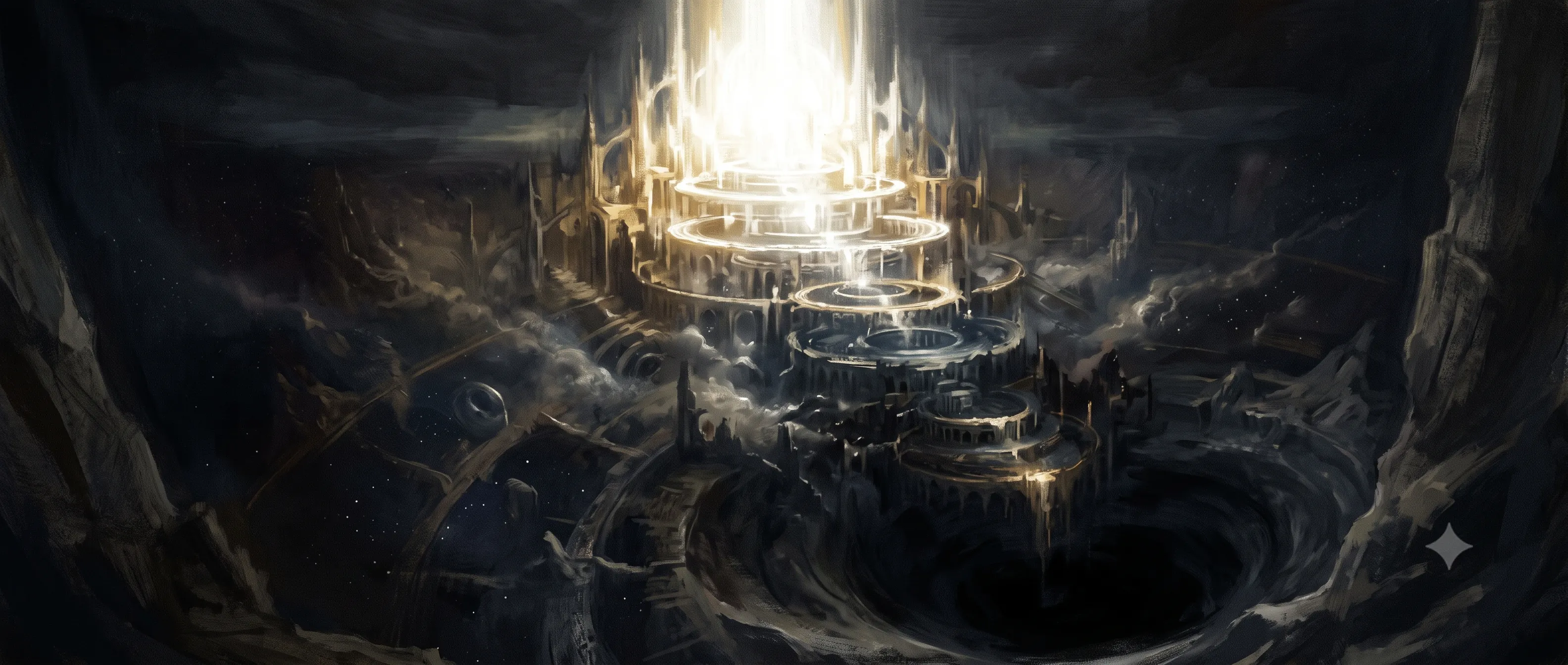
This is the truth beneath everything — the metaphysics no character fully holds and you, the GM, do. You rarely state it at the table; you run by it. Full canon is; this is the shape of it you need in hand.
The two, and the bond
Section titled “The two, and the bond”At the top of reality sit two primordial forces, and nothing else is pure:
- The Source — pure Order. The bones of reality, law-bound and deterministic.
- The Companion — pure Chaos. The life of reality, generative and non-reducible.
Their bond is existence itself. The condensation of the raw substrate into relational order was the Source-Companion bond; to be anything at all is to be a truce between the two. This is the capstone law — existence is compound. Every god, angel, daemon, person, beast, and stone is a bond of Order and Chaos, tilted toward one pole but never resting there. Only the two primordials are pure, and even they exist only as a pair.
The descent — the emanation ladder
Section titled “The descent — the emanation ladder”Reality steps down from the primordials in rungs, the lent light growing thinner at each step:
Source & Companion → the Gods (the Zar’ir) → the angels and daemons → the Mal’akha and Mal’akhaham lineages → humankind.
- The Gods (Zar’ir) are bonded Order-Chaos pairs — eight of them, one Order-god wed to one Chaos-god across each of the four discipline-divides (see Chapter 4).
- Angels and daemons are their emanations. Their true forms are nothing like the folk pictures: an angel is a stack of rotating rings of feather-shaped metal blades that emits light and moves by discrete recomputation; a daemon is a growing organic mass that absorbs light and grows into position. The pair is a sealed yin-yang — interpenetrating, distinct, each sustaining the other. Wings, halos, horns, and red skin are compression artifacts — the mortal eye flattening a form it cannot hold, exactly as it flattens any of the true forms.
- The Mal’akha (angel-descended) and Mal’akhaham (daemon-descended) are the bridge lineages between the divine and the human — normally invisible in the blood, occasionally surfacing (the playable Aasimar and Tiefling; PHB Chapter 3).
- Humankind is the ladder’s end: faith-diffuse, adaptable, the canvas.
The two laws that drive play
Section titled “The two laws that drive play”- Order emits; Chaos absorbs. This runs through everything — the disciplines’ colours, a caster’s eye-flash, the aesthetic of the whole world.
- All light is lent. Nothing is owned; power is borrowed against a bond and called back when the bond closes. This is the source of the magic-cost engine (PHB Chapter 6) and the reason the Hollow externalizes its cost. It is the first law of the world, and the sentence to run everything by.
The Wound in the weave
Section titled “The Wound in the weave”The Hollow is not a place, a power, or a will — it is the un-closed remainder of that first condensation, a defect trapped inside the world. Because it has no far end of relation, a cost run through it settles on whatever relation stands nearest; that accretion is the widening Wound ( for how you run it). Two forces move the Wound, and they are the deepest stakes in the setting:
- Severance widens it. Breaking a load-bearing bond undoes a mend directly — the route no instrument flags.
- Integration mends it. A bond sincerely restored, especially where one broke, closes the Wound. The Relational Principle runs both ways.
This is why the setting’s real moral axis isn’t good-versus-evil — it is bond-versus-severance. Every temple that preaches “the god is good, the devil is evil” (Chapter 4) is unknowingly teaching severance, and widening the Wound by a fraction with every sermon.
Running the cosmos
Section titled “Running the cosmos”You almost never explain any of this. You use it: as dramatic irony (the players’ characters chase truths you hold on one page), as the stakes behind the Hollow (a broken oath isn’t just drama — it literally thins reality), and as the quiet reframe that makes the whole world cohere — that this is a universe held together by relationship, and coming apart wherever relationship fails.