Chapter 9 — Building Adventures
Merretia rewards a particular shape of adventure. The world is built on debts, oaths, and a Wound that widens where bonds break — so the adventures that sing here are the ones built around a relationship under pressure, not just a dungeon with a prize at the bottom.
Start with a debt, an oath, or a seam
Section titled “Start with a debt, an oath, or a seam”The fastest way to a Merretian adventure is to pick one of three seeds and pull:
- A debt. Someone owes something they can’t pay — coin to the Iron Coin, a favor to a Fused House, a life to a guild. Debts are leashes; follow the leash. “Who owes whom, and what happens when it comes due?”
- An oath. A vow was sworn — and now keeping it and surviving it have come apart. Oaths are the setting’s built-in tragedy engine (a Vowbound forced to choose between two vows; a Halkari whose Stand means letting the innocent die). Ask each oathbound character what they swore, then bring them the day it costs them.
- A seam. The Hollow is thinning somewhere. A seam is a ticking clock the players can’t fully see — and the best answer to it is never more force, but a bond mended where one broke.
The strongest campaigns braid all three: a debt that pressures an oath that, when it breaks, opens a seam.
The worked example — The Cold Lamp
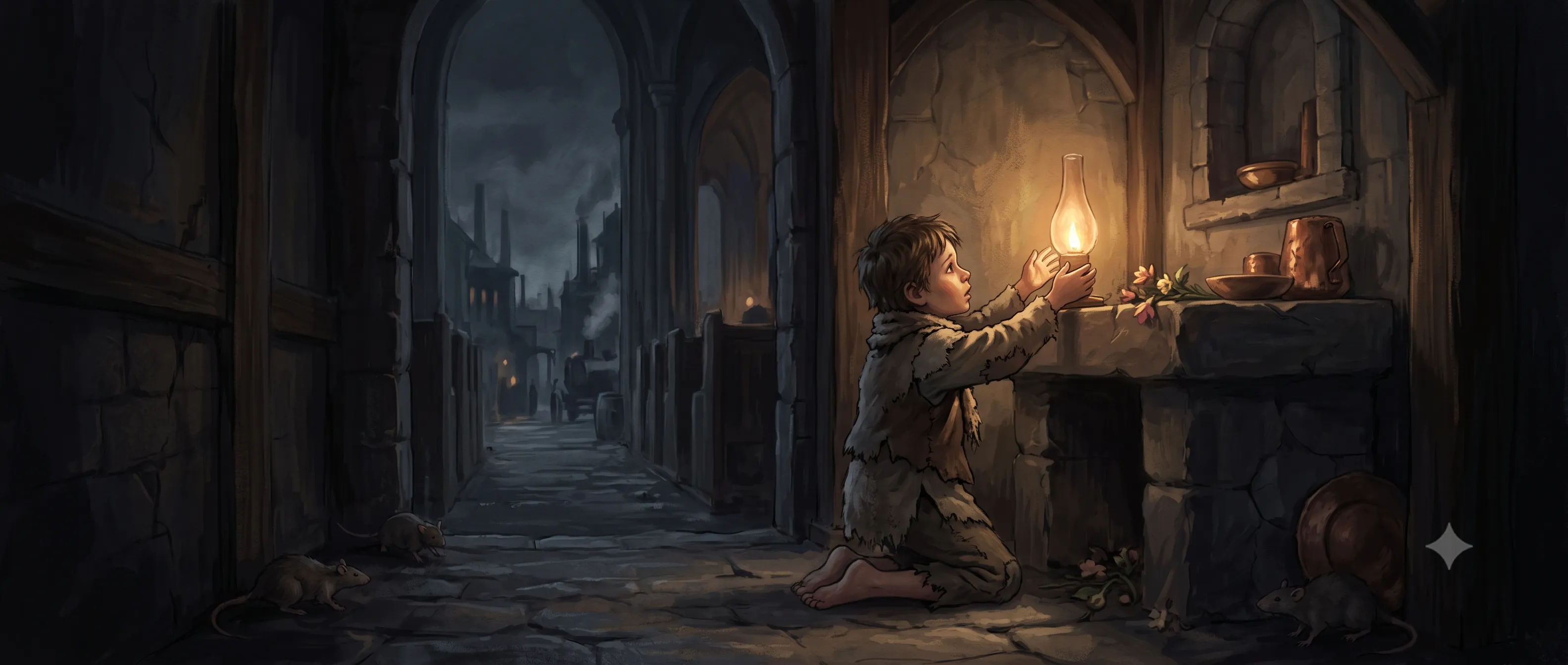
Section titled “The worked example — The Cold Lamp”The ready one-shot (CAMPAIGN/MODULES/) is the model. On its surface it is a small mystery — a thief has taken the Undying Lamp from a shrine. Underneath, it is the whole setting in miniature: the thief is Pip, a child stealing to save his dying sister Nel; the Lamp is a standing work of lent light that answered his sincere, unshaped faith when it would answer no greedy hand; and the module turns on the hinge the whole world turns on — the difference between a mundane theft and a cosmic truth, between the giant rats that are just rats and the thing that would be the Hollow if this were a darker night. It railroads gently (it’s a one-shot), gives players likable and unlikable characters, an antagonist, a red herring, and a foil, and it teaches the table the world’s values without a lecture. Read it as a template: a small human story with the cosmology quietly load-bearing underneath.
Supporting craft: (the functional roles a scene needs) and (canonical scenes and how they’re built).
Encounter building in this system
Section titled “Encounter building in this system”Two levers are as real as monster numbers (see ):
- A channeler is artillery, not infantry — glass, expensive, decisive for a few rounds. Build enemy forces the same way: a Thread of casters behind a Cage of elite non-casters. Let the players feel both the terror of an enemy channeler and the relief when it’s spent.
- Grid pressure and denied rest are difficulty. The scariest thing you can do to a well-supplied party is take them past the last recharge post, where charged gear is a countdown and Fray never clears. A dungeon that denies stillness is a Chaos-caster’s nightmare — use it on purpose.
For the creatures themselves, reach for the recognizable monster and assign it an origin: let the origin decide what it is and what killing it costs.
Downtime
Section titled “Downtime”Between adventures, Merretia’s institutions do the work: guild and House politics (favors called, alliances brokered via Alyu’amare, debts serviced through the Iron Coin), standing-work upkeep, rebonding a sundered focus stone, atoning for a broken oath, and recharging off the grid. Downtime is where the three-layer city reaches into the party’s life — and a good place to raise a debt that becomes the next adventure.
Pacing the Hollow across a campaign
Section titled “Pacing the Hollow across a campaign”The Wound Track is your long clock. Let punctures curdle single scenes; let a proto-seam turn a location into a slow civic emergency (a Seepwar); reserve a true seam and its catastrophic, mostly-failing closure for a climax — and make the closure winnable the one way the world allows, with a bond restored at the exact place one broke.