Chapter 4 — The Gods & the Hidden Truth
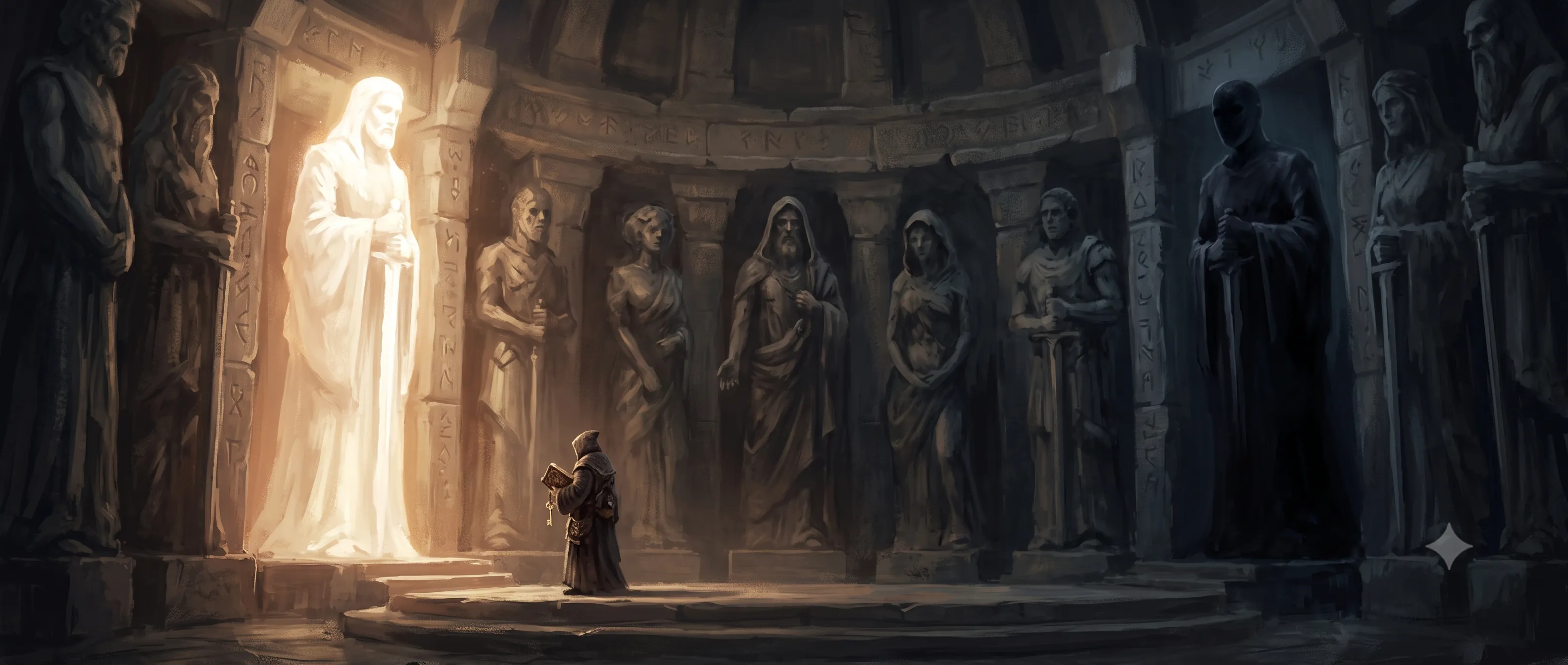
This chapter is DM-only. It holds the single largest secret of the setting’s religion: the truth about the gods that no temple on the continent fully knows. Guard it. Deployed with restraint, it is worth a whole campaign.
The truth, on one page
Section titled “The truth, on one page”There are eight Gods, and they are four bonded pairs — each a Zar’ir, one Order-god wed to one Chaos-god across a discipline-divide. The mainstream religions worship the eight as separate deities, having forgotten, over generations, that each god had a twin across the divide. The locked mapping:
| Discipline pair | Order-god | Chaos-god |
|---|---|---|
| Binding – Knowing | Embelekor | Michana |
| Weight – Growing | Zathra | Yadra |
| Current – Heart | Rashel | Bamoph-bam |
| Unmaking – Dream | Ilogo | Jawehn |
(Zathra, “the god of the wall and the watch,” is the Weight-god — a useful anchor when you need one.)
And here is the barb: the mainstream worships the Order-halves as gods and demonizes the Chaos-halves as devils — and every sermon that teaches “the god is good, the devil is evil” widens the Wound by a fraction, because it reinforces the severance of the primal pair-bond in the minds of believers. The most respectable religion on the continent is, without knowing it, a slow engine of the very thing the OCTA hunts. Almost no priest knows this. Most would be horrified.
The ten-percent ceiling
Section titled “The ten-percent ceiling”No religion holds the truth — and all of them hold a shard. The pooled ceiling of all mortal faith is about ten percent of what is real. So run every temple as sincere, useful, and incomplete: right about something, wrong about the frame. The names of the eight are widely known; what they stand for and who does what is unknown and endlessly contested across provinces. That contest — names known, meanings lost — is the central religious mystery of the setting, and your players’ characters can spend a campaign chasing what you have on the page above.
The Temple of the One is the nearest of all the religions to the truth (it reaches toward the underlying unity) and, not coincidentally, the one guild that cannot fuse into a House — which makes it the setting’s most interesting religious institution: closest to the secret, and structurally outside the capture.
The bridge to humanity
Section titled “The bridge to humanity”Between the divine and the human stand the Mal’akha (angel-descended) and Mal’akhaham (daemon-descended) lineages — normally invisible in the blood, occasionally surfacing as the marked Aasimar and Tiefling of the player’s roster. When one surfaces in your game, remember what it is: a fragment of the divine descent breaking the surface of an ordinary line — holy and cursed being the same thing, read from two sides.
Prophecy
Section titled “Prophecy”The setting’s prophecies are another shard-of-truth surface: real, partial, and dangerous to trust literally. Use them as you use the gods — the world believes them, they gesture at something true, and no one holds the whole of it.
Running the gods
Section titled “Running the gods”The whole chapter reduces to one instruction: hold the mapping, and never simply hand it over. Let the players earn the edges of it — a heretic who insists the god and the devil are one, a dreamwalker burned for saying so, a Temple-of-the-One mystic who’s closer than she should be. Dramatic irony is the engine; the gap between what you know and what the world believes is where the setting’s deepest stories live.