Chapter 8 — The Hollow & Its Manifestations
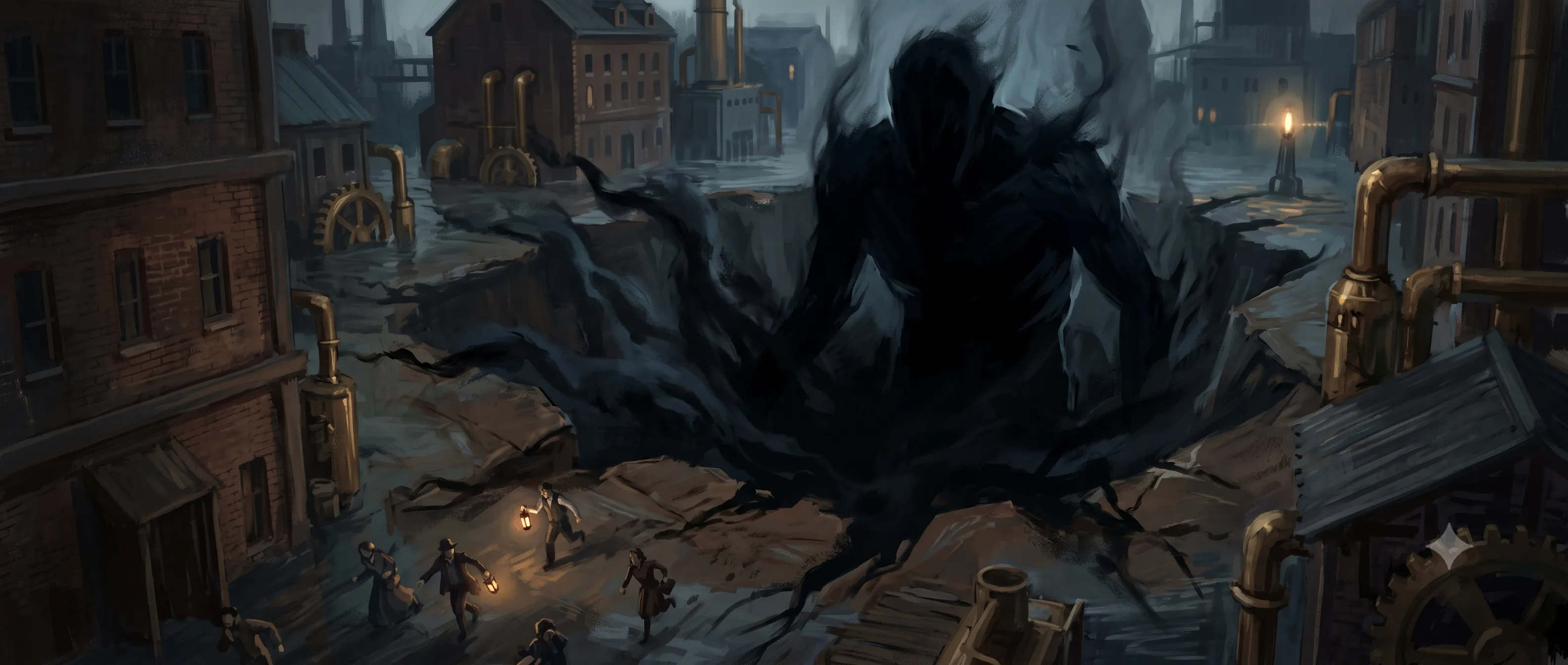
This is the GM’s chapter for the thing the Player’s Handbook only warns about. The Hollow is the setting’s engine of horror, and it runs on rules unlike anything else in the game — because it is not a monster, a power, or a will. It is an absence: the place where the weave of reality never closed, trapped inside the world like a vortex inside a superconductor. It has no self, no god, and no voice, because each of those is a closed loop of relation, and the Hollow is exactly the absence of one. It cannot want. It is the shape of a wanting that never happened.
Everything in this chapter follows from that one fact.
Part One — The Wound Track (keep this secret)
Section titled “Part One — The Wound Track (keep this secret)”When a character works the Hollow, they pay nothing they can see. You keep the bill. The Wound Track is the only number in this game the players never see — and the one you must spend hard, in the present, or the Hollow becomes a free win.
The rule of the Track: secret cause, present effect. The player never learns the count. But every mark you make must produce a consequence in this session — the world curdling around them — never a distant epilogue. If a Hollow-using character’s power feels free at your table, you are not spending the Track. That is the whole discipline of running the Hollow.
Keeping the Track
Section titled “Keeping the Track”Keep a hidden count for any locus where the Hollow is worked (a room, a site, a battlefield). Mark it:
- +1 each time a character casts a Hollow Working there.
- +1 for a severance — a load-bearing bond broken there with real consequence (a sworn ally betrayed, an oath shattered, a lineage’s grief brought to a head). This is the route no instrument flags — the OCTA cannot detect it, and it needs no Hollow discipline in the chain. It is your quietest and best campaign engine.
- +1 at your discretion for accumulated relational failure — a place where oaths keep breaking, a battlefield revisited by grief.
The seam ladder
Section titled “The seam ladder”| Track | State | What it means at the table |
|---|---|---|
| 1–2 | Puncture | Each Hollow act lands its cost now, on the nearest relation. Roll or pick from the Present-Cost table. The site mostly recovers. |
| 3 | Proto-seam | The site stops fully recovering. Focus stones flicker dark near it unprompted; animals avoid it before anyone knows why; minor seepage begins (the Unseen and lesser forms). This is the OCTA’s alarm threshold — and where a Seepwar begins (Part Three). |
| Seam | Seam | The locus stops recovering at all. Passage goes ambient — seepage arrives with no practitioner present; the tear is load-bearing in its own right (the Steam-Tunnel condition). A standing threat that must be closed, not fought. |
A seam usually forms from a proto-seam plus continued work, from a single catastrophic working (a greater summoning), or from stacked severance alone — a family or a place that keeps breaking at the same address until something is standing in the room that was never invited.
The Present-Cost table (d8)
Section titled “The Present-Cost table (d8)”When a puncture’s cost lands, it settles on whatever relation stands nearest. Roll or choose:
- The weather curdles — a wrongness in the air, a sudden cold with no source.
- An ally or NPC’s next meaningful roll sours (impose disadvantage; narrate the bad luck).
- A bonded pair nearby visibly frays — an argument, a coldness, a small betrayal between people who were fine an hour ago.
- Animals flee or panic; a mount won’t enter; birds go silent.
- Light and life spoil — a buried-sun cell dies, rations rot, a candle gutters out.
- A focus stone in the scene flickers toward void; a caster’s next Working comes harder.
- A wound won’t clot; a healing Working underperforms; someone’s rest doesn’t take.
- Something small that should not stir, stirs — nearby, unseen, and patient.
The user, meanwhile, feels fine — better than fine. That contrast is the horror. Play it.
Part Two — Closing a seam
Section titled “Part Two — Closing a seam”The party’s goal against the Hollow is almost never a body count. Killing what crosses closes nothing — it was never a being whose death was the relevant event.
- Press it back. Forcing a crossing back through the tear is Binding-work: it stops the immediate incursion but does not re-knit the locus. This is the achievable, session-scale win — buy the town a night.
- Close the seam. True closure means binding the locus itself: sustained, communal, nuclear-tier Binding performed at the tear. It is catastrophically costly (sun-tier energy paid in the closers’ own bodies), it needs several master Binders in concert, and it mostly fails — a seam offers structure nothing to grip, and the closer, standing nearest the door, risks becoming the borrowed shape the Hollow lacks. True closures are historic, rare, and the stuff of a campaign climax.
The one tool that changes the odds — and it’s beautiful. The Relational Principle runs both ways: severance widens the Wound, and integration mends it. A closure worked alongside a bond sincerely and publicly mended at the very place a bond once broke closes the seam faster and holds it longer than Binding alone. This is the exact inverse of severance, performed on purpose — and it is a real mechanic, not a sentiment: if your party engineers a genuine reconciliation at the seam (a feud ended, an oath restored, a grief laid down where it was made), grant the closure advantage, lower its DC, or halve its cost. The best answer to the Hollow is not more power. It is a mended bond in the exact place one broke.
Part Three — Detection, the OCTA, and the Seepwar
Section titled “Part Three — Detection, the OCTA, and the Seepwar”Detection: the bill, not the colour
Section titled “Detection: the bill, not the colour”The one question under every reading is whose door did the cost arrive at. Lawful work bills the practitioner; Hollow-work bills the world. The tells:
- On a stone: full void — the stone drinks both light and ink, a hole in the field (not a blank). Finely, a Knowing-adept finds a Hollow-touched object returns no coherent bearer-side ledger — the cost was never written into a person. (Reading the Knowing at a voided object is itself a Hollow-drift: the instrument is a door.)
- On a site: events cohere less well than they should; luck bends without a bender.
- On a survivor: the absence of the wear a working life should have left — a practitioner too whole against a documented history of practice. Long-term Hollow-users don’t retire; they go away, and something comes back wearing their face.
- On a living caster mid-Working: eye-flash and stone-colour, near-unfakeable — the colour is coupled to a circuit that either completes or does not.
Where detection fails — three story engines
Section titled “Where detection fails — three story engines”- Passive faith-leakage — unclaimed faith drifting into the Wound with no conscious user. No stone, no flash, no culprit. Civilizational and diffuse.
- The single extraordinary Dream-shunt — an ambiguous flicker a trained Reader can misjudge either way.
- The Dream-cover — the Dream’s own highest Working resembles the thing the OCTA hunts, because it does a leashed version of the same act. A master dreamwalker and a Hollow-cultist in indigo present nearly identically at a glance; only slowly tracing where the cost landed tells them apart, and a frightened institution never has slow. This gap produces the OCTA’s two signature injustices: legitimate dreamwalkers burned, and patient Hollow-workers hidden for years behind a Dream cover. Both are campaign gold.
The Seepwar — Sulamir’s real war
Section titled “The Seepwar — Sulamir’s real war”Because the Dome turns away armies but not the Hollow (Chapter 5), the city’s characteristic conflict isn’t a siege — it’s the Seepwar: the quiet, ongoing defense against Hollow incursion at the metaphysical layer the shield can’t reach. A proto-seam or seam inside the Dome is a civic emergency the OCTA, the guilds, and the Temple collaborate to answer. If your campaign lives in Sulamir, this is the war it’s fighting — and the enemy is winning by inches, in secret, exactly the way the Hollow always does.
Part Four — Running the Hollow’s presence (a craft rule)
Section titled “Part Four — Running the Hollow’s presence (a craft rule)”The Hollow has no voice, and never gets one. A voice is what a closed self-relation sounds like from outside; the Hollow is where that closure never reached. If it ever spoke with its own stable voice, it would by that fact have become a new archetype and stopped being Hollow. So in a scene, only two things may speak — and never a third:
- Ventriloquism — the borrowed voice of a hollowed person (a Hollow-possessed practitioner, §Bestiary), saying true things in a register that curdles them. It must never monologue, never explain a plan, never announce a grievance. The moment it does, it has become a person with motives and stopped being the Hollow.
- The doctrine — the tempter’s argument, “severance is liberation,” in a living, sincere, often loving mouth. This is where the real danger lives: not in what crosses, but in the idea that reaches a grieving lover or a cornered practitioner and makes cutting a bond sound like freedom. Give the argument to the tempted living. Let the absence, when the players finally meet it, be met as absence — silent, patient, and wrong.
Part Five — The Bestiary
Section titled “Part Five — The Bestiary”The design rule (canon): reach for the recognizable creature your players expect — then assign it an origin from the taxonomy below, and let the origin, not the silhouette, decide what it is, what kills it, and what killing it costs. A “zombie” might be a Hollow-revenant, an Aldeken of fallen Aldasen, or a Yulnesh person (never to be confused with a Hollow-thing) — the familiar name is only the costume.
The origin taxonomy (each stat block is tagged with one):
- Hollow-seepage — the visible shape of a thinning Wound; never a someone, only a hole wearing a mask. Order disciplines bind and destroy them cleanly; the Heart can’t seize them (no emotion) and the Knowing can’t read them (no mind). Killing them closes nothing (Part Two).
- Hollow-summoned — deliberately called through by a practitioner; more coherent, more dangerous, and every summoning leaves a traceable signature. Includes Hollow-possessed practitioners (the ventriloquist’s voice — the endpoint of a Hollow career).
- Kaiju — grown in the Wound over ages or crossed at enormous scale; rare, catastrophic, civilizational.
- Non-Hollow origins (the sharp contrast that keeps the dread meaningful): native beasts (mundane, displaced fauna — the giant rats of a one-shot), Aldasenian undead (the Aldeken of the sunken city), sea-horrors (ancient deep predators of the Maw), and Founding-era constructs (dormant or wandering angel-daemon machines).
The stat blocks — ~46 creatures across all seven origins, CR 1/8 to 21 — are in the companion bestiary,: Hollow-seepage (the Unseen, the Half-Seen Child, Gutter-Maw, and their kin), Hollow-summoned and possessed practitioners, two campaign-ending kaiju, and the mundane contrast that keeps the dread sharp — native beasts, the Aldeken, the sea-horrors of the Maw, and the Founding-era constructs.