The Cipherwright
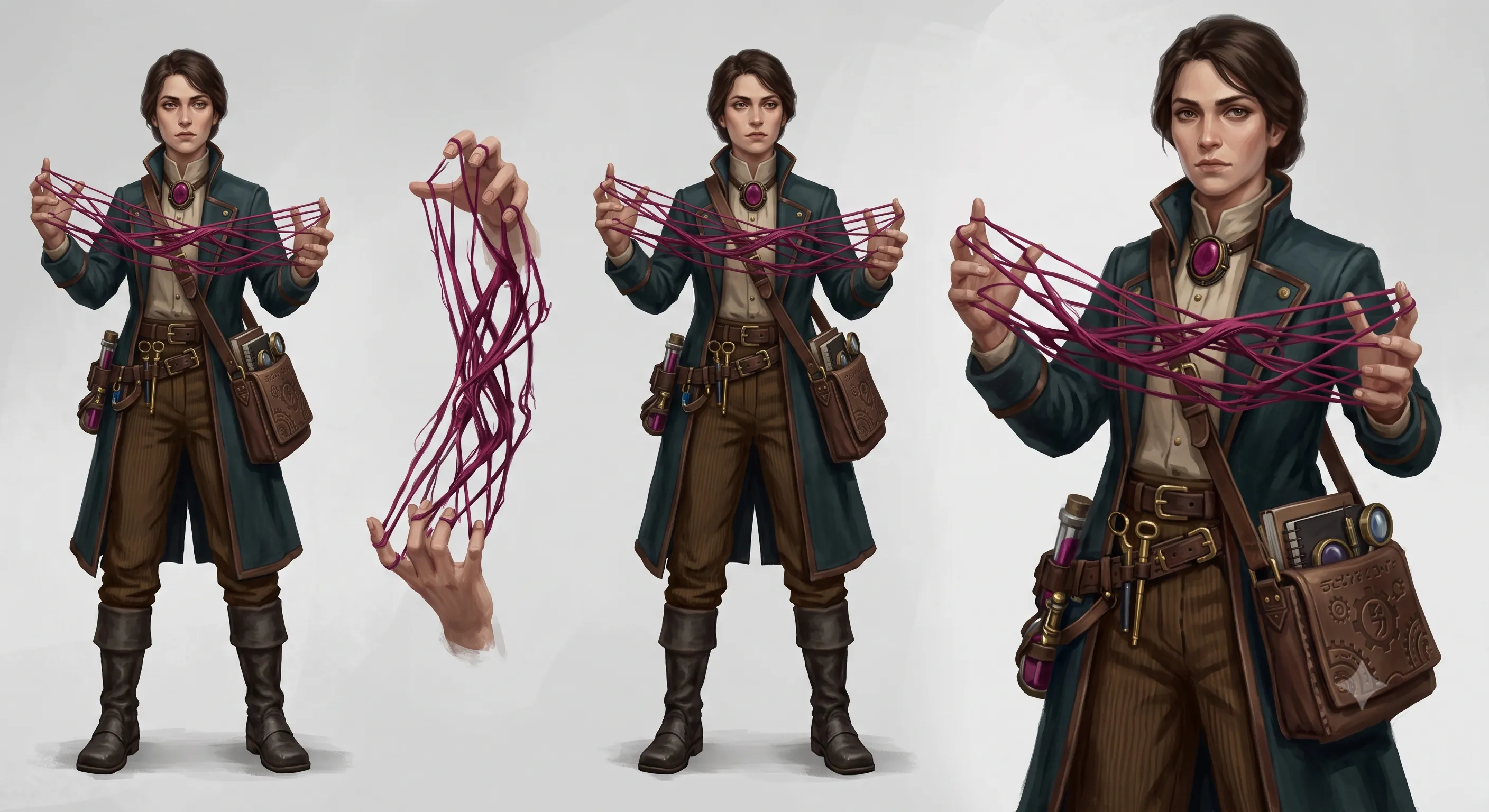
Plays like: the Wizard — the scholar-caster, weaving what others perceive.
The Cipherwright is the scholar who learned early that the deepest vault is a mind, and the sharpest blade is a well-placed fact. Spies, forgers, court analysts, and heretical librarians all study under this Calling — anyone who’d rather unravel a secret than a throat. They weave Threads: living cognitive constructs spun from stolen patterns, false memories, and borrowed faces, and they draw on the Knowing — the Chaos discipline that sits astride the Order/Chaos divide, trading in mind, pattern, fact, and illusion alike.
“Give me an hour alone with your letters and I will hand you back a stranger who signs your name.”
Quick Build & Core Stats
Section titled “Quick Build & Core Stats”Quick Build: High Intelligence, then Dexterity for defense, then Wisdom for saves. Choose the Veilwright Lexicon if you want to be the party’s face and infiltrator; Analyst for the puzzle-solver and foreseer; Thoughtplayer for the outlawed witch-lineage of attention-riding.
- Hit Die: d6 (d6 + Con mod per level after 1st)
- Primary Ability: Intelligence
- Saving Throws: Intelligence, Wisdom
- Armor: Light armor
- Weapons: Simple weapons, hand crossbows, rapiers, shortswords (no heavy weapons)
- Tools: Three of your choice from: thieves’ tools, forgery kit, disguise kit, cartographer’s tools, calligrapher’s supplies, any one gaming set
- Languages: Two of your choice, plus you can read any written language after studying a sample of it for 1 minute (Cipher’s Eye, below)
- Skills: Choose 4: Arcana, Deception, History, Insight, Investigation, Nature, Perception, Performance, Persuasion, Religion, Sleight of Hand, Stealth
- Starting Equipment: A rapier or shortsword; a hand crossbow and 20 bolts or two daggers; a Cipherwright’s Codex (a coded ledger that serves as your ritual focus/spellbook analogue); a Focus Stone set in a ring, pin, or spectacles; light armor; a set of two tools from your list; a scholar’s pack or spy’s pack
The Cipherwright Table
Section titled “The Cipherwright Table”| Level | Proficiency Bonus | Features | Threads | Filament Techniques Known | Max Working Tier |
|---|---|---|---|---|---|
| 1 | +2 | Reaching: The Knowing; The Codex; Ritual Weaving; Threadweaving; Cipher’s Eye | 3 | 1 | 1 |
| 2 | +2 | Quick Read | 4 | 2 | 1 |
| 3 | +2 | Lexicon chosen; Lexicon feature | 5 | 2 | 2 |
| 4 | +2 | Ability Score Improvement | 5 | 2 | 2 |
| 5 | +3 | Woven Reserve | 6 | 3 | 3 |
| 6 | +3 | Lexicon feature | 7 | 3 | 3 |
| 7 | +3 | Deep Cipher; Stolen Pages (first page) | 8 | 3 | 3 |
| 8 | +3 | Ability Score Improvement | 8 | 3 | 4 |
| 9 | +4 | Braided Thread | 9 | 4 | 4 |
| 10 | +4 | Lexicon feature | 10 | 4 | 4 |
| 11 | +4 | Cascade | 11 | 4 | 5 |
| 12 | +4 | Ability Score Improvement | 11 | 4 | 5 |
| 13 | +5 | Severed Pattern; Stolen Pages (second page) | 12 | 5 | 5 |
| 14 | +5 | Lexicon feature | 13 | 5 | 5 |
| 15 | +5 | Unbreakable Cipher | 14 | 5 | 6 |
| 16 | +5 | Ability Score Improvement | 14 | 5 | 6 |
| 17 | +6 | Master Weaver | 15 | 6 | 6 |
| 18 | +6 | Thread Beyond Sight | 16 | 6 | 6 |
| 19 | +6 | Ability Score Improvement | 16 | 6 | 6 |
| 20 | +6 | The Unwritten Page | 18 | 6 | 6 |
Class Features
Section titled “Class Features”Reaching: The Knowing. At 1st level you gain a Reaching into the Knowing, a Chaos discipline (mind/pattern/fact/illusion). You may attempt any Working of the Knowing up to your Max Working Tier, but you must know its shape first — and a Cipherwright keeps every shape they have ever learned in one place: the Codex (below). Casting a Working spends Fray as normal, subject to your Faith Die and the 75%/cap thresholds. As with every Chaos discipline, your Fray never clears on a short rest — a long rest of genuine stillness restores half of it (a quarter if the rest is broken), and its losses are drawn from the Loss Menu you wrote at character creation. Your eyes flash magenta and absorb light on every cast, giving watchers advantage on Insight to read you. Casting above your base Tier requires your Focus Stone; if it’s sundered by a called shot, you’re capped at cantrip-tier Knowing until you rebond it over downtime.
The Codex (your library). Your Cipherwright’s Codex is not a list of what you can do today — it is the ledger of everything you have ever decoded, and it has no upper limit. It begins play holding six Tier-1 Workings of the Knowing of your choice, and each time you gain a Cipherwright level you decode two more Workings of any Tier you can attempt into its pages, the ordinary fruit of your study. Beyond that, the Codex grows the way any good archive does: by theft, purchase, and witness. Whenever you find a Knowing Working written down — a rival’s cipher-ledger, a temple fragment, a dead colleague’s marginalia — or personally witness one cast and hold its shape in mind, you may transcribe it into your Codex over 2 hours of work and 10 seals of inks per Tier of the Working. A Working transcribed is a Working owned; the Codex forgets nothing.
Prepared Workings (your loadout). The Codex is the vault; your working memory is the key-ring. From the Workings in your Codex, you hold a number prepared equal to 2 + your Cipherwright level — these are the shapes you can weave at casting speed. When you finish a long rest with your Codex in hand, you may re-select your prepared set from anywhere in its pages: the infiltration loadout on Tuesday, the counter-caster’s kit on Wednesday. A Cipherwright who reads their ledger before bed is never the same caster two days running.
Ritual Weaving. A Working woven slowly is a Working the self barely feels. When you cast a Working directly from the open Codex, taking 10 minutes or more over the weaving — tracing the cipher line by line as you go — it costs no Fray at all. The Working must be in your Codex (prepared or not) and its Tier can be no higher than half your Max Working Tier, rounded up. The slow channel carries no urgency and no edge; it is how a Cipherwright unpicks a lock, reads a dead man’s letters, or drapes a safehouse in a false face without spending an ounce of themselves. The eye-flash still shows. It always shows.
Threadweaving (signature resource). You hold a pool of Threads, shown on the table. As a bonus action you may spend 1 Thread to weave a Filament — a small, sustained construct from your known Filament Techniques (below). You know one Filament Technique at 1st level and a second at 2nd; you learn an additional Technique at 5th, 9th, 13th, and 17th level (six known in all), as shown on the Cipherwright table. A woven Filament persists until you dismiss it (free action, at will) or it triggers/expires. The first two Filaments you weave between long rests cost no Fray — light weaving is the Cipherwright’s tempo. But the Knowing bills the self like every Chaos discipline: every Filament you weave after the second since your last long rest costs 1 Fray (rolled against your Faith Die as any Chaos cost, minimum 1). The mind that spins too many threads at once starts to lose track of which are the world’s and which are its own. You may hold woven Filaments simultaneously up to a number equal to your Intelligence modifier (minimum 1); beyond that, the cognitive load imposes disadvantage on Concentration saves and on your Knowing Faith Die rolls until you drop below the limit. You regain half your Threads (round up) on a short rest and all of them on a long rest.
Cipher’s Eye. At will, as no action or as part of another action, you may read a surface pattern you can see or touch — a lock, a forged seal, a person’s tell, a page of unfamiliar script. You gain advantage on the check to interpret, appraise, or read it, and can identify whether it was shaped by a Working (and its discipline) with a successful DC 10 + Tier Intelligence (Arcana) check.
Quick Read 2nd As a bonus action, spend no Thread to glance a single creature’s stance, breathing, and eyes; you learn whether it currently has an active Working, a woven construct of its own, or an elevated Strain/Fray total (numbers hidden, thresholds only).
Woven Reserve 5th Whenever you roll your Faith Die twice for a cast dead-center of your Tenet and take the higher, you also regain 1 spent Thread.
Deep Cipher 7th Your Filaments may now encode a full sentence or gesture-sequence rather than a single fact or face, and you may weave one at range (30 ft.) instead of by touch.
Stolen Pages 7th Every discipline is a language, and you have learned that all languages leak. Choose one Working from any other discipline — Order or Chaos — that you have personally witnessed cast with your own eyes. Over downtime, you decode it into your Codex (the usual transcription: 2 hours and 10 seals of inks per Tier) as a Knowing-approximation: not the thing itself, but a cipher of it, reconstructed from pattern alone. You may prepare and cast it as if it were a Working of the Knowing, except it costs +1 Fray above its Tier — a borrowed shape never sits quite right in the channel. Your eyes still flash magenta; the stolen page does not change what you are. At 13th level you may decode a second such Working. A stolen page, once transcribed, is yours forever — but it can never be woven through Ritual Weaving; approximations demand your full attention.
Braided Thread 9th Once per turn, you may spend 2 Threads instead of 1 to weave two different Filaments as a single bonus action.
Cascade 11th Once per long rest, for 1 minute, you may hold Filaments beyond your Intelligence-modifier limit (up to +2) without the Concentration/Faith Die penalty.
Severed Pattern 13th As a reaction when you see a creature within 60 feet cast a Working or trigger a woven construct, spend 3 Threads to force an Intelligence saving throw (DC 8 + proficiency bonus + Intelligence modifier); on a failure the effect fizzles or the construct unravels.
Unbreakable Cipher 15th Your Filaments can’t be dispelled or unwoven by anything below Tier 5. Additionally, you may choose to let your eye-flash lie: enemies attempting to read your magenta flash via Insight now suffer disadvantage instead of gaining advantage.
Master Weaver 17th Once per short rest, weave two Filaments for the cost of one.
Thread Beyond Sight 18th For +1 Thread, you may weave a Filament targeting any creature or place you have physically touched or previously cast a Knowing Working on, with no line of sight required, anywhere on the same plane.
The Unwritten Page (20th, capstone). Once per long rest, cast a Working of the Knowing spending only Threads (1 Thread per Tier, no Fray) and treat your Faith Die roll as if you’d rolled it twice and taken the higher, even if the cast isn’t dead-center of your Tenet.
Filament Techniques
Section titled “Filament Techniques”A Filament is a small, sustained construct of the Knowing — a shaped strand of pattern and attention that you spin out of yourself and leave standing in the world. Where a full Working does something and ends, a Filament stays: a held idea, a watching thread, a woven half-truth that persists until you dismiss it (a free action, at any distance) or until it triggers or expires. This is the Cipherwright’s tempo — you seed the room with Filaments before anything happens, then let them do their quiet work.
A Filament Technique is one kind of Filament you have learned to weave. You know one Technique at 1st level and a second at 2nd, and you learn one more at 5th, 9th, 13th, and 17th level — six in all (the Cipherwright table tracks this). To weave a Filament you spend a bonus action and 1 Thread; the first two Filaments you weave between long rests are free of Fray, and each one after the second costs 1 Fray (see Threadweaving). You may hold woven Filaments up to your Intelligence modifier at once (minimum 1) before the cognitive load begins to cost you.
Unless a Technique says otherwise, a base Filament carries a single fact, face, or instruction — one changed detail, one planted impression, one watched threshold. At 7th level, Deep Cipher upgrades every Filament you weave: it may then encode a full sentence or gesture-sequence rather than a single beat, and you may weave one at 30 feet rather than only by touch. Where a creature can resist a Filament, the save DC is your Working save DC (8 + proficiency bonus + Intelligence modifier), and the effect is a Knowing effect for the purpose of anything that detects, dispels, or is immune to the Knowing.
Choose your known Techniques from the following. (Your GM may let you author a new Technique of comparable weight, following these as models.)
- Guise-Thread. You rewrite one visible detail of yourself, a willing or touched creature, or an object you touch — the color of a coat, the crest on a seal, the cast of a face, the grain of a door. The change is illusory but coherent to every ordinary sense; a full disguise is several Guise-Threads woven together. A creature that has specific reason to doubt what it sees may spend an action to study the detail and make an Investigation check against your Working save DC to see through that one thread. (This is the appearance-altering Filament the Veilwright’s features build upon.)
- Planted Fact. You seed one simple, plausible impression in a creature you can see within range — you are expected here, that ledger is the one you asked for, the guard already waved you through. The target makes a Wisdom save; on a failure it treats the fact as its own settled belief until something plainly contradicts it, at which point it may make a new Wisdom save with advantage to shake free. It will not act against its own safety or morals on a Planted Fact; the thread bends belief, not will.
- Reading-Thread. You fix an analytic Filament to a lock, a page, a machine, a trail, or a person. For as long as it holds, you have advantage on Intelligence and Wisdom checks to read, appraise, decode, track, or otherwise interpret that specific subject, and you sense at once if it changes while you watch (a seal broken, a sentence altered, a person’s tell shifting). A patient Cipherwright leaves Reading-Threads on the things they expect to matter and reads them like a spider reads its web.
- Ward-Cipher. You weave a silent tripwire across a threshold, a container, or an object no larger than a door. The instant a creature crosses, opens, or lifts the warded thing, you know — a soft certainty in the back of your mind, wherever you are on the same plane — along with a single true impression of what triggered it (a person, an animal, a rush of wind). The Ward-Cipher does not stop the intruder; it tells on them. A creature that succeeds on a Perception check against your Working save DC as it approaches notices the thread and may choose to avoid or unpick it.
- Hush-Line. You dampen sound within a 5-foot radius of a point you touch (or, with Deep Cipher, weave at range). Conversation at a whisper inside the radius cannot be heard outside it, and ordinary noises made inside — a lockpick’s scrape, a blade drawn, a held breath — are muffled to silence past its edge. The Hush-Line does not block loud sound (a shout, a gunshot) and shows nothing to the eye; it is a room made discreet, not a room made silent.
- Look-Away. You weave a minor aversion around a small object or a single motionless creature (Medium or smaller). Ordinary eyes slide off it: while the warded subject stays still, it has advantage on Stealth checks and a creature must actively search for it — a Perception check against your Working save DC — to register it as worth noticing. Any deliberate motion, attack, or interaction ends the Look-Away at once. It hides the overlooked, not the hunted.
- Echo-Weave. You record up to six seconds of sound, a still image, or both at a point, and set the Filament to replay the loop on a trigger you name as you weave it (when a creature enters the room; when I dismiss my other Filament; at the third bell). The echo is convincing to sense but insubstantial — a voice from an empty study, a figure at a lit window, a conversation behind a door. A creature interacting with the echo (touching the figure, answering the voice and getting nothing back) may make an Investigation check against your Working save DC to recognize it as woven.
- Whisper-Thread. You spin a private two-way line to one creature you touch as you weave it. For as long as the Filament holds, the two of you can exchange whispered words, silently and at any distance on the same plane, as easily as speaking under your breath — no one between you hears a thing. Either of you may end it. It carries words only: not sight, not feeling, not the Knowing itself.
- False Trail. You plant misleading sensory evidence that reads as wholly genuine — footprints leading the wrong way, a dropped token, a scent, a smear of the right ink in the wrong hand. A creature that finds the trail treats it as real unless it has specific cause to doubt and succeeds on an Investigation check against your Working save DC. The False Trail persists until dismissed or until the thing it imitates would naturally fade; it is how a Cipherwright is somewhere they never were.
- Steadying Cipher. You weave a Filament of held attention onto yourself or a willing creature you touch — a thread that keeps one true thought from slipping. The warded creature has advantage on its next saving throw against being charmed or frightened, or on its next Concentration save, made before the Filament expires (one minute). A mind that knows exactly what it is holding is far harder to pull off of it.
The Three Lexicons
Section titled “The Three Lexicons”The Veilwright — illusion and disguise
Section titled “The Veilwright — illusion and disguise”3rd — Second Skin. Your appearance-altering Filaments also plant a false but coherent memory of the interaction in one creature affected (Wisdom save negates, DC = your Working save DC). 6th — Woven Ambush. The first time each turn you hit a creature currently fooled by your Filament or a Knowing illusion, add your Intelligence modifier as extra damage. 10th — Full Cipher-Cloak. Once per long rest, weave a 10-foot-radius illusion (sight and sound) without spending a Thread. 14th — Unseen Author. Your illusions resist detection by Insight or any sense below Tier 5; a creature you choose who knows the illusion is false can still act through it as if it were real to others.
The Analyst — divination, pattern-reading, foresight
Section titled “The Analyst — divination, pattern-reading, foresight”The Analyst does not merely read patterns already woven — she reads the ones about to be. Where the Veilwright writes false threads and the Thoughtplayer rides live ones, the Analyst reads the weave a few seconds ahead of everyone standing in it, and spends that foreknowledge like coin. (Counter-casting is a Cipherwright tool the whole class shares at 13th via Severed Pattern; this Lexicon is the diviner, not a second copy of it.)
3rd — Foreseeing (signature). When you finish a long rest, roll two d20s and record the numbers — these are your Foreseeings, glimpses of fixed points in the day’s weave. When any creature you can see (yourself included) makes an attack roll, a saving throw, or an ability check, you may replace that roll’s d20 with one of your recorded Foreseeings — you must choose to do so before the roll is made. Each Foreseeing may be used once; any unused expire at your next long rest. You don’t bend the odds; you already read them. In addition, as a reaction you may spend 1 Thread when you see a Working cast to learn its discipline and Tier.
6th — The Third Glance. You record a third Foreseeing at each long rest. Whenever you spend a Foreseeing on a roll, you also learn whether a hidden influence — an unseen creature, a laid trap, or an active Working — shaped that moment. And once per short rest you may study a place or a person for one minute to ask your GM a single yes-or-no question about the events likely to unfold there within the next hour (an augury; the answer can be weal, woe, both, or nothing).
10th — Read the Weave. You are always half a second ahead of a blow. As a reaction when a creature you can see makes an attack roll or a saving throw, spend 2 Threads: that creature must roll a second time and use the lower of the two results — you saw the worse line coming and stood them in it. Unlike Severed Pattern this bends fortune rather than fizzling magic, and it works on any roll, not only a cast. You also passively sense, of any creature within 30 feet, whether its Strain, Fray, or Conviction is elevated (thresholds only, never exact numbers).
14th — Perfect Deduction. Certainty stops slipping through your fingers. Your Foreseeings no longer expire unused — you still roll your full complement at each long rest, and may bank any you don’t spend, holding at most a number in reserve equal to your Intelligence modifier (minimum one). Once per long rest, you may also treat a single Foreseeing as any number you choose from 1 to 20 rather than its rolled value — the one moment in the day when you do not merely foresee the weave but dictate it.
The Thoughtplayer — attention-riding, the witch’s Knowing
Section titled “The Thoughtplayer — attention-riding, the witch’s Knowing”The Lexicon the academies do not teach. Thoughtplaying is a family-private lineage of the Knowing — trained at home, usually mother to daughter, never written down, and outlawed: the OCTA flags and hunts discovered thoughtplayers. Its law is absolute and older than any charter: the mind you touch always feels the touch. A thoughtplayer does not read minds unseen; they ride attention, and the ridden always know a rider is there — the art is in what you do with the moment after they feel you.
3rd — Attention-Riding. Spend 1 Thread and fix your eyes on a creature within 60 feet: you ride its attention for up to 1 minute, perceiving what it perceives and the surface current of its thought (impressions, not sentences). The target immediately feels the touch — always, no exceptions — and may make a Wisdom save at the end of each of its turns to throw you off. While riding, you have advantage on Insight checks against the target and know when it lies. 6th — Shared Sight. Weave a Filament to a willing creature: for 1 hour you and they may see through each other’s eyes at will. As a reaction while sharing, you may lend your vantage — grant them advantage on one attack roll or check you could plausibly inform. 10th — The Played Thought. As a bonus action against a creature you are riding, place one clear thought in its mind. It knows the thought is not its own — that is the terror of it — but must make a Wisdom save or act on a one-sentence suggestion (nothing directly self-harming) on its next turn. 14th — The Long Ride. Once per long rest, ride deep: over one minute of unbroken eye contact (willing, restrained, or unaware you began), descend past attention into memory. Ask the GM three questions about the target’s memories or intentions; they are answered truthfully. The cost is the lineage’s oldest warning: the ride runs both ways — the target learns one true thing about you, chosen by the GM, and knows exactly who was in their mind.