Chapter 8B — The Bestiary of Merretia
The design rule (canon):** reach for the recognizable creature your players expect, then assign it an origin, and let the origin, not the silhouette, decide what it is, what kills it, and what killing it costs. Each block is tagged with its origin. The Hollow-origin creatures are never a someone — an absence wearing a familiar mask; killing one **closes nothing (only Binding the seam does), and the Heart cannot seize them and the Knowing cannot read them. The non-Hollow origins (native beasts, the Aldeken, sea-horrors, constructs) are the sharp mundane contrast that keeps the dread meaningful.
Creatures are grouped by origin, roughly by threat within each.
Hollow-Seepage
Section titled “Hollow-Seepage”Seep-Wisp
Section titled “Seep-Wisp”
AC 15 · HP 10 (4d4) · Speed 5 ft., fly 30 ft. (hover, can't land)
Traits: No Mind, No Heart — immune to any effect that requires the target to have a mind or emotions (charm effects, fear effects, Knowing-discipline reads, Heart-discipline seizes all fail automatically). Dissolution — on death, the wisp’s body silently unravels into cold vapor in 1 round; nothing physical remains to loot or study. Killing Closes Nothing — destroying a seep-wisp does not affect the seam it leaked from; another may drift through within days. Flicker-Light — sheds dim light in a 5-ft. radius that it can suppress or resume as a bonus action; the light resembles a distant lantern or will-o’-wisp glow.
Actions: Chill Touch. Melee Attack Roll: +7, reach 5 ft. Hit: 4 (1d8) Cold damage, and the target can’t regain hit points until the start of its next turn.
GM note: The lowest, laziest seepage — barely more than a pressure gradient with a light on it. It drifts toward warm bodies out of raw thermal appetite, nothing more. OCTA field guides classify it as a “nuisance leak,” but every wisp confirms an active seam somewhere nearby worth a Binder’s attention.
The Half-Seen Child
Section titled “The Half-Seen Child”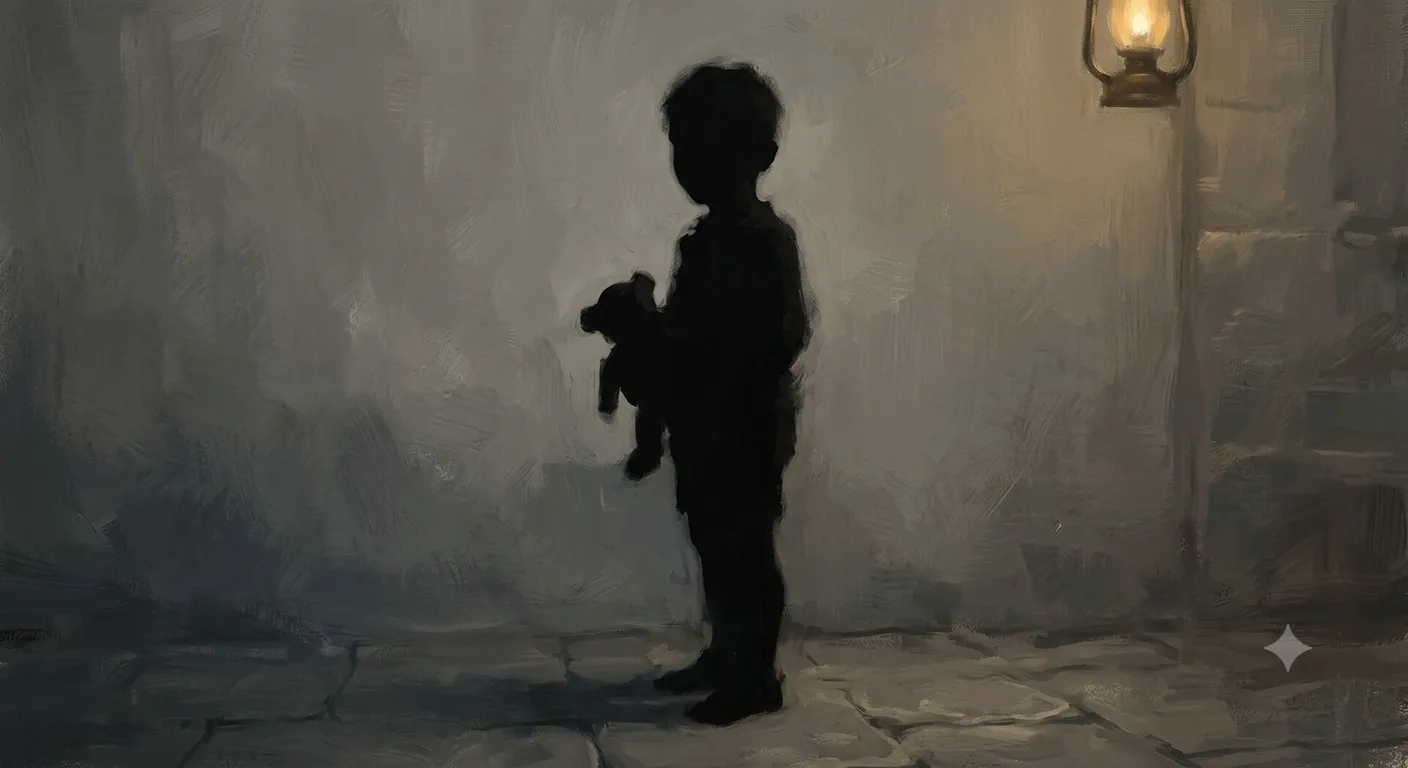
AC 13 · HP 22 (5d6+5) · Speed 30 ft.
Traits: No Mind, No Heart — as above; Heart discipline and the Knowing find nothing to seize or read. Dissolution on death. Killing Closes Nothing. Borrowed Face — appears as a specific missing or dead child known to nearby witnesses (drawn from ambient grief, not memory access); this is mimicry of shape, not identity — it has no knowledge of the child’s life and cannot answer questions truthfully or falsely, only echo fragments of tone. Wrongness Tell. A creature that starts its turn within 10 ft. of the Half-Seen Child and can see it makes a Wisdom Saving Throw: DC 11. Failure: It has disadvantage on attack rolls against the Half-Seen Child until the end of its turn, unsettled by the mismatch between the face and the movement.
Actions: Cold Grasp. Melee Attack Roll: +5, reach 5 ft. Hit: 7 (2d4+3) Cold damage, and the target’s speed is halved until the end of its next turn.
GM note: The single cruelest shape a thin seam produces, and the most misdiagnosed — grieving families sometimes refuse to let a Binder close it, believing it’s him, come back. It isn’t. It has never been anyone.
The Unseen
Section titled “The Unseen”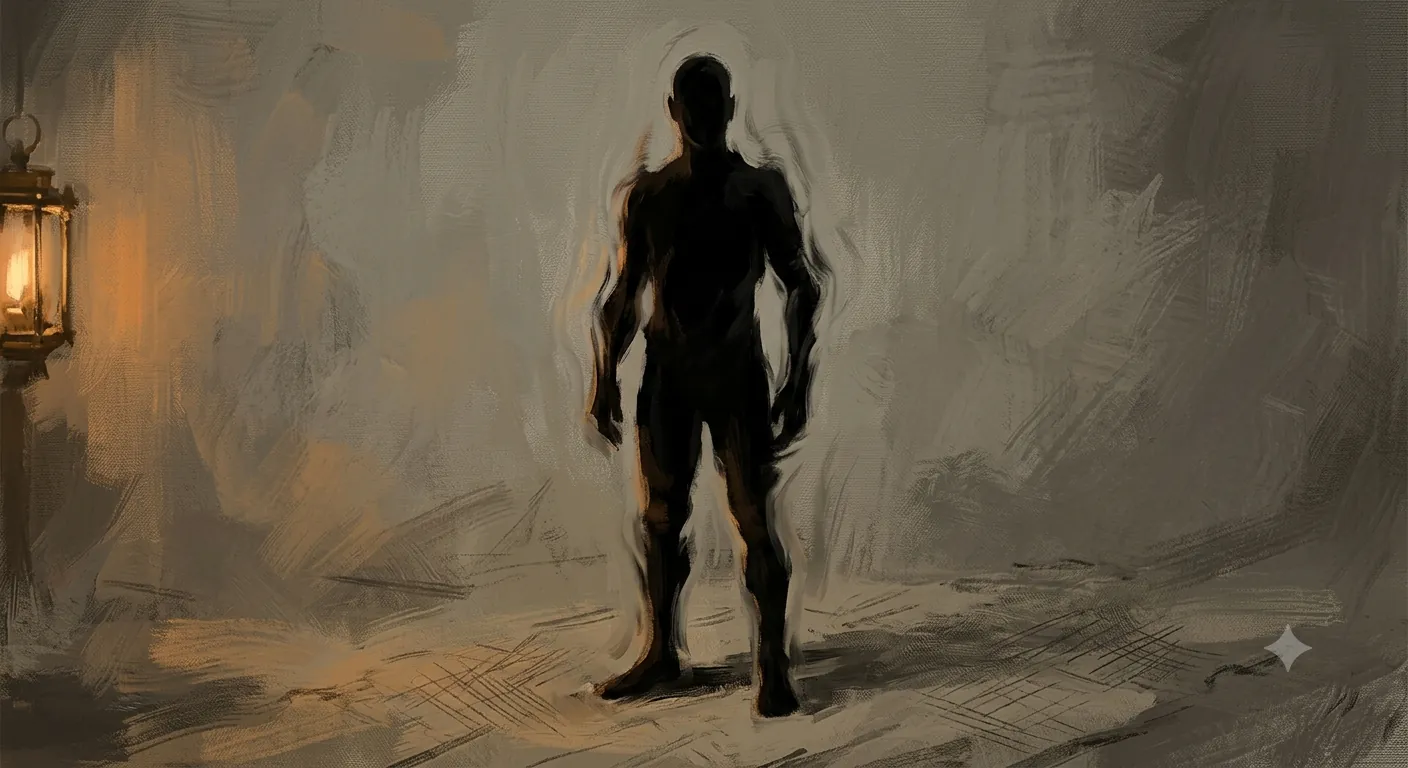
AC 14 (natural armor, Dex) · HP 45 (10d8) · Speed 40 ft.
Traits: Invisibility. The Unseen is invisible at all times; it cannot be made visible by any means short of true seeing or a Binding circle, and even then it appears only as a faint outline, never a face. No Mind, No Heart. Heart-discipline seizure fails automatically (nothing to grip); Knowing-discipline reads return only static. Ambush Predator. Advantage on attack rolls against any creature it has surprised. Dissolution. On death, its body silently unravels into absence over 1 round, leaving no corpse, blood, or trace. Killing Closes Nothing. Destroying the Unseen does not seal the seam it leaked from — the tunnel section stays cold, damp, and wrong, and another will drift through in time; only a Binder sealing the seam itself ends the haunting.
Actions: Multiattack. The Unseen makes two claw attacks. Claw. Melee Attack Roll: +6, reach 5 ft. Hit: 8 (1d8+4) Slashing damage. Cold Pull. Ranged Attack Roll: +6, range 30 ft. Hit: 10 (3d6) Cold damage, and the target is pulled 10 ft. toward the Unseen.
GM note: This is the type-specimen: not a stalker with a grudge, not a spirit with unfinished business — a pressure differential in a human-shaped hole, doing what pressure differentials do, which is seek the warm and the bonded. Found for two winters running in the Steam Tunnels beneath the old works, where three separate pairs of workers vanished before a Binder finally traced and sealed the seam. Order magic (Binding especially) affects it cleanly, like closing a valve; everything else is theater.
Gutter-Maw
Section titled “Gutter-Maw”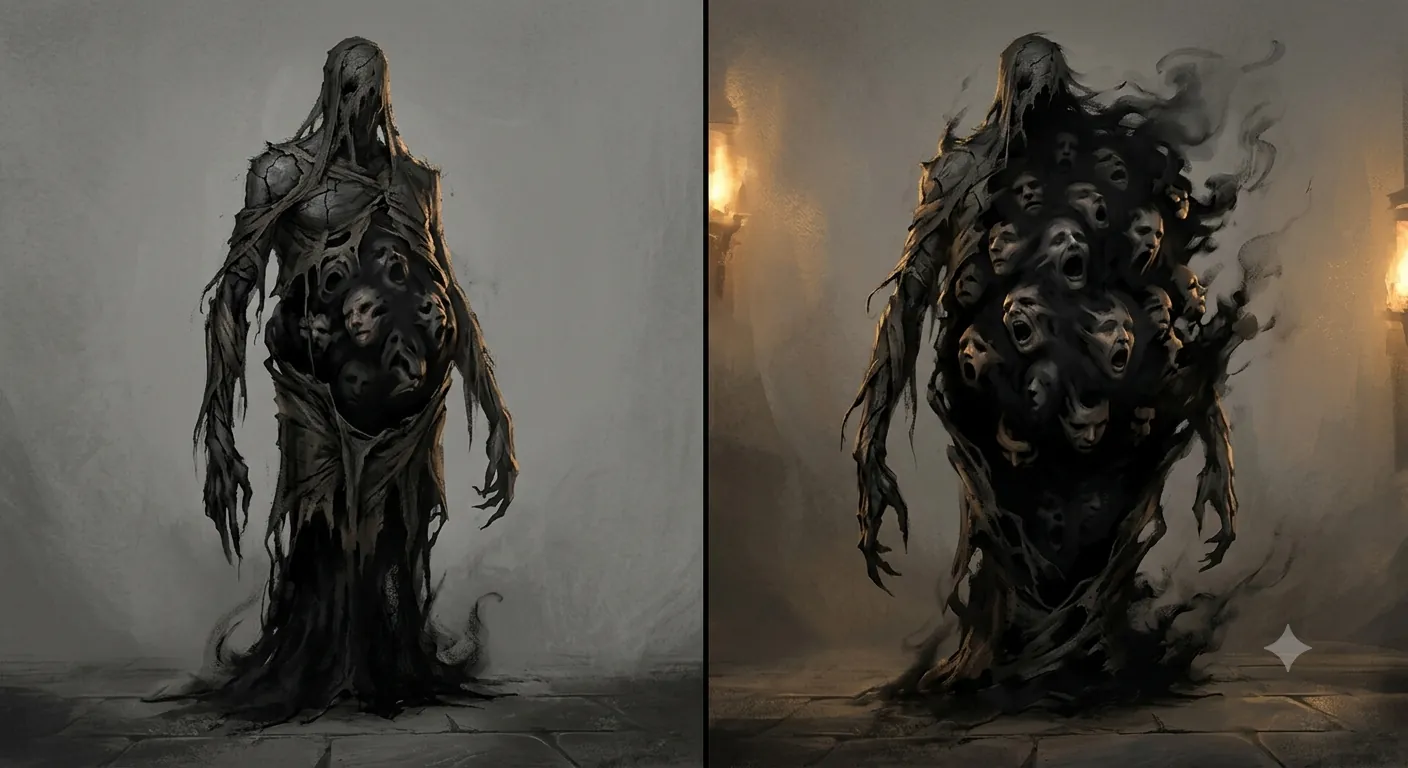
AC 12 (natural armor) · HP 60 (8d10+16) · Speed 10 ft., climb 10 ft.
Traits: No Mind, No Heart. As above — the Knowing reads only overlapping noise, not thought; nothing here to charm or seize. Aberrant Ground. The area within 10 ft. of Gutter-Maw is difficult terrain; countless mouths across its surface make its skin unstable to stand on or near. Chorus of Wrong Sound. This is not speech and never resolves into words. Each creature that starts its turn within 20 ft. of Gutter-Maw and can hear it makes a Wisdom Saving Throw: DC 13. Failure: It is Frightened until the start of its next turn. The sound is dozens of familiar voices — a parent’s, a sibling’s, a lover’s — layered into noise with no sentence ever completing. Dissolution. On death, its whole mass collapses into a wet absence and evaporates within a minute, leaving only a damp stain. Killing Closes Nothing.
Actions: Multiattack. Gutter-Maw makes three Bite attacks. Bite. Melee Attack Roll: +5, reach 5 ft. Hit: 13 (3d6+3) Piercing damage. If the target is Medium or smaller, it has the Grappled condition (escape DC 13) by one of the many mouths and must repeat the save vs. Chorus of Wrong Sound at the start of each of its turns while Grappled.
GM note: A seam thinned past coherence, still trying to wear a shape and failing — dozens of half-formed faces and voices sliding across a single wrong body. It doesn’t lie in the chorus (it can’t; there’s no mind to lie with) — every voice fragment is a true thing the seam soaked up from someone nearby, curdled and repeated out of order. Terrifying to hear, meaningless to interrogate.
Coinflip
Section titled “Coinflip”
AC 13 · HP 18 (4d4+8) · Speed 20 ft., fly 20 ft. (hover)
Traits: No Mind, No Heart. As above. Dissolution on death. Killing Closes Nothing — and here it matters doubly, since the field it generates can outlive its body by a few rounds (see below). Probability Bleed (Aura). While Coinflip is within 30 ft. of a creature, that creature’s attack rolls made within the aura are rolled twice, and the result is determined by the GM secretly choosing better or worse — the creature never knows which applies until the outcome lands. This aura persists for 1d4 rounds after Coinflip dies, an eddy in the seam settling out.
Actions: Wrongfooting Touch. Melee Attack Roll: +4, reach 5 ft. Hit: The target makes a Constitution Saving Throw: DC 12. Failure: Its next attack roll or saving throw automatically becomes the worse of two rolls (ignoring advantage/disadvantage on that roll).
GM note: Not malice, not “bad luck magic” — a Chaos-shaped tear where the discipline of Chaos absorbed too much certainty out of the local air and never gave it back. Gamblers’ guilds in port towns have paid Binders well to sweep their back rooms for these; a Coinflip loose under a card table will bankrupt a house in a night, one way or the other, at random.
Absence-Swarm
Section titled “Absence-Swarm”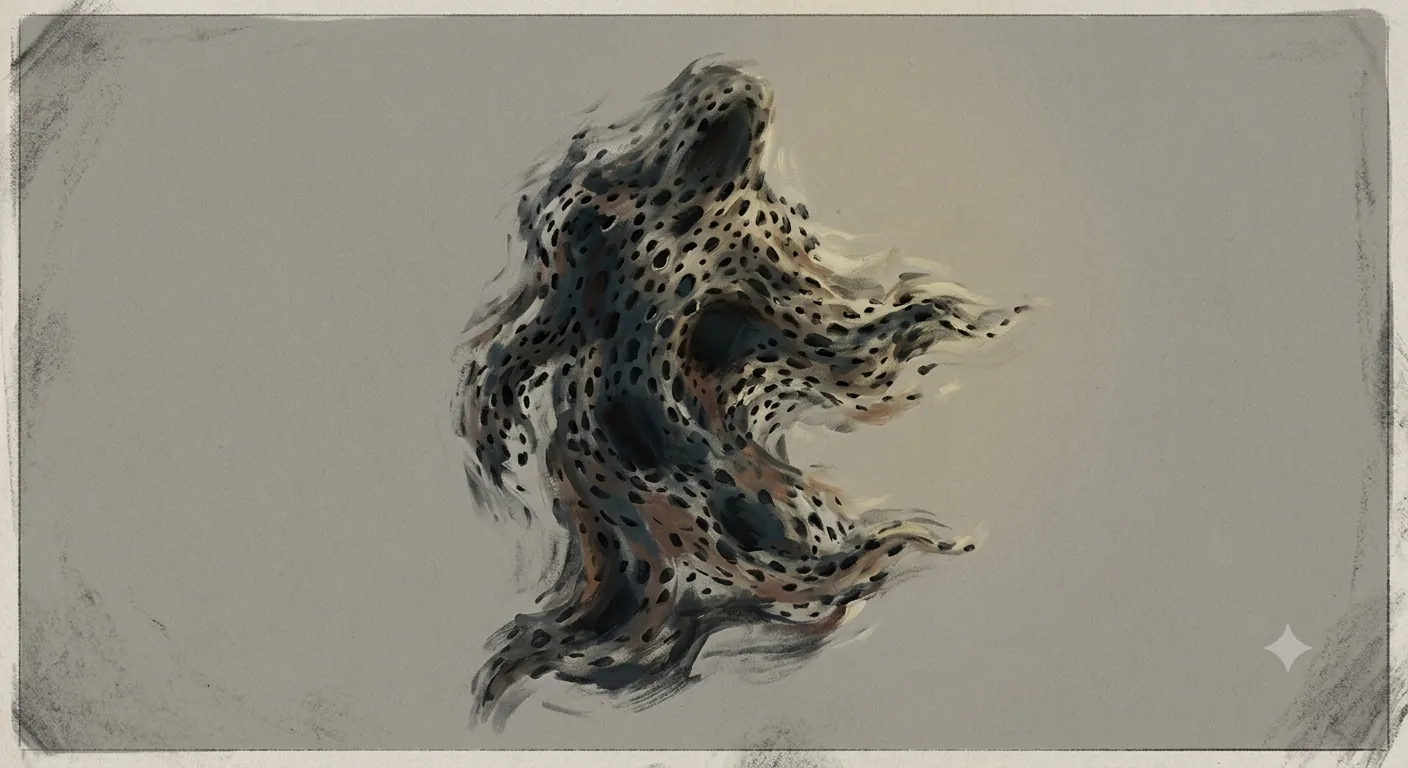
AC 13 · HP 32 (5d8+10) · Speed 30 ft., climb 30 ft.
Traits: No Mind, No Heart. Each fragment of the swarm is mindless and heartless individually and collectively; the Knowing reads nothing, the Heart discipline seizes nothing. Swarm. The swarm can occupy another creature’s space and vice versa, and it can move through any gap wide enough for a single Tiny fragment. It takes no extra damage from area effects that would normally halve on a swarm-density basis; instead it takes half damage whenever it isn’t reduced below half its hit points already, reflecting how much of it is simply not fully there. Dissolution. Each fragment that “dies” simply thins to nothing; there is no swarm corpse, only fewer motes the next round. Killing Closes Nothing — scattering the swarm doesn’t touch the seam feeding it; a new swarm re-condenses from the same seam within a tenday if left unbound.
Actions: Many Small Bites. Melee Attack Roll: +5, reach 5 ft., one creature in the swarm’s space. Hit: 10 (4d4) Necrotic damage, or 5 (2d4) Necrotic damage if the swarm has half its hit points or fewer.
GM note: What a seepage looks like when it fails to cohere into any single shape at all — hundreds of tiny absences moving as one intention that isn’t an intention, only a shared pressure gradient. Reads on paper like a swarm of insects or bats; reads to the touch like reaching into a held breath that was never taken.
Stillpoint
Section titled “Stillpoint”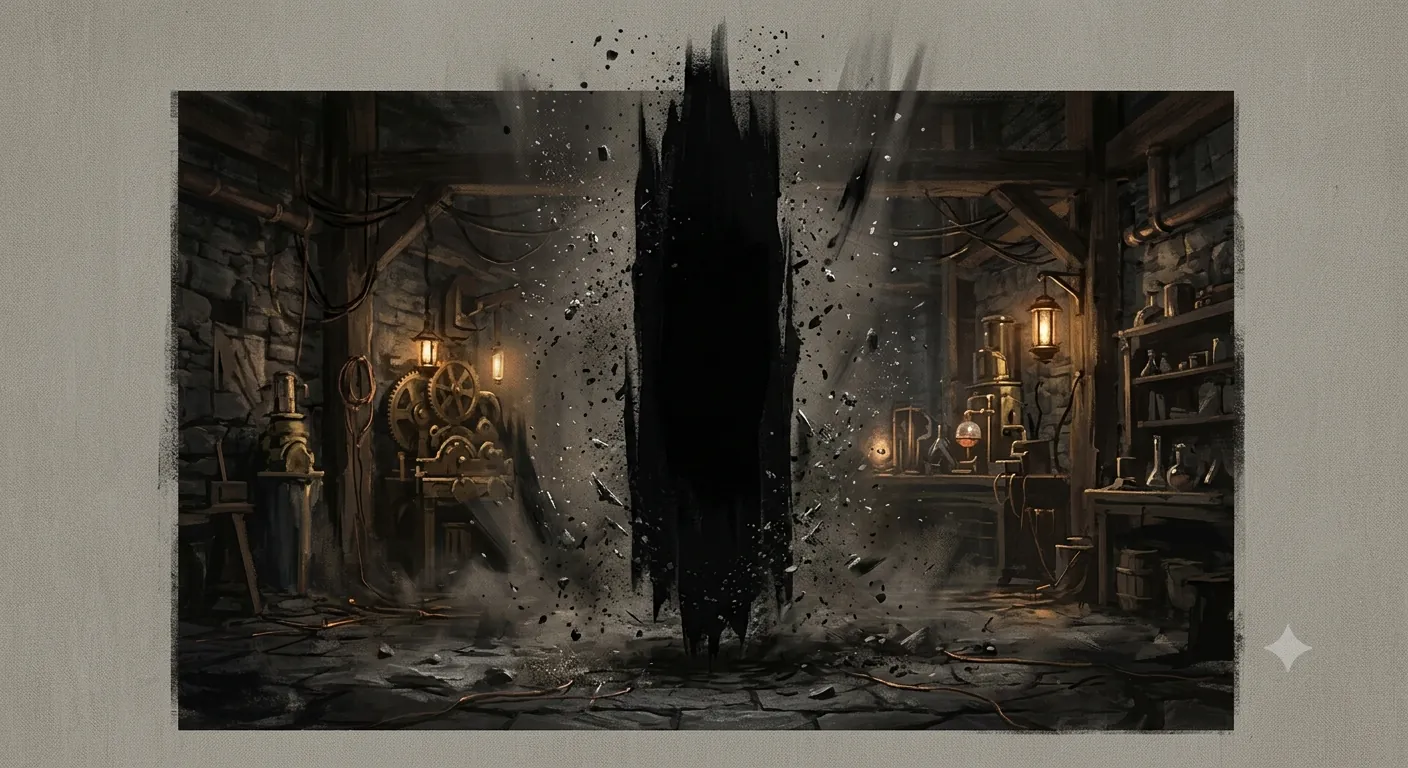
AC 15 (natural armor) · HP 85 (10d10+30) · Speed 0 ft. (stationary; see Anchor)
Traits: No Mind, No Heart. As above; nothing here to seize or read. Anchor. Stillpoint cannot move from the seam it emerged from, but its stall-field (below) extends 30 ft. from it in all directions, filling a room-sized space. Causality Fails Here. At the start of each creature’s turn (other than Stillpoint’s) within the stall-field, roll a d6: on a 1–2, that creature’s turn is skipped as if it hadn’t acted (it loses its action, bonus action, and movement for the round, unaware time passed differently for it); on a 3–4, nothing unusual happens; on a 5–6, the creature briefly repeats — it may take its last turn’s action again as a free action before acting normally. Stillpoint itself is unaffected. Dissolution. On death, the stall-field collapses instantly and Stillpoint’s body dissolves into vapor over 1 round. Killing Closes Nothing — the room’s local time returns to normal, but the seam that birthed the stutter remains open and will eventually spawn another Stillpoint or worse if not Bound.
Actions: Grasping Limb. Melee Attack Roll: +7, reach 15 ft. (its limbs stretch oddly across the stalled space). Hit: 16 (2d10+5) Force damage.
GM note: This is a seam that didn’t just thin the wall between here and the Wound — it thinned the wall between now and now, and something is leaking through that isn’t matter at all. OCTA classifies these as Class-3 temporal hazards and recommends full-room evacuation before Binding; adventuring parties without warning have lost entire rounds of the fight without realizing it, or worse, watched an ally’s death play twice.
The Long Hush
Section titled “The Long Hush”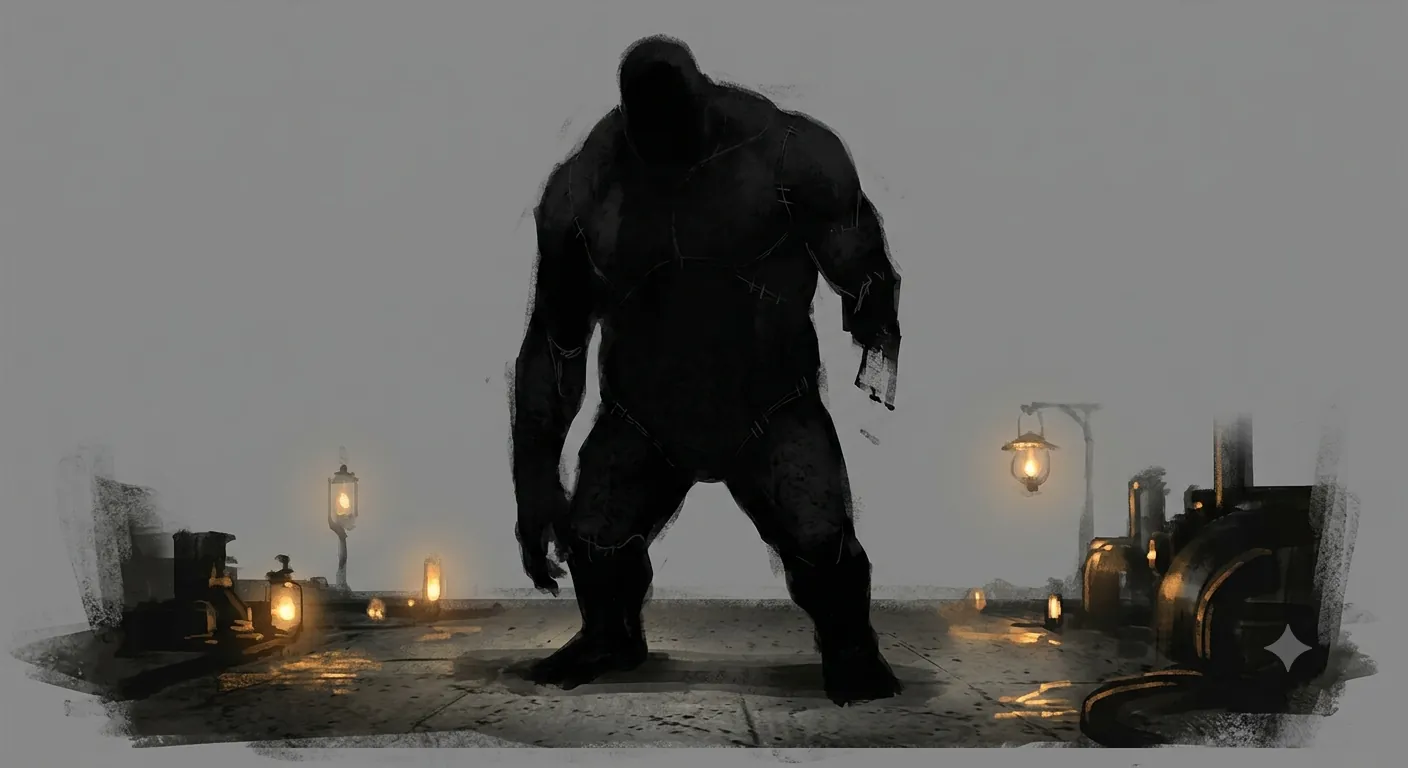
AC 16 (natural armor) · HP 165 (18d12+54) · Speed 30 ft. (fills the space it moves through)
Traits: No Mind, No Heart. Heart-discipline seizure and Knowing-discipline reads fail automatically against it — it has never once had a feeling to find. Room-Filling Presence. The Long Hush doesn’t so much enter a space as become it; while it occupies a room or chamber 40 ft. across or smaller, all light sources within (torches, focus stones, lanterns) burn at half brightness, and the air runs cold enough to fog breath. Dread Bleed. Each creature that starts its turn able to see the Long Hush, or within 30 ft. of it in darkness, makes a Wisdom Saving Throw: DC 15. Failure: It is Frightened until the start of its next turn. On a failure by 5 or more, the creature also takes 7 (2d6) psychic-adjacent Necrotic damage — not from a mind touching theirs, but from raw dread pressure, the same way cold burns. Dissolution. On death, the Long Hush does not fall so much as stop being present; the room’s temperature and light normalize within a minute, and nothing physical is left behind. Killing Closes Nothing — the seam beneath whatever room it haunted remains open, and the dread will return, thinner but no less real, within a season unless Bound.
Reactions: Recoil From Order (1/round). When targeted by an Order-discipline spell or effect, the Long Hush can use its reaction to attempt a Constitution Saving Throw: DC 15; on a failure, it takes no extra effect from this trait (Order magic still functions normally against it — this reaction only reflects how visibly the creature recoils, a useful tell for Binders gauging seam depth).
Legendary Actions: The Long Hush can take 2 legendary actions, choosing from the options below. Only one may be used at a time, and only at the end of another creature’s turn. It regains spent legendary actions at the start of its turn.
- Reach Through. The Long Hush makes one Crushing Limb attack.
- Smother the Light. One light source within 60 ft. gutters out for 1 round.
Actions: Multiattack. The Long Hush makes two Crushing Limb attacks. Crushing Limb. Melee Attack Roll: +8, reach 15 ft. Hit: 19 (3d8+5) Bludgeoning damage plus 7 (2d6) Cold damage.
GM note: The cluster’s boss-tier entry: a seam so thinned that an entire room has become the wound’s antechamber, and the Long Hush is simply what that much absence looks like when it finally grows a body to move around in. Parties who “win” the fight and don’t call a Binder within days often find the room re-fills within a month — sometimes with something worse, since a seam this wide has had a long, quiet while to practice being a shape.
Hollow-Summoned
Section titled “Hollow-Summoned”Mudlark Husk
Section titled “Mudlark Husk”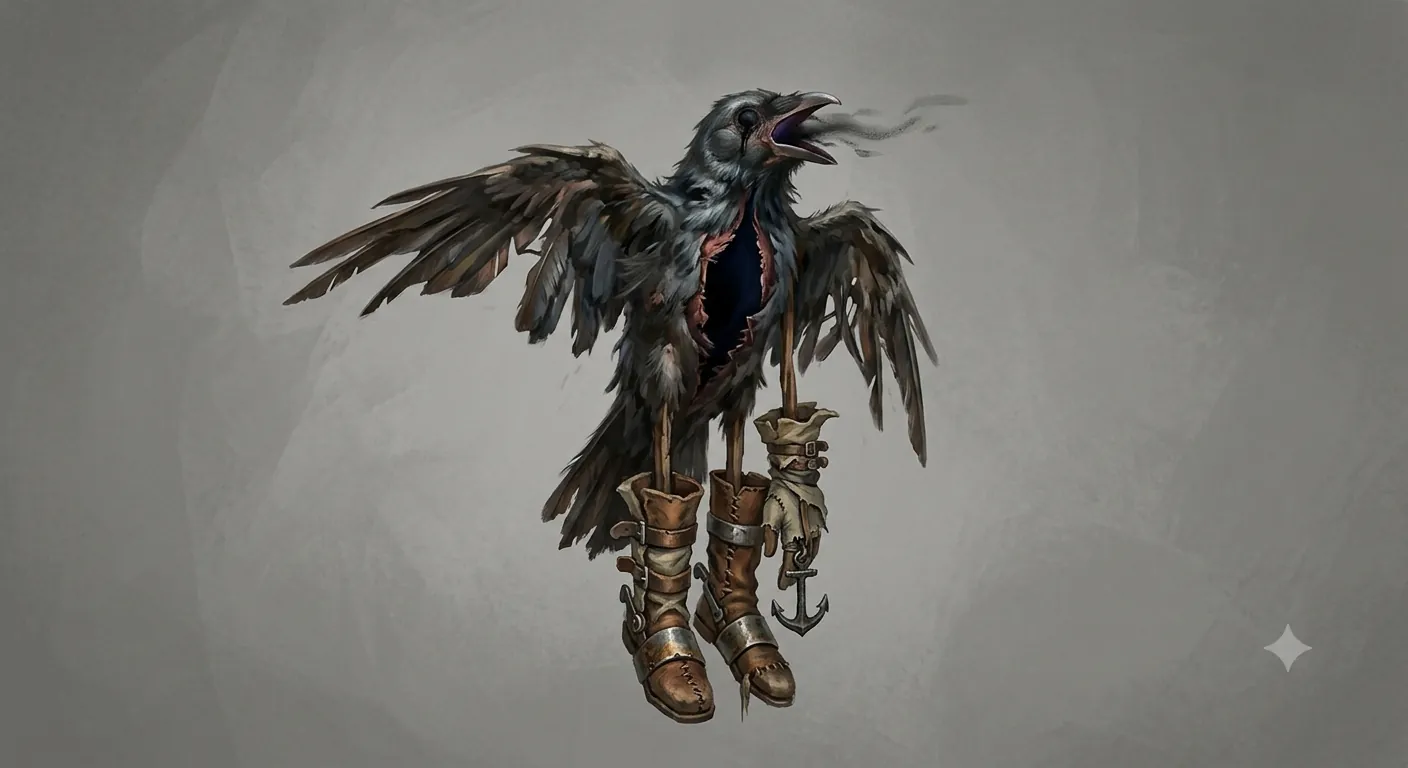
AC 14 (natural armor) · HP 22 (5d4+10) · Speed 15 ft, fly 45 ft (hover)
Traits:
- No Mind, No Heart. Immune to any effect requiring a mind or emotions — charm and fear effects, Heart-discipline seizure, and Knowing-discipline reads all fail automatically.
- Borrowed Skin. The Husk wears a dead crow’s body, stitched wide at the seams by whatever wears it from inside. Its eyes, when you look close, are a flat glossy black with no pupil.
- Ventriloquist Silence. The Husk cannot speak in its own voice. If it must communicate, it does so by clicking its beak in a rhythm the summoner taught it — a code, not language.
- Seam-Weak. Any weapon or spell with the Order tag (see Order discipline) deals an extra 1d4 radiant damage to the Husk and it cannot regenerate this HP loss.
- Traceable Summoning Signature. The Husk’s blood, if drawn, cools instantly into a black residue bearing a faint geometric brand unique to its summoner — a Knowing-discipline caster who studies it for 1 hour can identify the summoner’s discipline-lineage (DC 15 Arcana or a successful Knowing working).
Actions:
- Multiattack. The Husk makes two Claw attacks.
- Claw. Melee Attack Roll: +5, reach 5 ft., one target. Hit: 5 (1d4+3) Slashing damage.
- Beak Drain. Melee Attack Roll: +5, reach 5 ft., one incapacitated creature. Hit: 9 (2d6+3) Necrotic damage, and the Husk gains temporary HP equal to the damage dealt.
- Blink Through the Seam (1/day). The Husk vanishes and reappears within 30 ft, as misty step, leaving a smell of ozone and wet feathers.
GM note: Whoever called this thing over used a crow carcass as an anchor because dead things are cheap and don’t ask questions on the way through. It’s loyal exactly as far as its summoner’s will reaches — cut that thread (kill or bind the summoner) and the Husk goes feral, hunting warmth with no more plan than a moth has for a candle.
The Remembered Boy
Section titled “The Remembered Boy”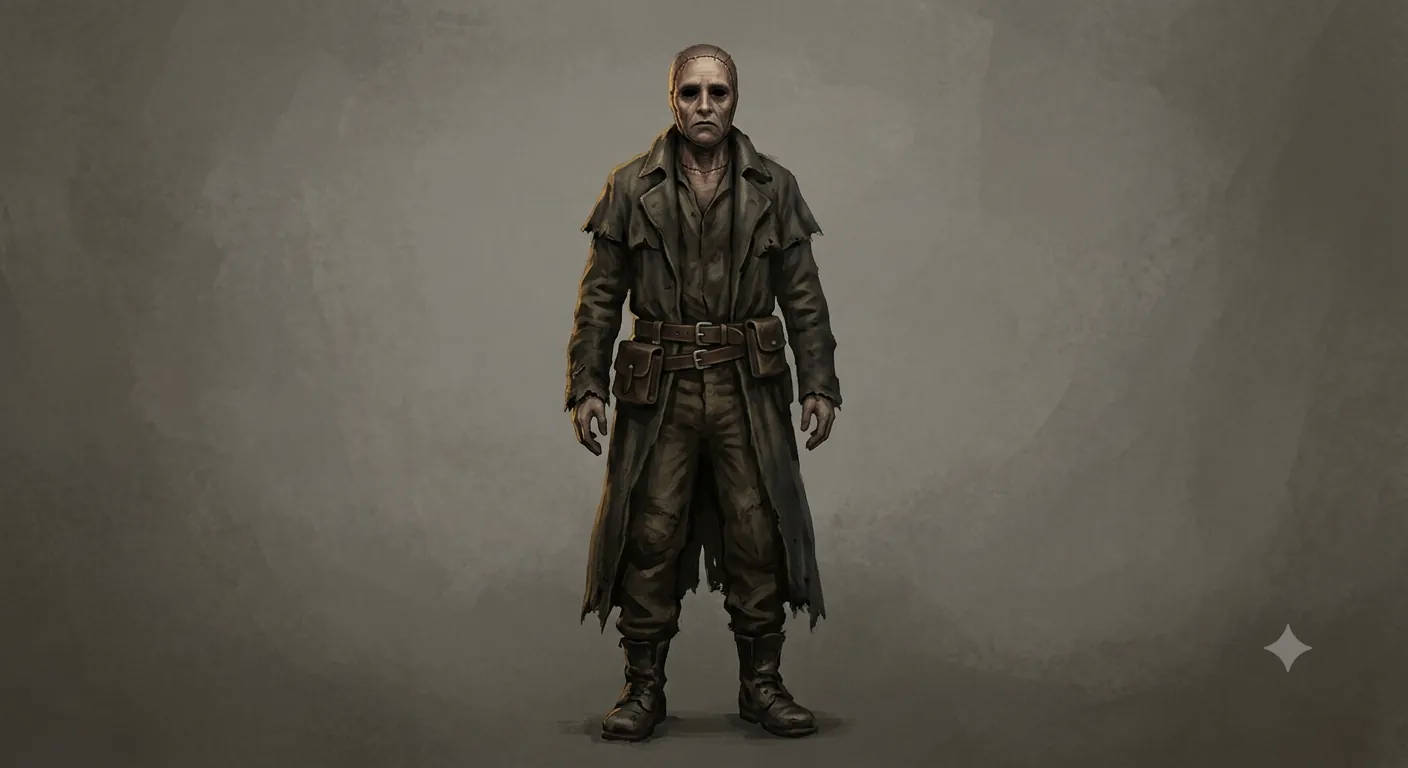
AC 13 · HP 39 (6d8+12) · Speed 40 ft, can move through spaces as narrow as 1 inch
Traits:
- Stolen Face. The Remembered Boy wears the exact appearance and voice of someone pulled from its summoner’s memory — usually someone dead, sometimes someone merely far away. It never breaks character and never says anything that person wouldn’t say, because it has nothing else to draw on.
- No Interior. Charm effects, the HEART discipline, and any effect that reads intent or desire automatically fail against it — there is no one home to want anything.
- Sunlight Weakness. In direct sunlight, the Remembered Boy has disadvantage on attack rolls and Dexterity checks.
- Dissolution. At 0 HP, the Remembered Boy doesn’t die — it unravels into cold vapor over 1 round, the stolen face sloughing off last like a mask. Nothing is closed by this; the seam that let it through remains open until Bound.
- Traceable Summoning Signature. The vapor residue, tested with a focus stone within 10 minutes, glows the exact channel color of the summoner’s discipline.
Actions:
- Multiattack. The Remembered Boy makes two Grasping Chill attacks.
- Grasping Chill. Melee Attack Roll: +6, reach 5 ft., one target. Hit: 10 (2d6+3) Cold damage.
- Wear the Face (Recharge 5-6). The Boy speaks in the exact voice of the person it’s mimicking, saying something true that only that person could have known (drawn from the summoner’s memory, never invented). Each creature within 30 ft that can hear it and understood the reference makes a Wisdom Saving Throw: DC 13. Failure: It is Frightened until the end of its next turn.
GM note: Somebody’s grief got harvested for parts. The face is real — a real dead brother, a real absent daughter — but the thing wearing it has never had a thought of its own in its unlife. It cannot monologue, cannot confess, cannot be reasoned with as if it remembers being that person, because it doesn’t remember anything. It’s ventriloquism wearing sorrow.
Ashgrave Hound
Section titled “Ashgrave Hound”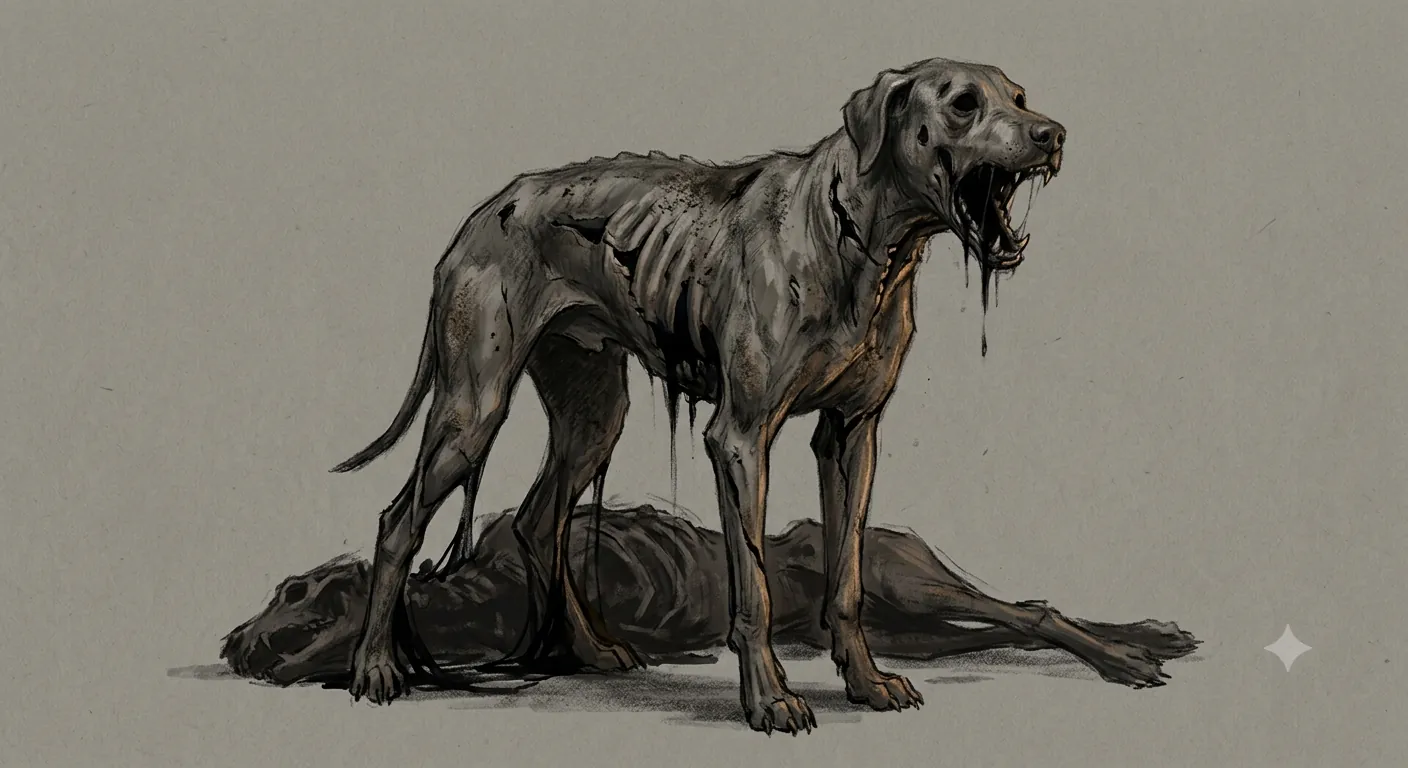
AC 15 (natural armor) · HP 68 (8d10+24) · Speed 50 ft
Traits:
- Borrowed Frame. The Hound wears the stitched-together body of a warhorse and something with too many teeth. Its coat smokes faintly with ash that never falls.
- No Mind, No Heart. The Hound cannot be read by the KNOWING (no coherent mind to read) or seized by the HEART discipline (no emotion to take hold of). It can, however, be commanded, banished, or unmade cleanly by Order-discipline Binding workings — treat any Binding spell/working targeting it as if cast at advantage.
- Pack Tether. While within 30 ft of another Ashgrave Hound, this Hound has advantage on attack rolls.
- Traceable Summoning Signature. The Hound’s ash residue, if collected within an hour of its death, retains a burnt sigil-print matching its summoner’s personal seal — usable as evidence in a Council inquiry.
Actions:
- Multiattack. The Hound makes two Bite attacks.
- Bite. Melee Attack Roll: +7, reach 5 ft., one target. Hit: 14 (2d10+4) Piercing damage plus 7 (2d6) Fire damage.
- Ashen Howl (Recharge 5-6). Each creature within 20 ft makes a Constitution Saving Throw: DC 14. Failure: It is Frightened until the end of its next turn and takes 5 (1d10) Psychic damage.
GM note: Cheap muscle for a summoner who needed a monster fast and didn’t care what it cost the dead animal whose shape it wears. Killing it is easy and satisfying and closes nothing — the seam that let it through stays open, hungry, until someone Binds it shut. Most adventuring parties never learn this and wonder, three towns later, why the Hollow keeps finding new hounds to wear.
Hollow-Possessed Hedge-Ward (Low Tier)
Section titled “Hollow-Possessed Hedge-Ward (Low Tier)”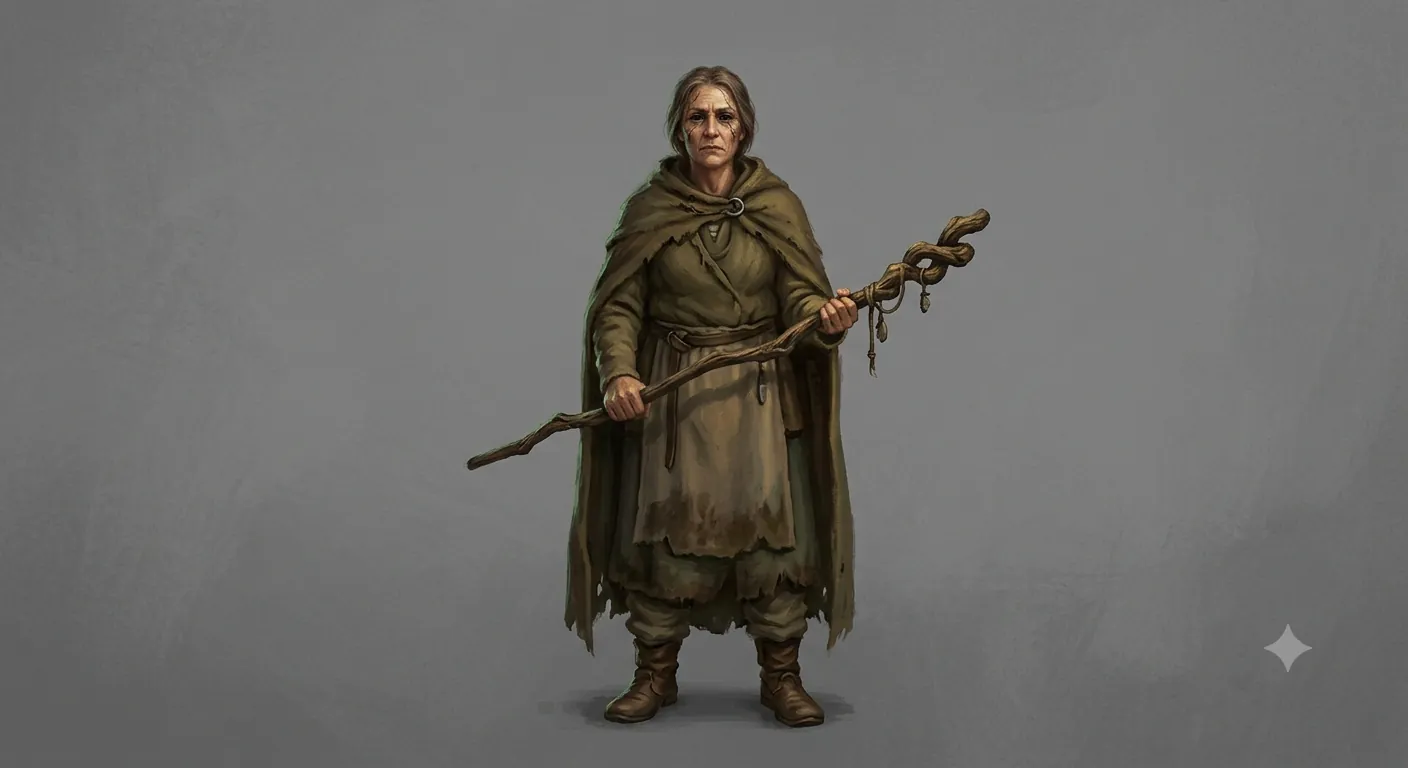
AC 13 (unarmored) · HP 45 (7d8+14) · Speed 30 ft
Traits:
- Voided Eyes. This was once a village hedge-ward who practiced the Order discipline of Warding. Her eyes no longer flash ward-blue when she casts — they go flat, voided black, every time.
- Ventriloquism, Not Monologue. She speaks in her own remembered voice and cadence, and everything she says is true — old grudges, real names, real fears she genuinely once had. She never delivers a villain’s speech, never explains a plan, never gloats at length. She says one true, cutting thing and then acts. GMs should cut her off after a sentence or two; the Hollow wearing her has no interest in talking longer than that.
- Turned Discipline. Her Warding is inverted — instead of protecting, her workings now thin the barrier between here and the Wound in a small area.
- No Rescue by the Heart. The HEART discipline cannot reach whatever is left of her; there is no one left inside answering. The Knowing discipline cannot read her either — a read returns only static. She can only be freed by Binding the seam that entered her, not by emotional appeal.
- Traceable Summoning Signature. She carries, somewhere on her body, the same brand-mark as every creature loosed from her seam — investigators who find one Hollow-summoned creature and then find her can connect the pattern.
Actions:
- Multiattack. She makes two Warding Lash attacks.
- Warding Lash. Melee Attack Roll: +5, reach 5 ft., one target. Hit: 9 (2d6+2) Force damage.
- Thin the Seam (1/day). She opens a 10-foot-radius zone where the barrier is weak for 1 minute; at the start of each of her turns thereafter, roll 1d20 — on a 18-20, a Hollow-Seepage creature (GM’s choice, CR 2 or lower) manifests at the zone’s edge.
- One True Thing. Once per combat, as a bonus action, she says a single sentence of devastating truth to one creature that knew her. That creature makes a Wisdom Saving Throw: DC 14. Failure: It has disadvantage on attack rolls against her until the end of its next turn.
GM note: This is the shape a Hollow career ends in — not a monster you fight so much as a person you have to stop while grieving that you’re doing it. She cannot be talked back. There is no speech where she reveals she’s still in there. The only mercy available is quick, and it doesn’t undo the seam that made her.
The Weeping Groom
Section titled “The Weeping Groom”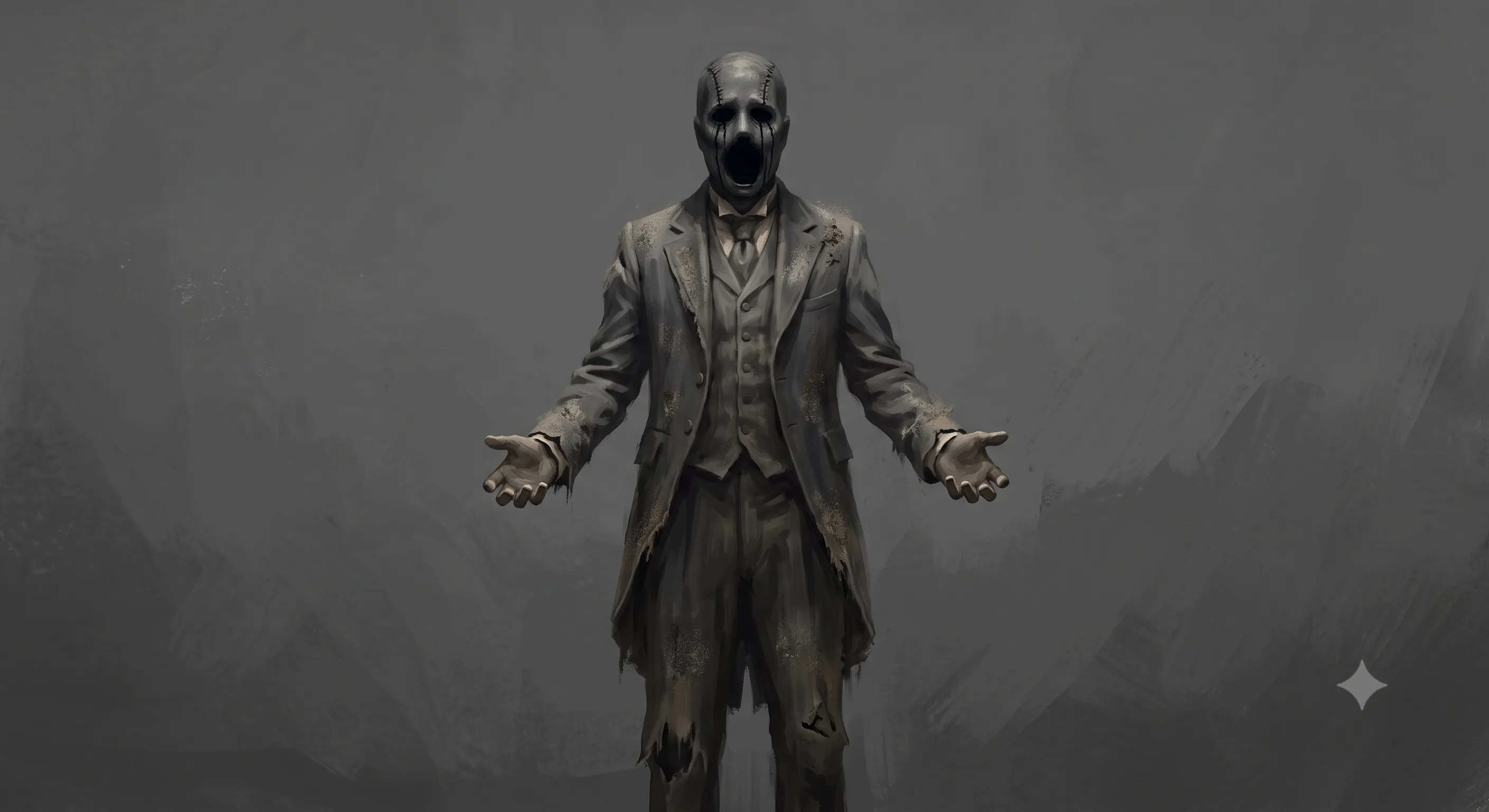
AC 16 (natural armor) · HP 82 (11d8+33) · Speed 30 ft
Traits:
- Wedding-Day Face. The Groom wears the appearance of someone’s fiancé, spouse, or beloved — pulled from the summoner’s memory and refined over multiple summonings until it is nearly perfect. The first time a creature that knew the real person sees it, that creature makes a Wisdom Saving Throw: DC 15. Failure: It is Frightened for 1 minute.
- No Interior, Perfect Surface. Immune to the HEART discipline and unreadable by the KNOWING. It can imitate affection, grief, longing — flawlessly, in the exact cadence of the person it mimics — but there is nothing behind the performance, and it never sustains a scene longer than a beat or two before violence.
- Blade of Borrowed Vows. Its weapon (oath-metal, stolen, corrupted) deals extra damage against creatures under an active oath or vow.
- Dissolution. At 0 HP it collapses into a wedding veil’s worth of grey ash. Killing it closes nothing.
- Traceable Summoning Signature. The ash carries a faint floral perfume unique to the summoner’s personal effects — a scent-tracking working (or a good bloodhound) can follow it home.
Actions:
- Multiattack. The Groom makes two Vow-Blade attacks.
- Vow-Blade. Melee Attack Roll: +7, reach 5 ft., one target. Hit: 13 (2d8+4) Slashing damage, plus 10 (3d6) Necrotic damage if the target is under any magical oath, geas, or bonded-pair effect.
- Borrowed Vow (Recharge 5-6). The Groom speaks a single line in the exact voice of a loved one to one creature within 30 ft. That creature makes a Wisdom Saving Throw: DC 15. Failure: It is Charmed for 1 minute (charm fails automatically against creatures who never knew the mimicked person).
GM note: Bonded-pair energy — the specific ache of a real partnership — is exactly what seepage and summoned things crave, and this is a purpose-built lure for it. Somewhere, a summoner fed it a memory of someone’s actual wedding day to get this good a copy. It never monologues about love; it says one perfect sentence and then it’s a knife.
Hollow-Possessed Binder (High Tier)
Section titled “Hollow-Possessed Binder (High Tier)”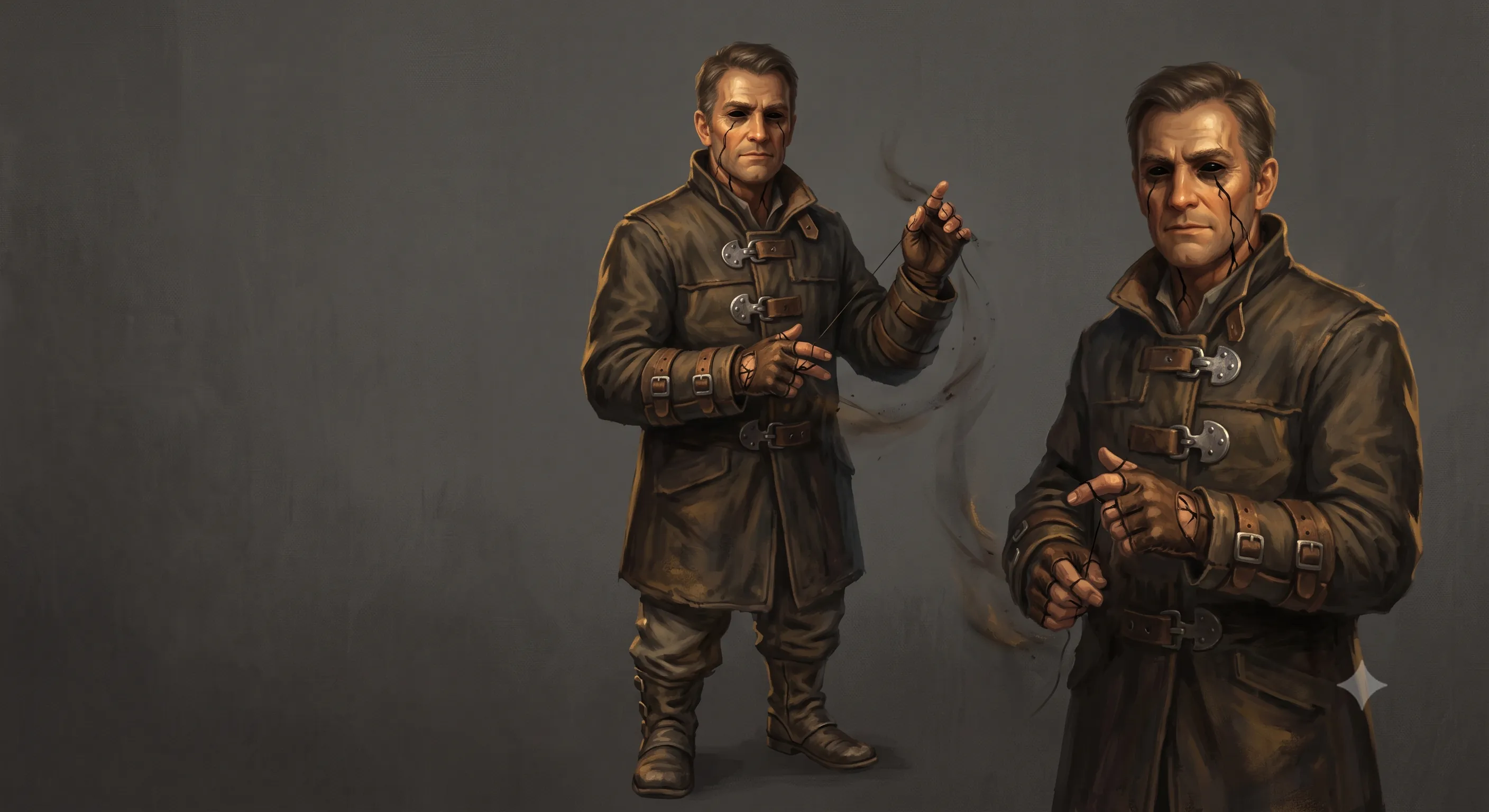
AC 17 (oath-metal warding, no longer worn willingly) · HP 133 (14d8+70) · Speed 30 ft
Traits:
- A Binder, Turned. He was one of the Order’s most decorated Binders — the discipline that seals seams, that should be the cure for everything on this table. His eyes no longer flash Order-white; they are voided black, and he binds seams open now instead of shut.
- Ventriloquism, Not Monologue. Every sentence he speaks is a true fragment of the man he was — a real regret, a real name, a real technique explained in his real teaching voice — cut off before it becomes a speech. The Hollow wearing him has no patience for exposition; if a GM finds themselves writing him a monologue, stop and cut it to one line.
- Inverted Binding. His signature working no longer closes seams — it widens them, and it does so with the same precision that made him famous.
- Unkillable by Half-Measures. Because he still carries genuine Binding mastery (inverted or not), ordinary weapons and Order damage that would drop a lesser possessed vessel instead trigger Last Ward (below).
- No One Left to Read. The Knowing discipline cannot read him — a read returns only static — and the Heart discipline finds nothing to seize.
- Traceable Summoning Signature. Every seam he widens bears his personal binding-signature, identical to the one he used for twenty years of legitimate work — which means the Council’s own archives can identify him, a fact investigators find nearly unbearable.
Actions:
- Multiattack. He makes two Seam-Chain attacks.
- Seam-Chain. Melee Attack Roll: +8, reach 10 ft., one target. Hit: 16 (2d10+5) Force damage, and the target is Restrained until the end of its next turn (DC 17 Strength check to escape).
- Widen the Seam (Recharge 4-6). He tears a 15-foot-radius zone thin for 1 minute. At the start of each of his turns, a Hollow-Seepage creature of CR 3 or lower manifests at its edge (GM’s discretion, up to 3 total).
- Reaction — Last Ward. When reduced to 0 HP for the first time, instead of dropping, he drops to 1 HP and becomes a translucent bound-shell for 1 round, immune to all damage, before the possession fully collapses.
GM note: This is the worst version of the possessed-practitioner problem: someone whose actual job was closing what he’s now opening, still technically excellent at it. Nothing he says in combat is a lie and nothing he says is the truth from him — it’s the last true fragments of a real man being used as a lockpick. The only closure here is Binding the seam itself; killing the body ends the immediate threat and nothing else. Expect the party that loved or trained under him to have a very bad night.
Vasktherion, the Called Maw
Section titled “Vasktherion, the Called Maw”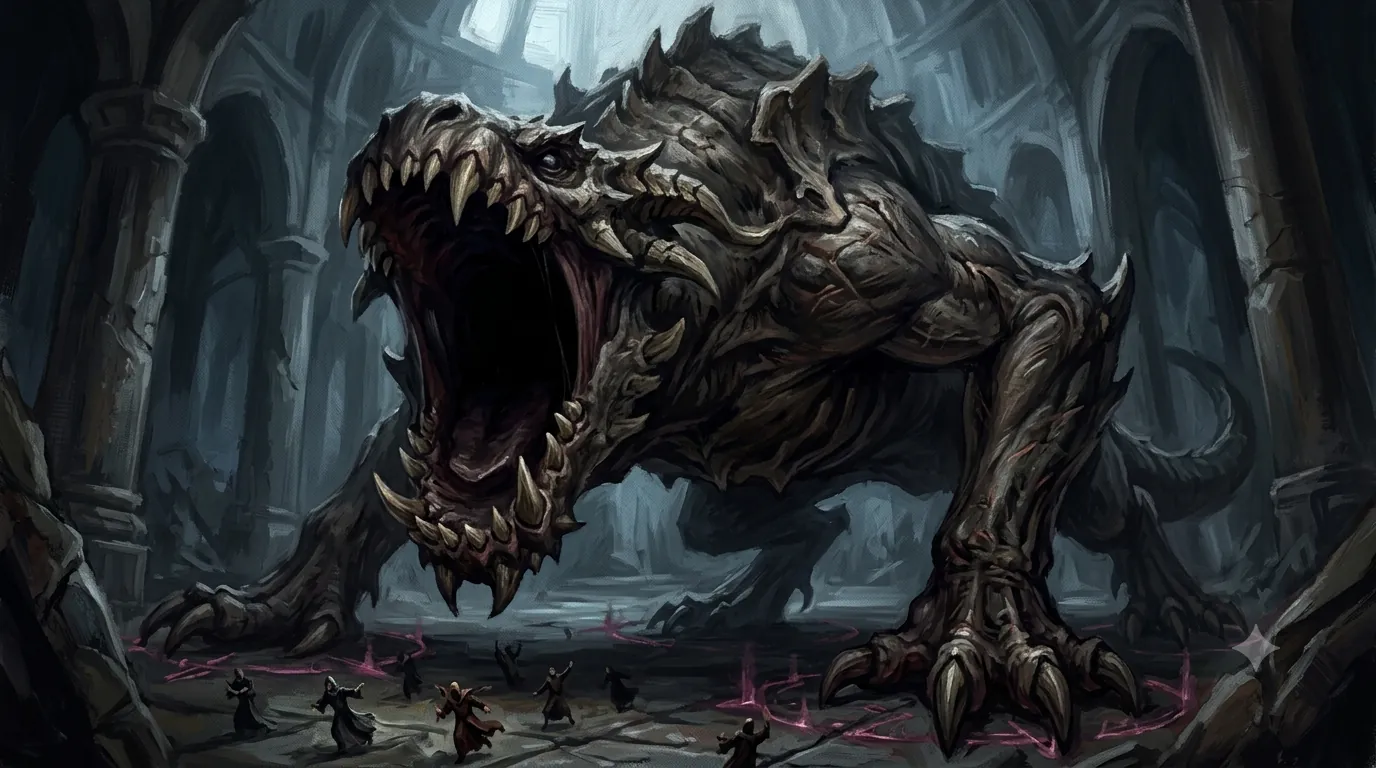
AC 18 (natural armor) · HP 210 (20d12+80) · Speed 40 ft, burrow 20 ft
Traits:
- Borrowed Titan-Frame. Vasktherion wears the flesh of something huge and dead — the summoner reached for a Kravis carcass or something like it, and got more than they bargained for holding together.
- No Mind, No Heart. Immune to the KNOWING and the HEART discipline entirely. Order-discipline Binding workings targeting it are made with advantage, and a successful Binding seals the seam rather than merely damaging the creature — the intended endgame for anything this size.
- Ravenous Anchor. While Vasktherion is present, all Hollow-Seepage creatures within 1 mile have advantage on saves against Order Binding — it is, in effect, propping the local Wound-thinness open. This is why Greater summonings are civilizationally dangerous even when “just” a combat-being: they don’t just threaten, they destabilize.
- Dissolution, Delayed. On death, Vasktherion doesn’t vanish immediately — its borrowed frame remains as inert, decaying matter for 1d4 days before dissolving, long enough for scholars (or looters) to study the borrowed body’s original species.
- Traceable Summoning Signature. A summoning at this scale leaves a permanent scar on the local ley-lattice, visible to any focus-stone reading within 10 miles for months afterward — this is not a summoning anyone can hide.
Actions:
- Multiattack. Vasktherion makes three Rend attacks.
- Rend. Melee Attack Roll: +11, reach 10 ft., one target. Hit: 19 (3d8+7) Slashing damage.
- Swallow. Melee Attack Roll: +11, one Large or smaller creature. Hit: 24 (4d8+7) Piercing damage; if this reduces the target to 0 HP, it’s swallowed instead of killed outright, taking 14 (4d6) Acid damage at the start of each of Vasktherion’s turns until freed.
- Void Bellow (Recharge 5-6). Constitution Saving Throw: DC 17, each creature within 30 ft. Failure: 27 (6d8) Thunder damage and the creature is pushed 15 ft. Success: Half damage.
Legendary Actions (3/round; end of another creature’s turn):
- Lash. One Rend attack.
- Burrow Surge (costs 2 actions). Vasktherion burrows up to half speed and attacks any creature it passes under.
GM note: A Greater summoning like this is a Council-level incident, not a monster-of-the-week — someone with real resources and real desperation reached this far into the Wound and got a whole regional destabilization for their trouble. The temptation is to treat it as “just a bigger fight.” It isn’t: even after it’s dead, the seam it widened stays weak for a season, and everything that crawls through in the meantime is on the summoner’s account.
The Cathedral That Walks
Section titled “The Cathedral That Walks”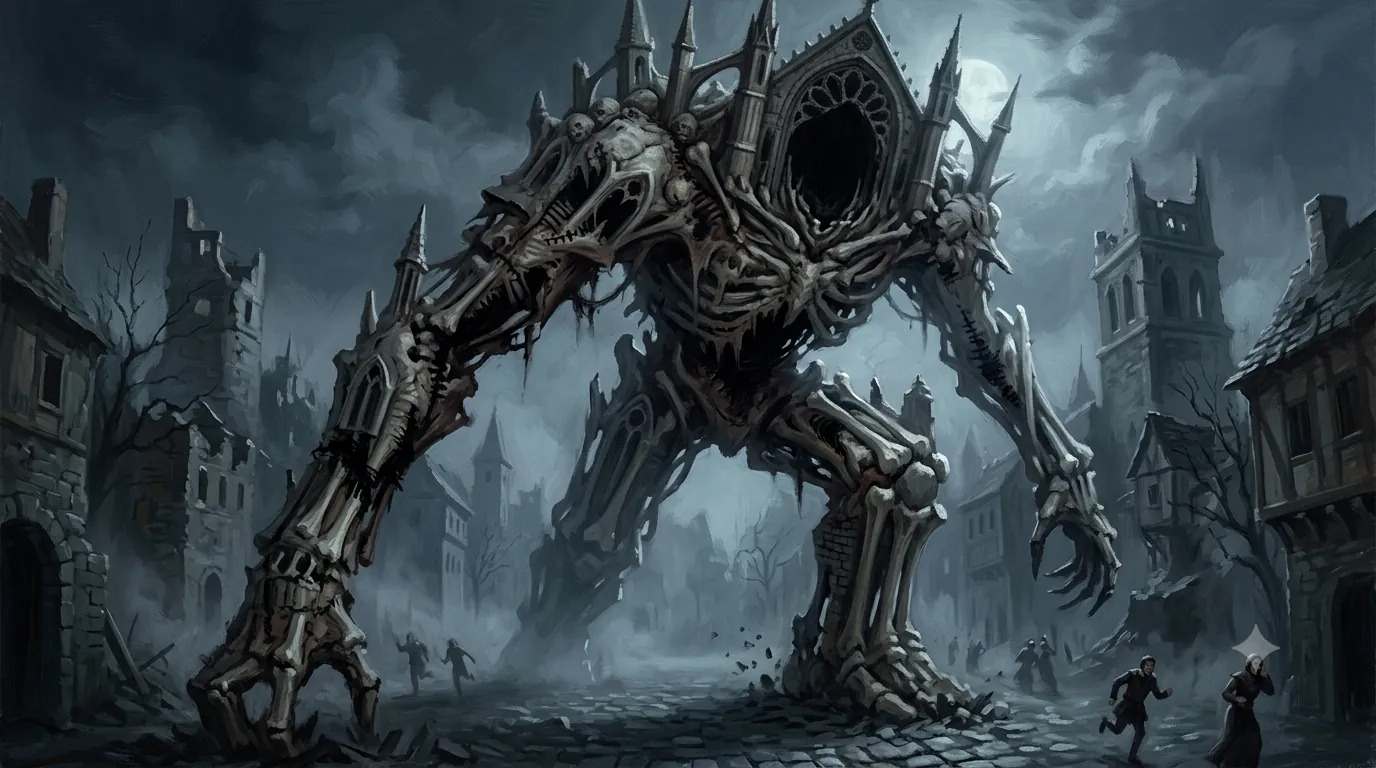
AC 19 (natural armor) · HP 285 (19d20+95) · Speed 30 ft
Traits:
- Cathedral of Bones. Called through as a weapon by a coalition of practitioners rather than a lone summoner, this thing was built from dozens of borrowed dead — a mass grave stitched into a single towering silhouette, vaguely humanoid, vaguely architectural, wrong in both directions at once.
- No Mind, No Heart. Fully immune to the KNOWING and HEART. As with all summoned Hollow, Order Binding workings against it are made with advantage — and this is, canonically, the only clean way to end this fight without the seam re-opening within the week.
- Chorus of the Borrowed. Once per round when it takes damage, the Cathedral emits a discordant sound made of dozens of overlapping voices — never a sentence, never a plea, just noise built from stolen throats. Creatures within 30 ft that hear it make a Wisdom Saving Throw: DC 18. Failure: Frightened until the end of their next turn.
- Ravenous Anchor (Major). While active, all Hollow-Seepage creatures within 5 miles have advantage on saves against Order Binding, and new seepage manifestations in the region are 50% more frequent for as long as it stands.
- Dissolution, Catastrophic. On death, the Cathedral collapses into its dozens of component corpses simultaneously — a mass-grave’s worth of remains appearing at once, a forensic and moral crisis for whatever town is nearest.
- Traceable Summoning Signature. This scale of summoning requires a coalition working, not a lone caster — investigators who Bind the seam and study the residue can identify not one signature but a pattern of several, cross-referenced against Council registries.
Actions:
- Multiattack. The Cathedral makes three Crush attacks.
- Crush. Melee Attack Roll: +13, reach 15 ft., one target. Hit: 26 (3d10+8) Bludgeoning damage.
- Collapsing Nave. The Cathedral targets a 20-foot cube within 60 ft. Dexterity Saving Throw: DC 19, each creature in the area. Failure: 33 (6d10) Bludgeoning damage and the creature has the Prone condition. Success: Half damage.
- Voided Gaze (Recharge 5-6). The Cathedral’s countless borrowed eyes flash void-black in unison. Wisdom Saving Throw: DC 18, each creature within 60 ft that can see it. Failure: Its next Order-discipline casting fails automatically, the working’s energy siphoned into keeping the Cathedral’s borrowed seams knit together.
Legendary Actions (3/round; end of another creature’s turn):
- Shudder. The Cathedral moves up to half its speed without provoking opportunity attacks.
- Reaching Spire. One Crush attack against a creature within 15 ft.
- Feed the Seam (costs 2 actions). The Cathedral pulls in ambient Wound-energy, regaining 15 HP.
GM note: This is what happens when more than one desperate, powerful faction wants the same weapon and none of them ask what it costs the dead to build it. It is not a person, was never a person, and cannot be reasoned with or grieved as one — but everyone whose remains it’s built from had a name, and the aftermath scene (identifying bodies, notifying families, explaining to a Council tribunal why a coalition summoning this size wasn’t caught earlier) should hit harder than the fight did.
VOKHRAITH, THE CATHEDRAL WOUND
Section titled “VOKHRAITH, THE CATHEDRAL WOUND”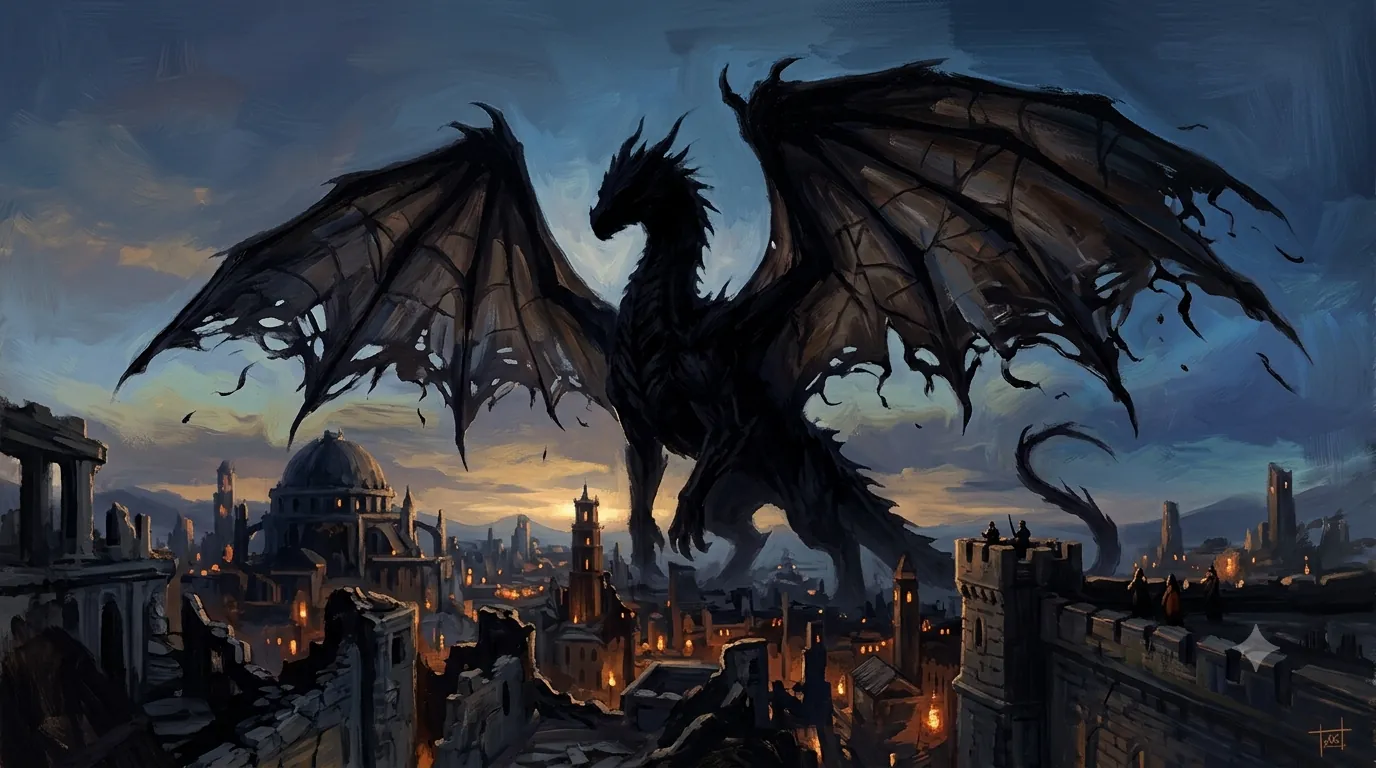
AC 21 (natural armor, seam-plates) · HP 487 (25d20 + 225) · Speed 60 ft, fly 120 ft, burrow 30 ft (through solid stone via seam-travel)
Traits:
- No Mind, No Heart. Vokhraith cannot be read, charmed, frightened, or bargained with by any means. Discipline effects keyed to the KNOWING or the HEART automatically fail against it — there is no one home to affect. It has no goals beyond the seepage’s single hunger: warmth, living tissue, bonded pair-energy.
- Borrowed Silhouette. Over four centuries in the Wound, the seepage thickened into the shape terror gives it — an ancient dragon, wings of layered vapor-membrane stretched over a lattice of smaller seams. The shape is a mask. Nothing under it corresponds to dragon anatomy; called shots to “vital organs” find only more absence.
- Cathedral of Seams. Vokhraith’s body is a fused colony of hundreds of minor seepage-tears bound into one civilizational-scale wound. Anywhere it has bled, torn ground, or nested, minor Hollow-seepage creatures spontaneously coalesce (see Lair Actions).
- Order Sunders It; Nothing Else Does. Weapons or spells channeling the Binding discipline score critical hits on any roll of 18–20 against Vokhraith and deal an extra 4d10 force damage. Non-Order magic damage is halved unless the weapon bears worked oath-metal.
- Killing Closes Nothing. Reducing Vokhraith to 0 HP causes its borrowed dragon-shape to boil off as vapor (Dissolution), but the seam-cathedral beneath the Wound it grew from remains open. Within 1d4 days a new seepage-shape — smaller, but hungry — begins condensing in the same territory unless the seam itself is ritually Bound (see GM note).
- Legendary Resistance (3/Day). If Vokhraith fails a saving throw, it can choose to succeed instead.
Actions:Multiattack. Vokhraith makes three attacks: one Void Maw, and two Seam Claw. Void Maw. Melee Attack Roll: +16, reach 15 ft., one target. Hit: 32 (4d12 + 9) Piercing damage, and the target makes a Constitution Saving Throw: DC 24. Failure: Its warmth is drawn — it takes 18 (4d8) Necrotic damage at the start of each of its turns until an ally spends an action pressing living contact against it (ending the drain). Seam Claw. Melee Attack Roll: +16, reach 10 ft., one target. Hit: 24 (4d8 + 9) Slashing damage. Absence Breath (Recharge 5–6). Vokhraith exhales a 90-foot cone of pressureless void. Constitution Saving Throw: DC 24, each creature in the cone. Failure: 66 (12d10) Necrotic damage. Success: Half damage. Creatures reduced to 0 HP by this damage don’t die — they are pulled through, vanishing into the seam-cathedral (treat as banished; see GM note on reclaiming the lost). Seam-Step (1/turn, no action). Vokhraith can vanish into a seam and reappear from any other seam within 300 feet as part of its movement.
Legendary Actions (3/turn, regain at start of turn):
- Claw. Vokhraith makes one Seam Claw attack.
- Draw the Warm (Costs 2 Actions). Vokhraith targets one bonded pair (any two creatures within 30 ft of each other who have fought or traveled together) it can see; both make a Wisdom Saving Throw: DC 24. Failure: Each is pulled 30 feet toward the other and toward Vokhraith.
- Reknit (Costs 2 Actions). Vokhraith regains 20 hit points as nearby seam-tissue folds back into it. Can’t be used if Vokhraith took Order/Binding damage this round.
Lair Actions (Initiative count 20): Within its cathedral territory, Vokhraith can take one lair action:
- A minor Hollow-seepage creature (use a shrieker-mimic or void-hound, GM’s choice, roughly CR 2–4) tears itself out of the nearest scarred ground and acts on initiative count 20.
- The ground in a 20-foot radius anywhere within the lair becomes a seam: it counts as difficult terrain, and any creature that starts its turn there takes 9 (2d8) necrotic damage.
- Vokhraith swaps places with any minor seepage creature within its lair, teleporting to that creature’s space (the creature vanishes, absorbed).
Regional Effects: The land around Vokhraith’s cathedral (up to 6 miles) is a slow bleed:
- Bonded pairs (married couples, oath-partners, adventuring duos) traveling the region feel a pull toward the lair’s center, as if walking downhill, and each dawn must make a Wisdom Saving Throw: DC 15, losing one hour’s travel to the pull on a failure.
- Wild animals and livestock within the region are gaunt and thin — the seepage has been drawing ambient warmth for generations.
- Order-discipline focus stones glow faintly and unprompted anywhere in the region, as if straining toward something.
- If Vokhraith is destroyed, these effects fade over 2d10 days.
GM note: The OCTA’s files on Vokhraith span three failed containment expeditions and one Founding-Era vault that sealed a smaller version of it four hundred years ago before the seal cracked. It has no name, no want, no monologue to give the party — every “dragon” behavior (territoriality, hoarding warmth instead of gold, nesting) is the seepage doing what seepage does at scale, wearing the shape big enough to be worth wearing. The only way to actually end this is a multi-caster Binding ritual sung directly into the original seam-mouth (the true “lair,” a fissure at the cathedral’s geometric center, usually disguised as the “heart” the party expects to find) — killing the dragon-shape just buys the region a few years before the next mask condenses. Parties that only fight will win a legendary battle and lose the war; make sure at least one NPC in the campaign knows that and says so before initiative is rolled.
MAERUK, THE DROWNED COLOSSUS
Section titled “MAERUK, THE DROWNED COLOSSUS”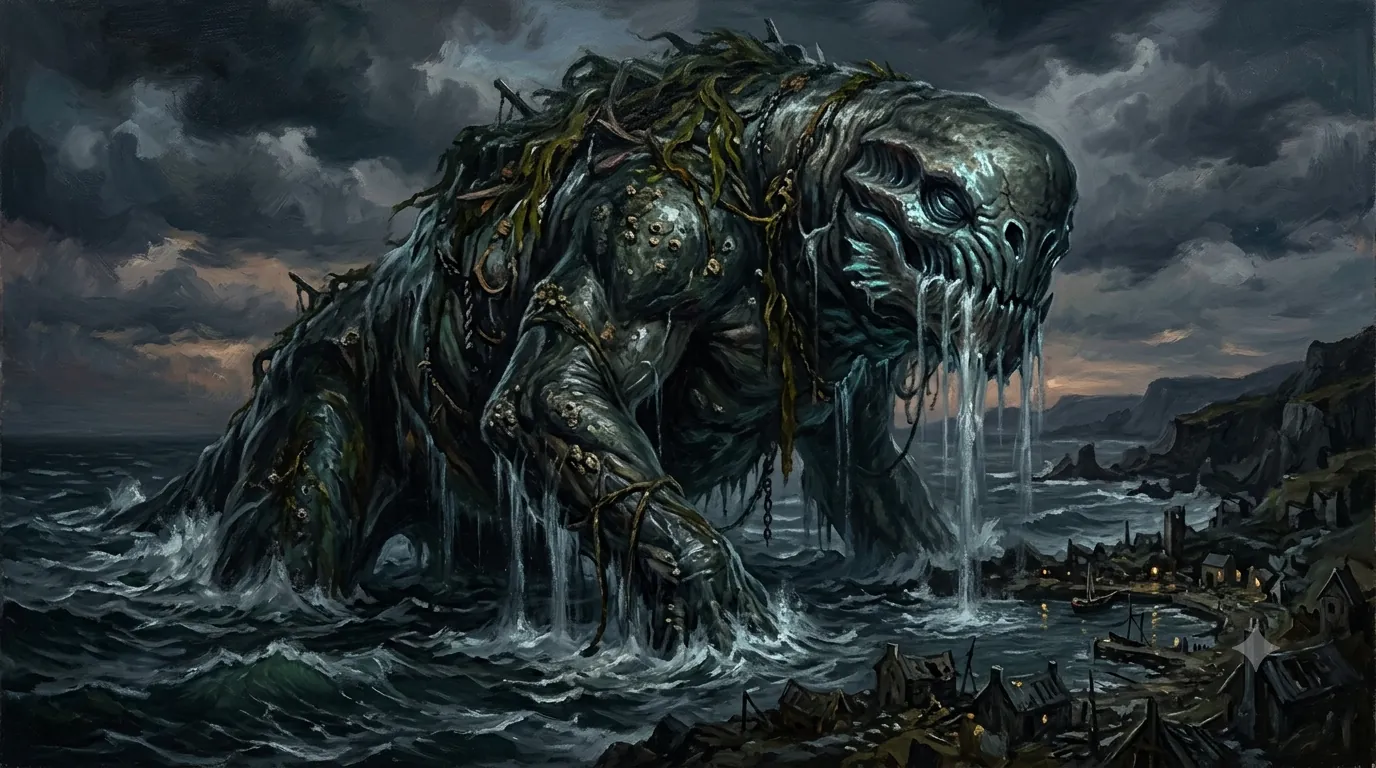
AC 19 (rock-hide) · HP 412 (24d20 + 168) · Speed 40 ft, swim 80 ft
Traits:
- Ancient, Not Hollow. Maeruk crossed whole through an enormous tear in the West Sea roughly nine hundred years ago and has simply been growing since. It has no seam, no seepage-signature, no absence at its core — Order disciplines gain no special advantage against it, and Chaos-discipline effects that dampen or absorb are fully effective. It is exactly as real and as mortal as it looks. Killing it is real killing.
- Colossal Displacement. Whenever Maeruk enters water for the first time on a turn or ends its turn there, every creature within 60 feet makes a Strength Saving Throw: DC 22. Failure: It is knocked Prone and swept 30 feet by the surge and takes 14 (4d6) Bludgeoning damage.
- Pressure-Song. Maeruk’s vocalizations travel through water and stone alike. Creatures within 1 mile underwater, or 300 feet on land, that can hear it make a Wisdom Saving Throw: DC 20 at the start of their turn. Failure: Frightened until the end of their next turn (no save needed if already immune to that source).
- The Weight of It. Maeruk’s mass is civilizational in the wrong way: if it dies on land or in shallow water, its collapse deals 88 (16d10) Bludgeoning damage to everything in a 200-foot radius (Dexterity Saving Throw: DC 24 for half) and permanently reshapes the coastline. Coastal settlements have historically preferred to drive it back to deep water rather than finish it.
- Legendary Resistance (3/Day).Actions:Multiattack. Maeruk makes three attacks: two Crush and one Engulfing Maw, or three Crush. Crush. Melee Attack Roll: +17, reach 20 ft., one target. Hit: 34 (4d12 + 10) Bludgeoning damage. Engulfing Maw. Melee Attack Roll: +17, reach 15 ft., one Large or smaller creature. Hit: 27 (4d8 + 10) Piercing damage, and the target is swallowed. A swallowed creature is Restrained, can’t be targeted from outside, takes 21 (6d6) Acid damage at the start of each of Maeruk’s turns, and dies at 0 HP inside. Maeruk can have only one creature swallowed at a time; if it takes 40+ damage from inside in a single turn, it makes a Constitution Saving Throw: DC 20. Failure: It regurgitates all swallowed creatures, which land Prone in a space within 10 feet. Tidal Tail Sweep (Recharge 5–6). Maeruk sweeps its tail through a 30-foot cone. Dexterity Saving Throw: DC 22, each creature in the area. Failure: 45 (10d8) Bludgeoning damage and the creature is pushed 20 feet. Success: Half damage.
Reactions:Undertow. When a creature Maeruk can see moves within 10 feet of deep water while within 60 feet of Maeruk, Maeruk forces a Strength Saving Throw: DC 22; on a failure the creature is pulled 30 feet toward the water and to the surface adjacent to Maeruk.
Legendary Actions (3/turn):
- Surge. Maeruk moves up to half its speed without provoking opportunity attacks.
- Crush (Costs 1 Action). Maeruk makes one Crush attack.
- Call the Deep (Costs 2 Actions). Maeruk’s pressure-song intensifies; each creature within 300 feet that failed its most recent Pressure-Song save takes 9 (2d8) Psychic damage.
Lair Actions (Initiative count 20, in open water only):
- A rogue current tears through the battlefield: each creature in water makes a Strength Saving Throw: DC 18. Failure: Moved 20 feet in a random direction and has disadvantage on attack rolls until the end of its next turn.
- Maeruk churns silt and wreckage into the water in a 60-foot radius, heavily obscuring the area until the start of its next turn.
- The temperature plummets around Maeruk; each creature within 30 feet takes 7 (2d6) Cold damage.
Regional Effects: Within Maeruk’s hunting range (a stretch of coast or deep channel up to 20 miles):
- Fishing catches thin dramatically; local sailors report the water “leaning” toward deep channels.
- Storms along the coast arrive faster and harder than weather alone accounts for — Maeruk’s passage displaces enough water to seed squalls.
- Old Sulamiri ruins in the region, where they exist, show fresh scarring — Maeruk is old enough to remember what stood there before the sea took it, and returns to circle the wrecks.
GM note: Maeruk is not a Wound creature and the OCTA barely tracks it — it belongs in the same file as the Kravis and the Kravilith, a survivor of something ancient and enormous rather than a symptom of anything thinning. That’s the twist worth playing up: after a campaign of Hollow-seepage where killing never actually fixes the underlying wrongness, Maeruk is refreshingly, terrifyingly honest — if the party kills it, it is actually dead, the coast is actually safer, and the only cost is the very real one stated in The Weight of It: nine centuries of mass have to go somewhere when it finally stops moving. Let a coastal town’s mayor argue for driving it off instead of finishing it, and mean it.
Native Beasts
Section titled “Native Beasts”Cold Lamp Rat
Section titled “Cold Lamp Rat”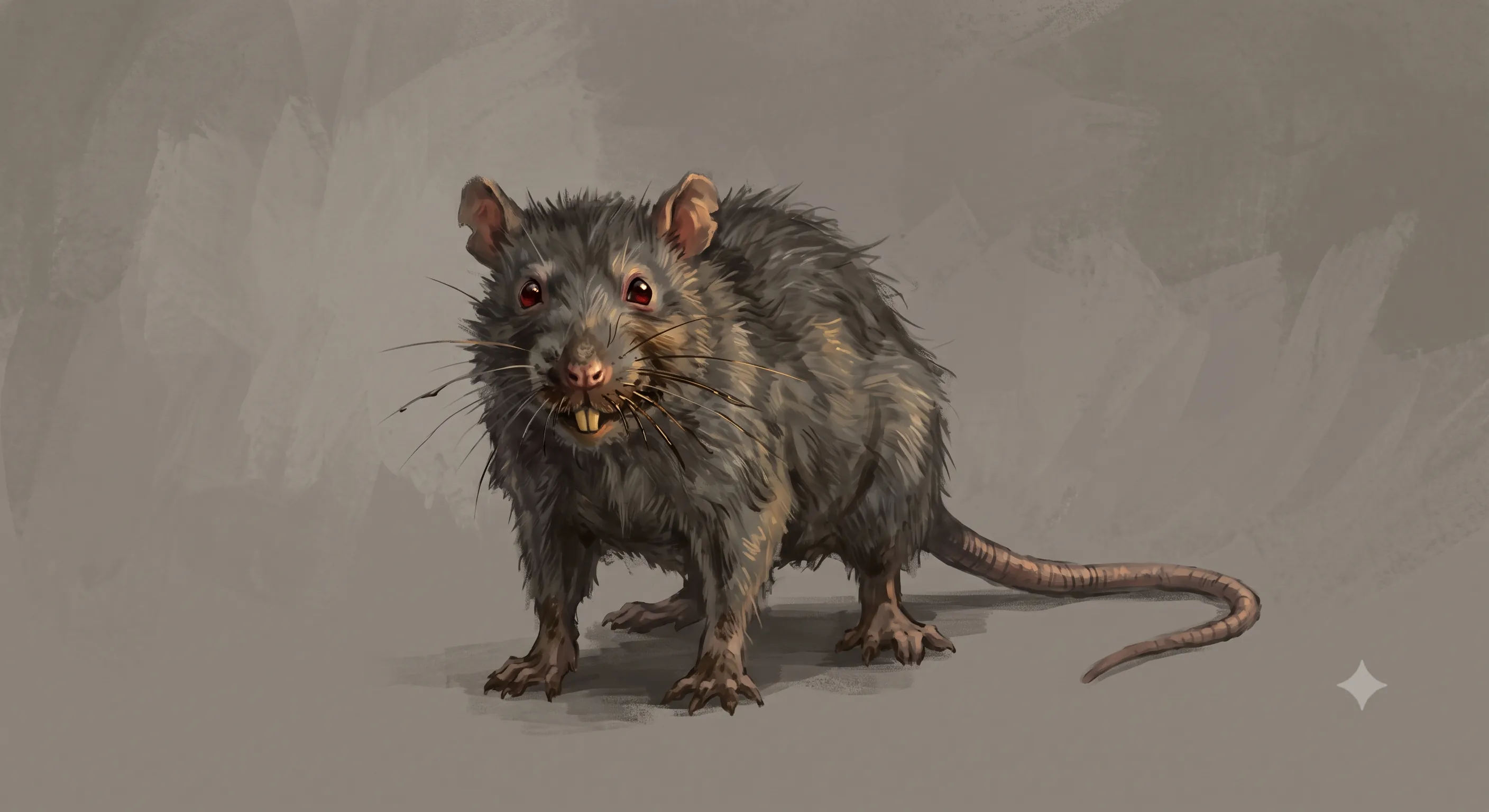
AC 12 (natural) · HP 7 (2d4 + 2) · Speed 30 ft.
Traits: Pack Tactics — advantage on attack rolls against a creature if at least one other Cold Lamp Rat is within 5 ft. of it and not incapacitated. Keen Smell — advantage on Wisdom (Perception) checks relying on smell. Numbers — for every four rats beyond the first in a mob, the GM may add one extra bite attack to the group’s turn (cap at 4 extra).
Actions: Bite. Melee Attack Roll: +4, reach 5 ft., one target. Hit: 3 (1d4 + 1) Piercing damage.
GM note: These are the Cold Lamp’s tunnel vermin, nothing more — no seam feeds them, no summoner called them. They swarm because there are a lot of them and the lamp-oil smells like food. A torch and a closed door solves this encounter; no discipline is required or even relevant.
Steam-Tunnel Louse
Section titled “Steam-Tunnel Louse”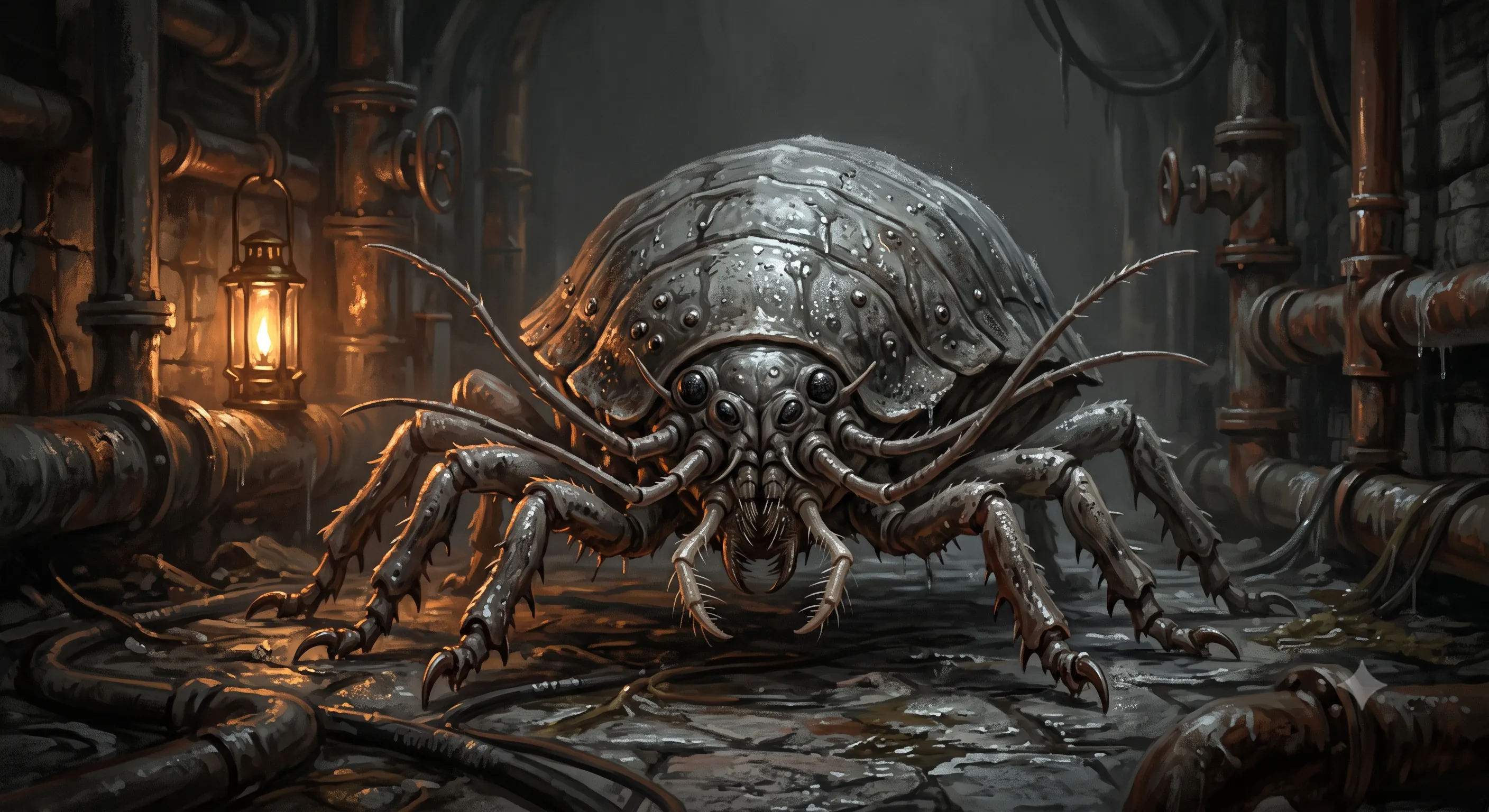
AC 13 (chitin) · HP 13 (3d6 + 3) · Speed 30 ft., climb 30 ft.
Traits: Heat-Seeking — has advantage on attack rolls against any creature that moved within 10 ft. of an active steam vent this turn. Steam-Slick Shell — difficult terrain from steam condensation doesn’t slow it.
Actions: Bite. Melee Attack Roll: +4, reach 5 ft., one target. Hit: 5 (1d6 + 2) Piercing damage.
GM note: Colonized the Center-Spire steam-tunnels generations after the pipes went in — a scavenger niche, not a Founding-era leftover. Players who assume “tunnels under an angel-daemon ruin” means construct or Hollow are meant to be a little disappointed. Sometimes a bug is just a bug.
Rent Jackal
Section titled “Rent Jackal”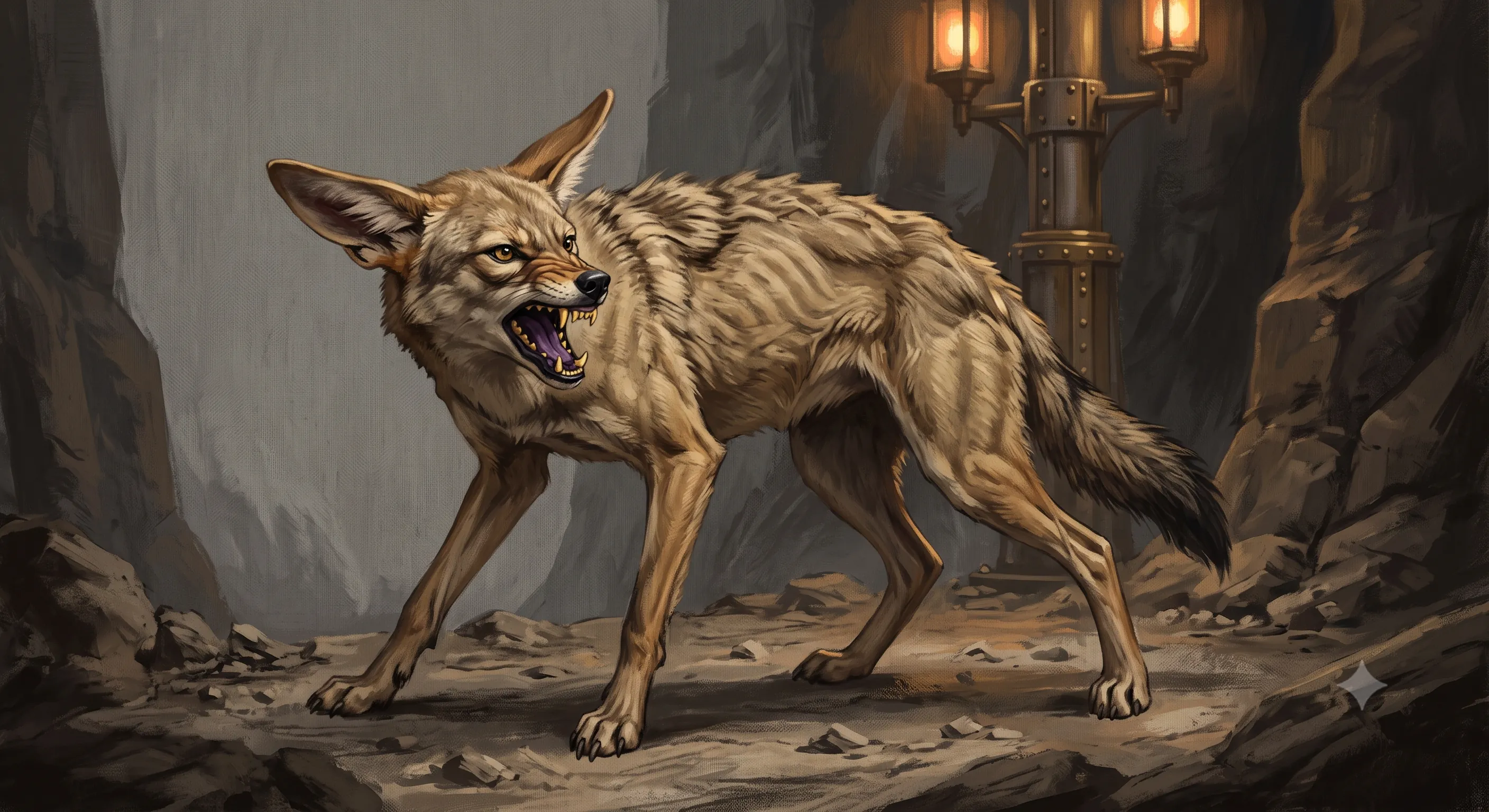
AC 13 (natural) · HP 26 (4d8 + 8) · Speed 50 ft.
Traits: Pack Tactics — advantage on attack rolls against a creature if an ally of the jackal is within 5 ft. of it. Sure-Footed — treats canyon scree and loose rock as normal terrain and has advantage on saves against being knocked prone by unstable ground.
Actions: Bite. Melee Attack Roll: +4, reach 5 ft., one target. Hit: 6 (1d6 + 3) Piercing damage. If the target is bitten by two or more Rent Jackals on the same turn, it makes a Strength Saving Throw: DC 12. Failure: It is knocked Prone.
GM note: Runs the switchbacks of the Long Rent in packs of six to twelve. Loud, coordinated, entirely explicable — the party should be able to hear these coming and choose their ground. No signature to trace, no seam to find. Just don’t get surrounded.
Ashfang Viper
Section titled “Ashfang Viper”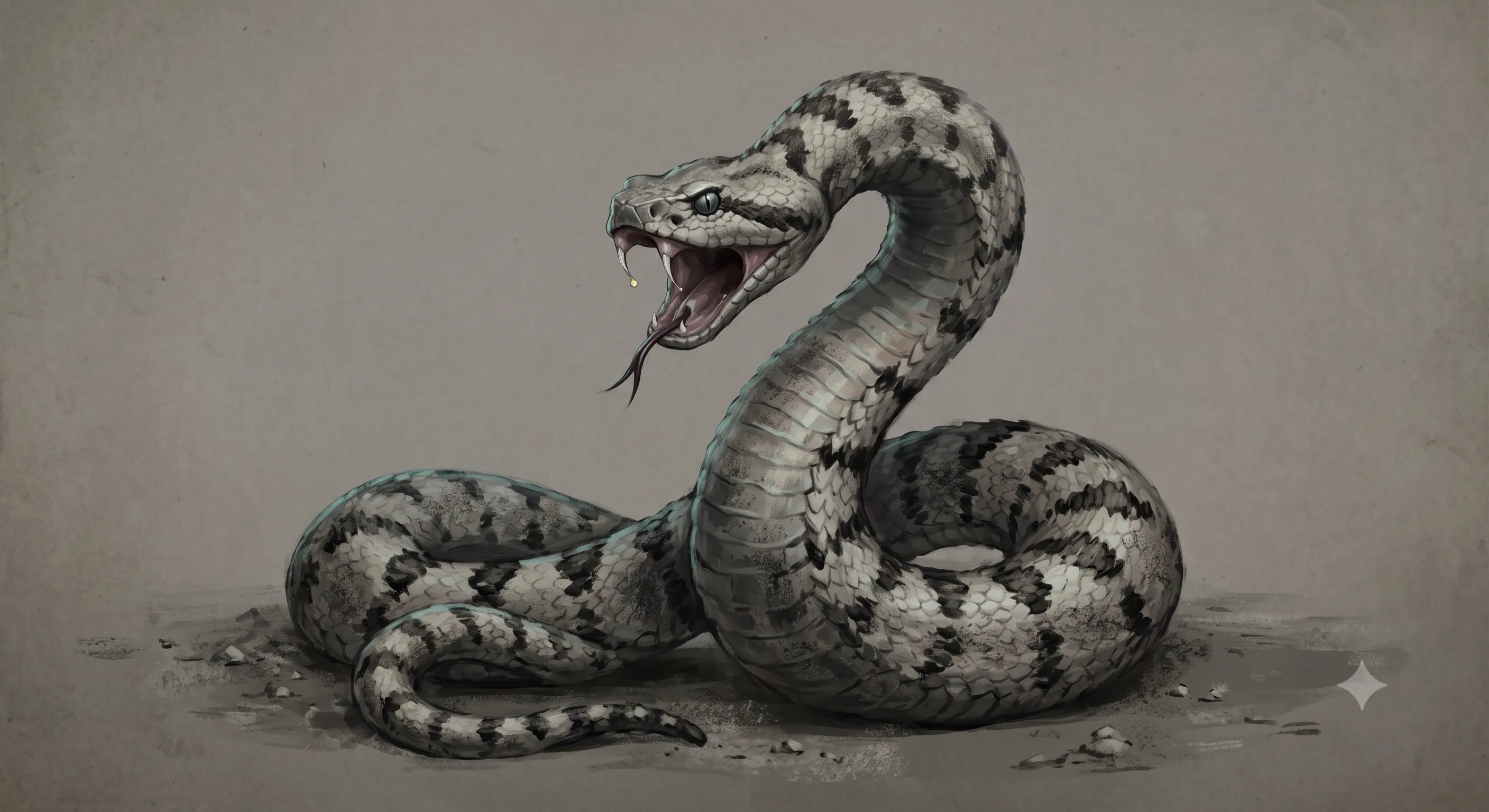
AC 13 (natural) · HP 33 (6d8 + 6) · Speed 30 ft., climb 20 ft.
Traits: Ambush Coloration — has advantage on attack rolls against any creature it has surprised.
Actions: Bite. Melee Attack Roll: +5, reach 5 ft., one target. Hit: 4 (1d4 + 2) Piercing damage plus 10 (3d6) Poison damage, and the target makes a Constitution Saving Throw: DC 13. Failure: Poisoned for 1 minute (repeat save at end of each of its turns).
GM note: Ash-canyon fauna, full stop. Its venom is chemistry — Restoration and mundane antivenom both work fine, and no Binding or seam-craft is required to neutralize it. Good creature to run right after a Hollow encounter, precisely because the players will keep flinching for a discipline check that isn’t needed here.
Canyon Strider
Section titled “Canyon Strider”
AC 12 (natural) · HP 42 (5d10 + 15) · Speed 50 ft.
Traits: Sure-Footed — canyon terrain never counts as difficult terrain for it. Skittish — has advantage on saving throws against being frightened, but if it fails a Wisdom save vs. fear it flees at full speed for 1 minute rather than fighting.
Actions: Hooves. Melee Attack Roll: +6, reach 5 ft., one target. Hit: 9 (2d6 + 4) Bludgeoning damage. Ram (Recharge, requires 20 ft. straight-line move before the hit). If it hits with Hooves after moving at least 20 ft. straight toward the target, the target also takes 7 (2d6) Bludgeoning damage and makes a Strength Saving Throw: DC 13. Failure: It is knocked Prone.
GM note: Canyon-folk break these to saddle; wild ones are just wary herd animals with a nasty kick. It bolts from the smell of an open seam the way it’d bolt from smoke — pure animal instinct, not detection magic, so don’t let players read tactical intel into “the mount is spooked.”
Highland Stalker
Section titled “Highland Stalker”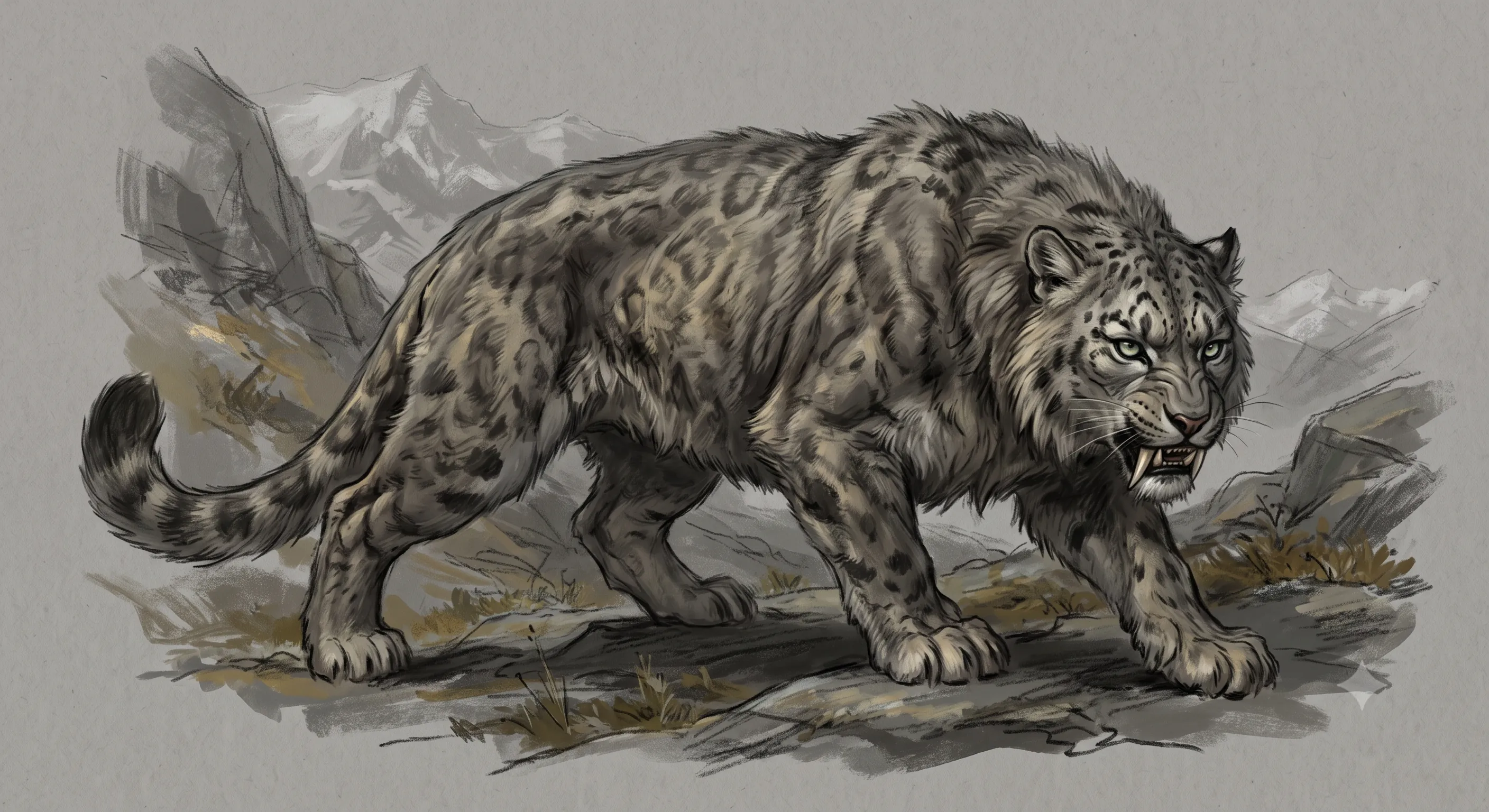
AC 15 (natural) · HP 58 (9d10 + 9) · Speed 40 ft., climb 30 ft.
Traits: Snow Camouflage — advantage on Stealth checks made in snow, fog, or bare rock. Pounce — if it moves at least 10 ft. straight toward a target and then hits it with a Claw attack on the same turn, the target makes a Strength Saving Throw: DC 14. Failure: It is knocked Prone, and the Stalker can make a bite attack against it as a bonus action.
Actions: Multiattack. The Stalker makes two Claw attacks. Claw. Melee Attack Roll: +6, reach 5 ft., one target. Hit: 7 (1d8 + 3) Slashing damage. Bite. Melee Attack Roll: +6, reach 5 ft., one target. Hit: 9 (1d10 + 4) Piercing damage.
GM note: The apex predator of the high provinces — territorial, solitary, and completely indifferent to anything cosmic. It’s here to remind the table that “big cat on a mountain” doesn’t need a Wound behind it to be a genuine threat.
Steam-Wyrm Eel
Section titled “Steam-Wyrm Eel”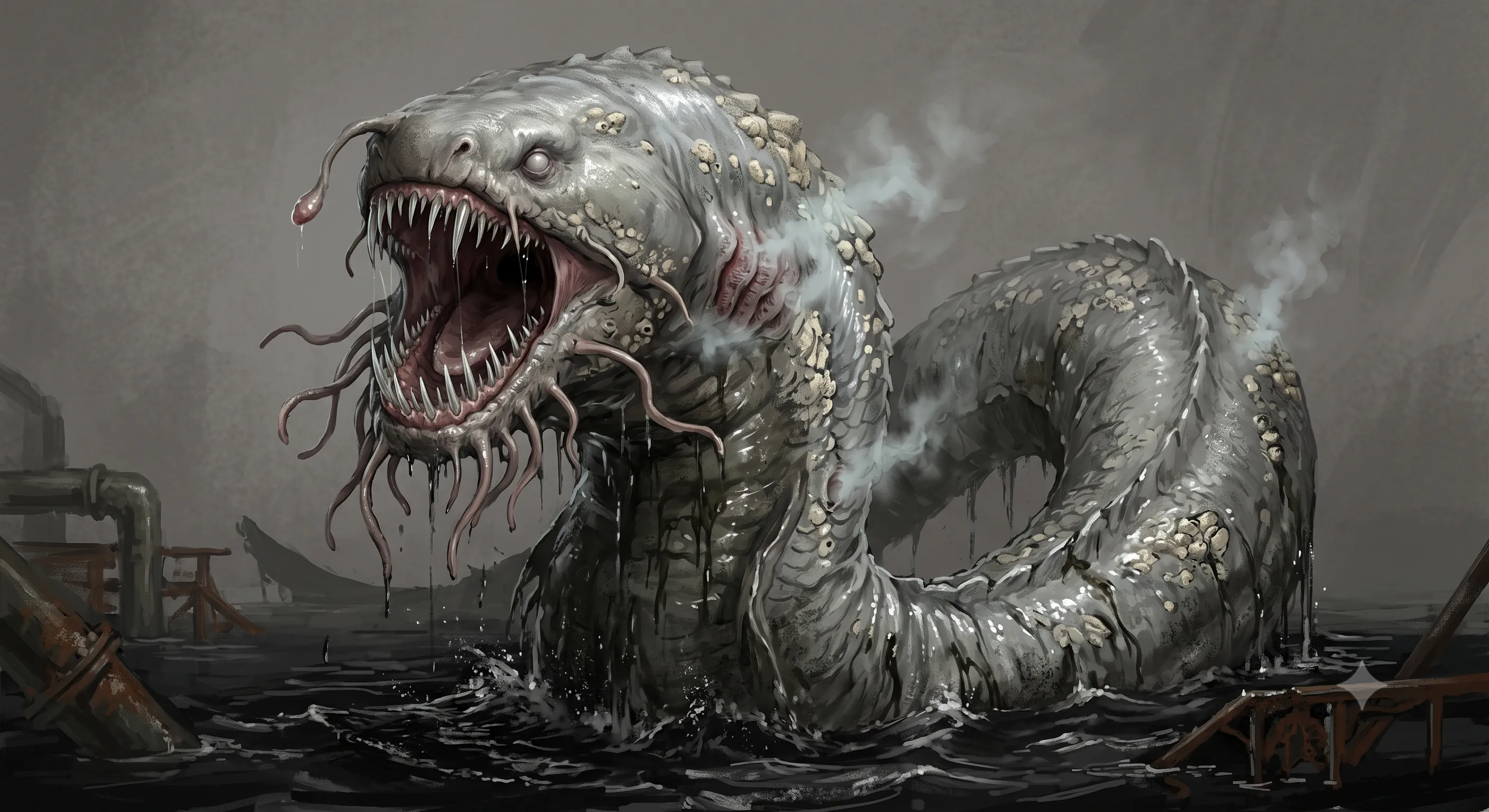
AC 13 (natural) · HP 76 (9d12 + 18) · Speed 10 ft., swim 40 ft.
Traits: Amphibious — can breathe air and water. Scalding Hide — a creature that starts its turn grappled by the Eel takes 3 fire damage.
Actions: Multiattack. The Eel makes one Bite attack and one Coil attack. Bite. Melee Attack Roll: +7, reach 10 ft., one target. Hit: 13 (2d8 + 4) Piercing damage. Coil. Melee Attack Roll: +7, reach 5 ft., one target. Hit: 10 (2d6 + 4) Bludgeoning damage, and the target has the Grappled condition (escape DC 15) if the Eel doesn’t already have a creature grappled.
GM note: Colonized the flooded cisterns under the Center-Spire steam works long after the Founding-era plumbing went cold — it likes the residual heat, nothing more. No construct logic, no ancient purpose. Just a very large, very hungry eel that thinks the tunnels are a lake.
Rent-Maw Bear
Section titled “Rent-Maw Bear”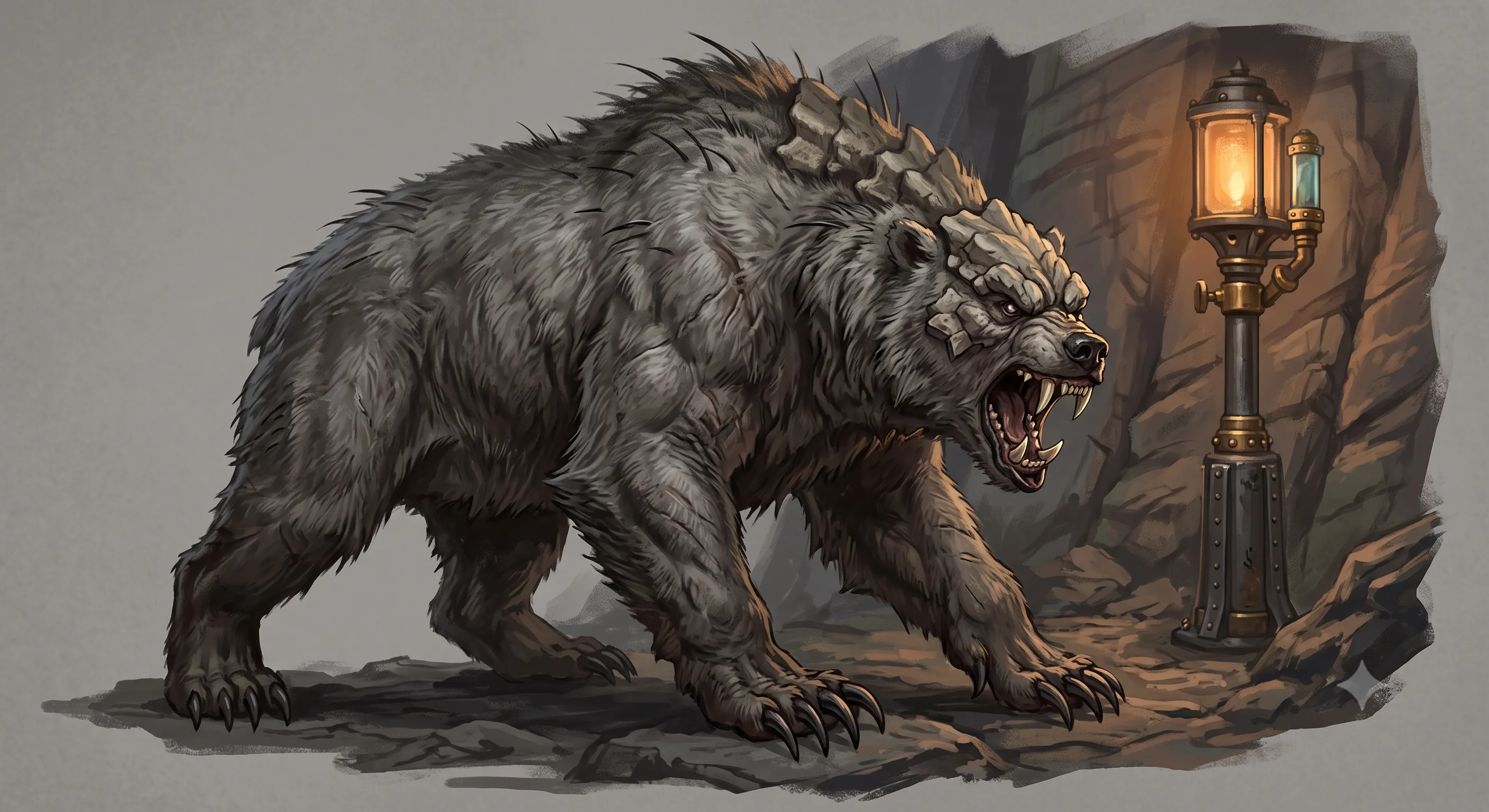
AC 15 (natural) · HP 127 (15d12 + 30) · Speed 40 ft., climb 30 ft.
Traits: Keen Smell — advantage on Wisdom (Perception) checks that rely on smell. Siege Monster — deals double damage to objects and structures. Relentless (1/Day) — if reduced to 0 hp by an attack that isn’t a critical hit, drops to 1 hp instead.
Actions: Multiattack. The Bear makes one Bite attack and two Claw attacks. Bite. Melee Attack Roll: +9, reach 5 ft., one target. Hit: 19 (3d8 + 6) Piercing damage. Claw. Melee Attack Roll: +9, reach 5 ft., one target. Hit: 15 (2d6 + 6) Slashing damage.
GM note: The undisputed apex of the Long Rent canyon floor — ancient in local legend, nonexistent in any Order or OCTA seam record, because there’s nothing to record. The field guide entry reads, in full: “predator, territorial, do not summon, do not seal, do not go there without a reason.” Sometimes the scariest thing in the canyon is just the biggest thing in the canyon.
No artifacts, files, or external actions were used for this task — all eight stat blocks are contained in the markdown above, ready to paste into the Master’s Guide.
More Native Beasts — the low end & the far biomes
Section titled “More Native Beasts — the low end & the far biomes”Tithe-Crow
Section titled “Tithe-Crow”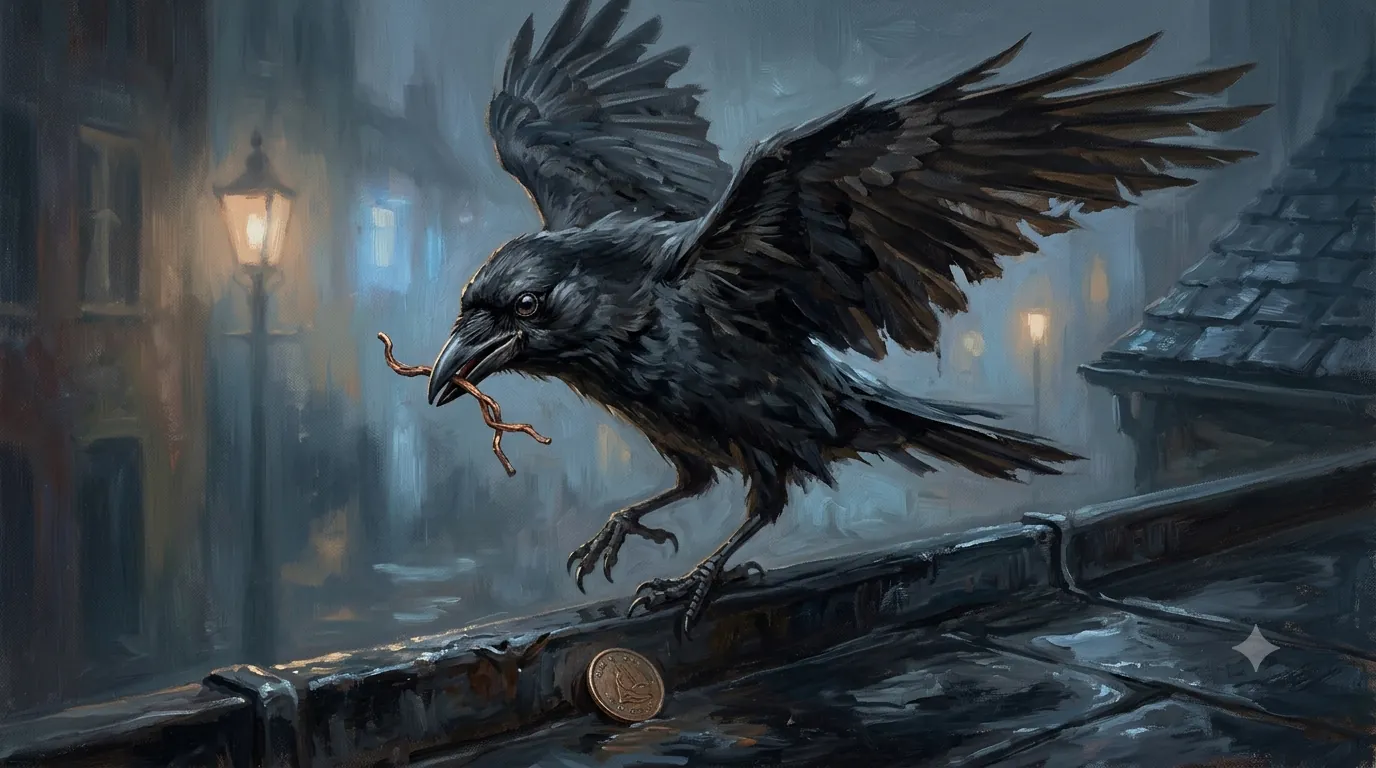
AC 11 · HP 4 (1d4 + 2) · Speed 10 ft., fly 50 ft.
Traits: Mob — advantage on attack rolls against a creature if at least one other Tithe-Crow is within 5 ft. of it and not incapacitated. Mimicry — can imitate simple sounds it has heard (a coin’s ring, a latch, a whistle); a creature discerns the fakery with a successful DC 10 Wisdom (Insight) check. Magpie Eye — has advantage on Wisdom (Perception) checks to notice shiny or metallic objects.
Actions: Beak. Melee Attack Roll: +4, reach 5 ft., one target. Hit: 1 Piercing damage. Larcenous Snatch. The crow makes a Dexterity (Sleight of Hand) check (+4) contested by a creature’s Dexterity (Sleight of Hand) or Wisdom (Perception) check to pluck one unsecured object of 1 lb. or less; on a success it takes the object and flies off with it.
GM note: Roof-rats with wings, is all — the Cold Lamp district is black with them at dusk. No seam roosts them, nothing summoned the flock; they mass on the tithe-boxes and gutter-lines because that’s where the crumbs and dropped coppers are. If one lifts a party member’s ring, that’s a chase scene and a good laugh, not an omen. Let the players relax into “it’s a bird.”
Alley Cur
Section titled “Alley Cur”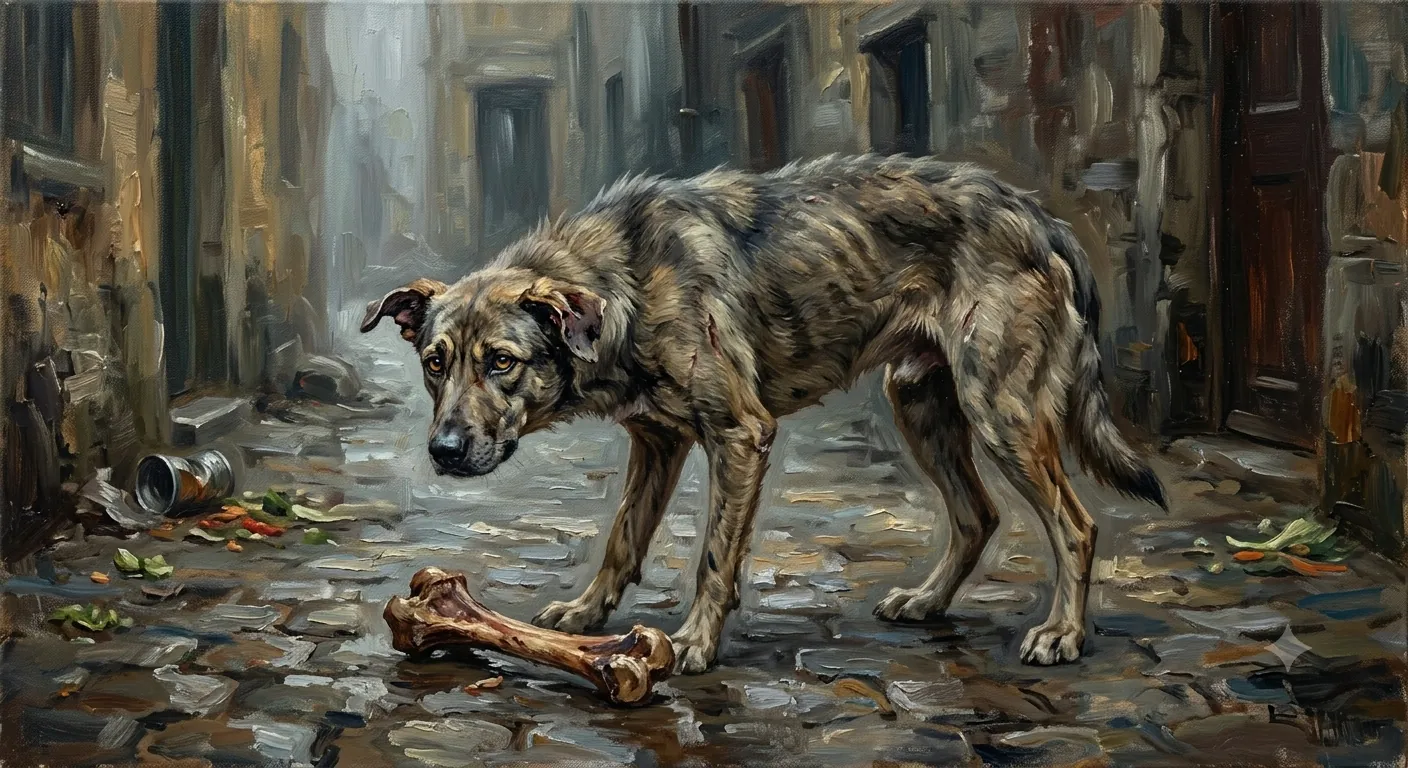
AC 12 (natural) · HP 9 (2d6 + 2) · Speed 40 ft.
Traits: Pack Tactics — advantage on attack rolls against a creature if an ally of the cur is within 5 ft. of it and not incapacitated. Keen Hearing and Smell — advantage on Wisdom (Perception) checks that rely on hearing or smell.
Actions: Bite. Melee Attack Roll: +3, reach 5 ft., one target. Hit: 4 (1d6 + 1) Piercing damage. If the target is bitten by two or more Alley Curs on the same turn, it makes a Strength Saving Throw: DC 11. Failure: It is knocked Prone.
GM note: The strays that own every back-lane and market-close in the low city — the Warrens are lousy with them. They bark first, they cringe from a thrown boot, and a strip of jerky buys their loyalty for the afternoon. There’s no cunning behind the pack beyond hunger and habit. Players braced for something wearing a dog’s shape can exhale; this one is exactly a dog.
Drayw-beast
Section titled “Drayw-beast”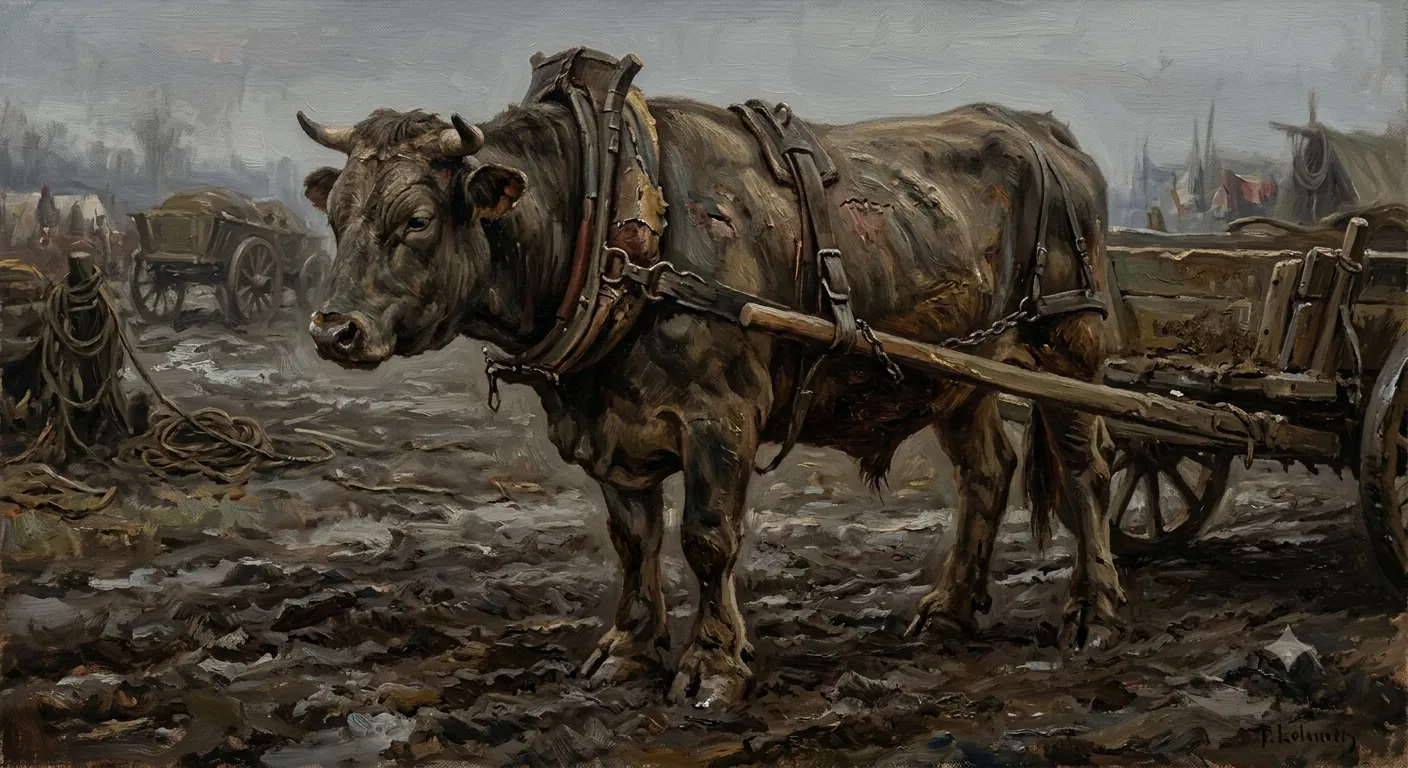
AC 11 (hide) · HP 22 (3d10 + 6) · Speed 40 ft.
Traits: Beast of Burden — counts as one size larger for the purpose of carrying capacity and pushing, dragging, or lifting. Sure-Footed — has advantage on saving throws against being knocked Prone.
Actions: Hooves. Melee Attack Roll: +5, reach 5 ft., one target. Hit: 8 (1d10 + 3) Bludgeoning damage, and if the target is a creature it makes a Strength Saving Throw: DC 13. Failure: It is knocked Prone.
GM note: Every caravan, mill, and haulage yard from the Warrens to the Waste-Land roads runs on these — patient, plodding, dumb as a post. It is not a mount with a secret; it is freight on legs. The only danger is standing behind one when a wagon-strap snaps and it kicks out of plain animal panic. No signature, no discipline check — just don’t crowd its hindquarters.
Brinegull Swarm
Section titled “Brinegull Swarm”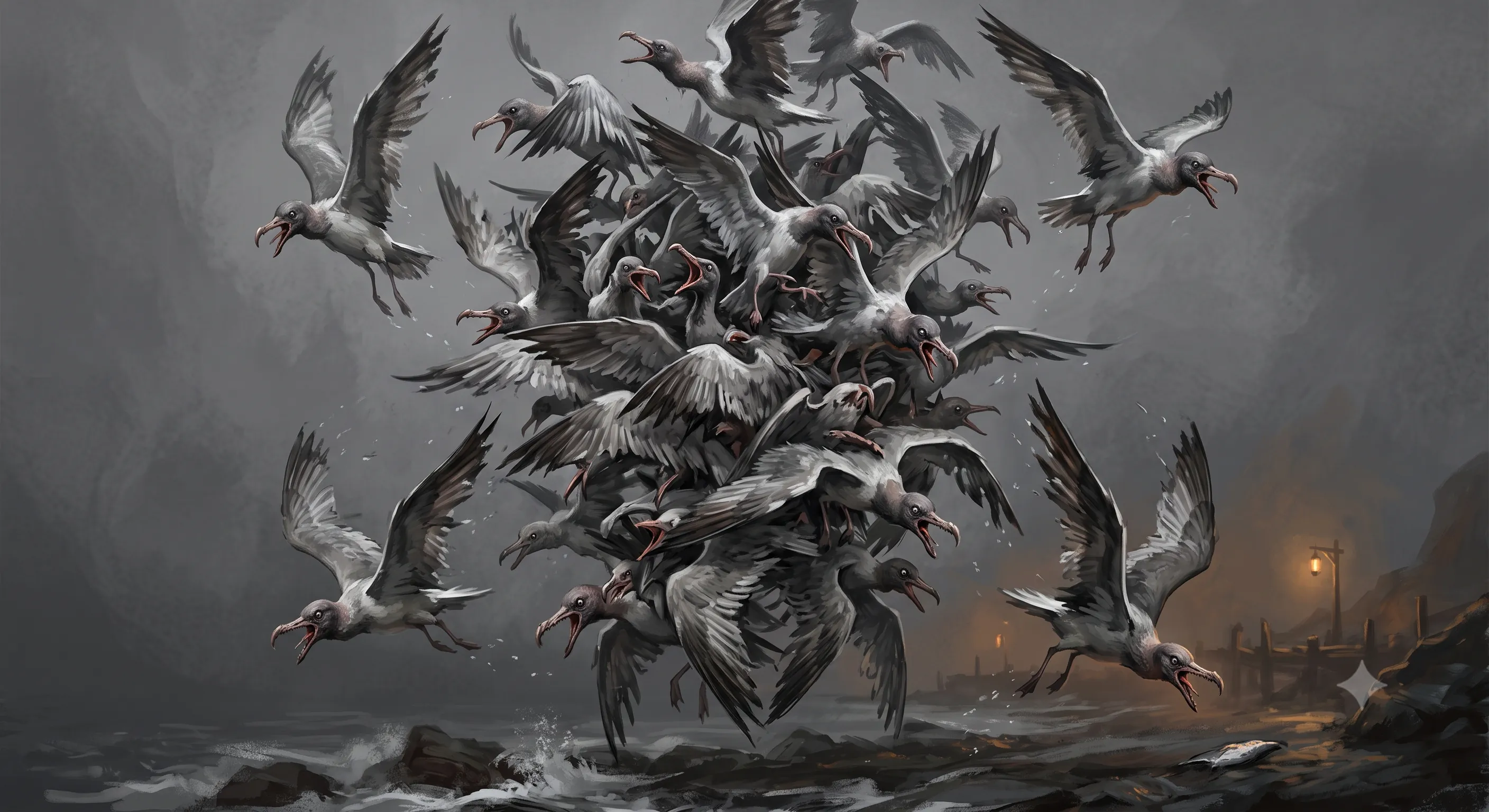
AC 12 · HP 22 (5d8) · Speed 10 ft., fly 40 ft.
Traits: Swarm — can occupy another creature’s space and vice versa, and can move through any opening large enough for a Tiny bird. The swarm can’t regain hit points or gain temporary hit points.
Actions: Beaks. Melee Attack Roll: +4, reach 5 ft., one target in the swarm’s space. Hit: 7 (2d6) Piercing damage, or 3 (1d6) Piercing damage if the swarm has half its hit points or fewer.
GM note: Scavenger gulls off the West Sea — they wheel over the quays and the fish-gutting sheds and mob anything that smells of a dropped catch. This is a picnic hazard, not a portent: a lit torch, a thrown net, or simply eating your lunch indoors ends the encounter. Sea-birds squabbling over herring is the most ordinary thing on the coast, and it’s meant to feel that way.
Saltmarsh Leech-Cluster
Section titled “Saltmarsh Leech-Cluster”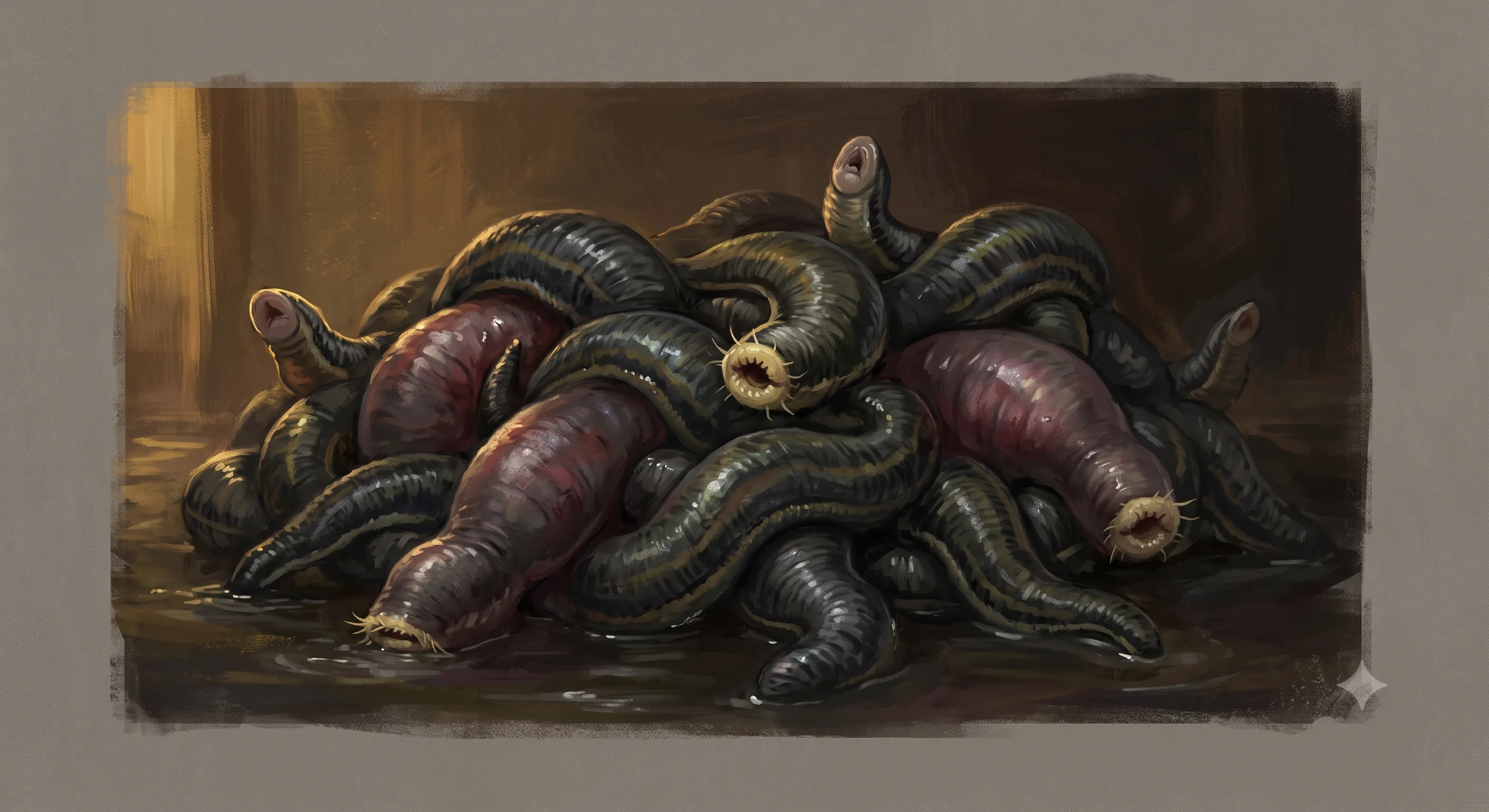
AC 10 · HP 16 (3d8 + 3) · Speed 5 ft., swim 20 ft.
Traits: Swarm — can occupy another creature’s space and vice versa, and can move through any opening large enough for a Tiny leech. The swarm can’t regain hit points or gain temporary hit points. Blood Scent — has advantage on attack rolls against any creature that is Bleeding or below half its hit point maximum.
Actions: Leeches. Melee Attack Roll: +2, reach 5 ft., one target in the swarm’s space. Hit: 5 (2d4) Piercing damage, or 2 (1d4) if the swarm has half its hit points or fewer, and the target’s hit point maximum is reduced by an amount equal to the damage taken. This reduction lasts until the target finishes a short or long rest and picks the leeches off, and the target dies if this reduces its hit point maximum to 0.
GM note: Bog-leeches of the marsh flats, thick in every stagnant channel past the coast road — they home in on warmth and a heartbeat, nothing subtler than that. The drain is grim but wholly mundane; salt, a flame, or a firm scrape removes them, and the lost vitality returns with a night’s rest. If the players start eyeing the wound for a seam, gently remind them that leeches have been doing exactly this since long before the Hollow.
Reed-Stalker
Section titled “Reed-Stalker”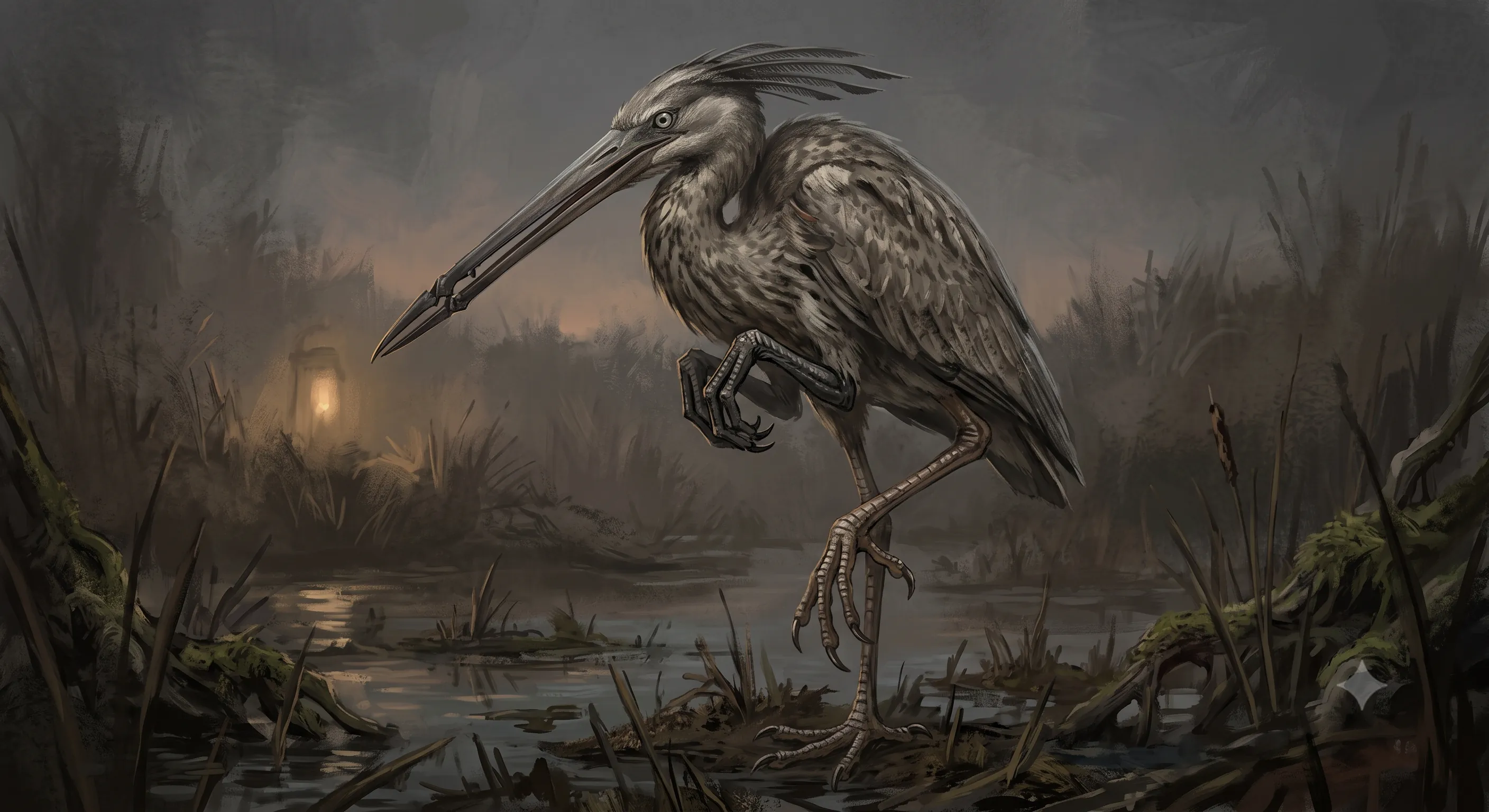
AC 13 (natural) · HP 22 (5d8) · Speed 30 ft., fly 40 ft.
Traits: Standing Stillness — while it remains motionless among reeds or shallow water, it has advantage on Dexterity (Stealth) checks and can take the Hide action even while lightly obscured. Ambusher — has advantage on attack rolls against any creature it has Surprised.
Actions: Spear-Beak. Melee Attack Roll: +5, reach 5 ft., one target. Hit: 8 (1d10 + 3) Piercing damage. If the target was Surprised, it takes an extra 5 (2d4) Piercing damage.
GM note: A long-legged wading bird that hunts the marsh shallows — it stands stock-still for an hour and then spears a frog, a fish, or an unwary ankle. The stab hurts because the beak is long and the strike is fast, not because anything is guiding it. It’s a heron, functionally; put one in the reeds specifically to reward the survival check and to remind the table that “something waiting motionless in the water” can just be dinner-hunting wildlife.
Plains Courser
Section titled “Plains Courser”
AC 12 (natural) · HP 34 (4d10 + 12) · Speed 60 ft.
Traits: Herd Skittishness — has advantage on saving throws against being Frightened, but if it fails a Wisdom save against fear it bolts at full speed for 1 minute rather than fighting, and other coursers within 60 ft. that can see it must save or bolt with it. Trampling Charge — if it moves at least 20 ft. straight toward a target and then hits it with Hooves on the same turn, the target makes a Strength Saving Throw: DC 13. Failure: It is knocked Prone, and the courser can make one Stomp against it as a Bonus Action.
Actions: Hooves. Melee Attack Roll: +5, reach 5 ft., one target. Hit: 10 (2d6 + 3) Bludgeoning damage. Stomp. Melee Attack Roll: +5, reach 5 ft., one Prone target. Hit: 9 (2d6 + 2) Bludgeoning damage.
GM note: The open grassland’s herd-runner — think wild horse or plains antelope, moving in a nervous hundred-head band. The real hazard isn’t malice, it’s mass: spook the herd and the danger is being underfoot when it stampedes. Nothing is herding them but each other. If the ground-thunder makes the players reach for a discipline check, that’s the wrong instinct here — it’s just a lot of frightened animals running the same way at once.
Crag-Nanny
Section titled “Crag-Nanny”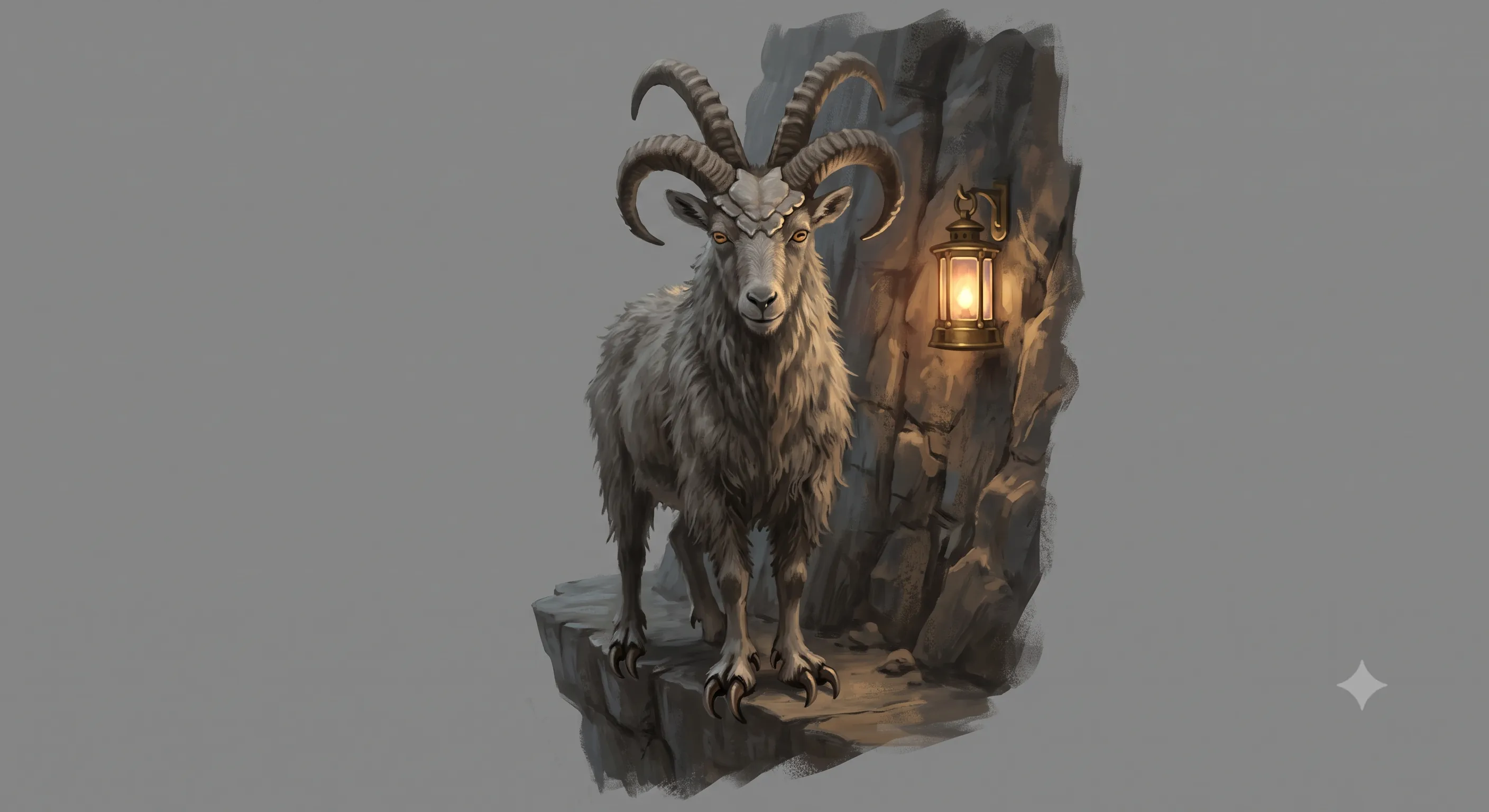
AC 11 (natural) · HP 11 (2d8 + 2) · Speed 40 ft., climb 30 ft.
Traits: Sure-Footed — bare rock, scree, and steep slopes never count as difficult terrain for it, and it has advantage on saving throws against being knocked Prone. Charge — if it moves at least 20 ft. straight toward a target and then hits it with Ram on the same turn, the target takes an extra 3 (1d6) Bludgeoning damage and makes a Strength Saving Throw: DC 10. Failure: It is knocked Prone.
Actions: Ram. Melee Attack Roll: +3, reach 5 ft., one target. Hit: 4 (1d6 + 1) Bludgeoning damage.
GM note: A shaggy mountain goat that treats a sheer cliff-face like a garden path. Herders on the high slopes milk them; wild ones just want the ledge you’re standing on and will butt you off it if you crowd the trail. That’s the whole threat — a stubborn animal and a long drop. No summoner keeps goats. If a player eyes the impossibly steep climb it just made and suspects the uncanny, reassure them: goats simply do that.
Thornhog
Section titled “Thornhog”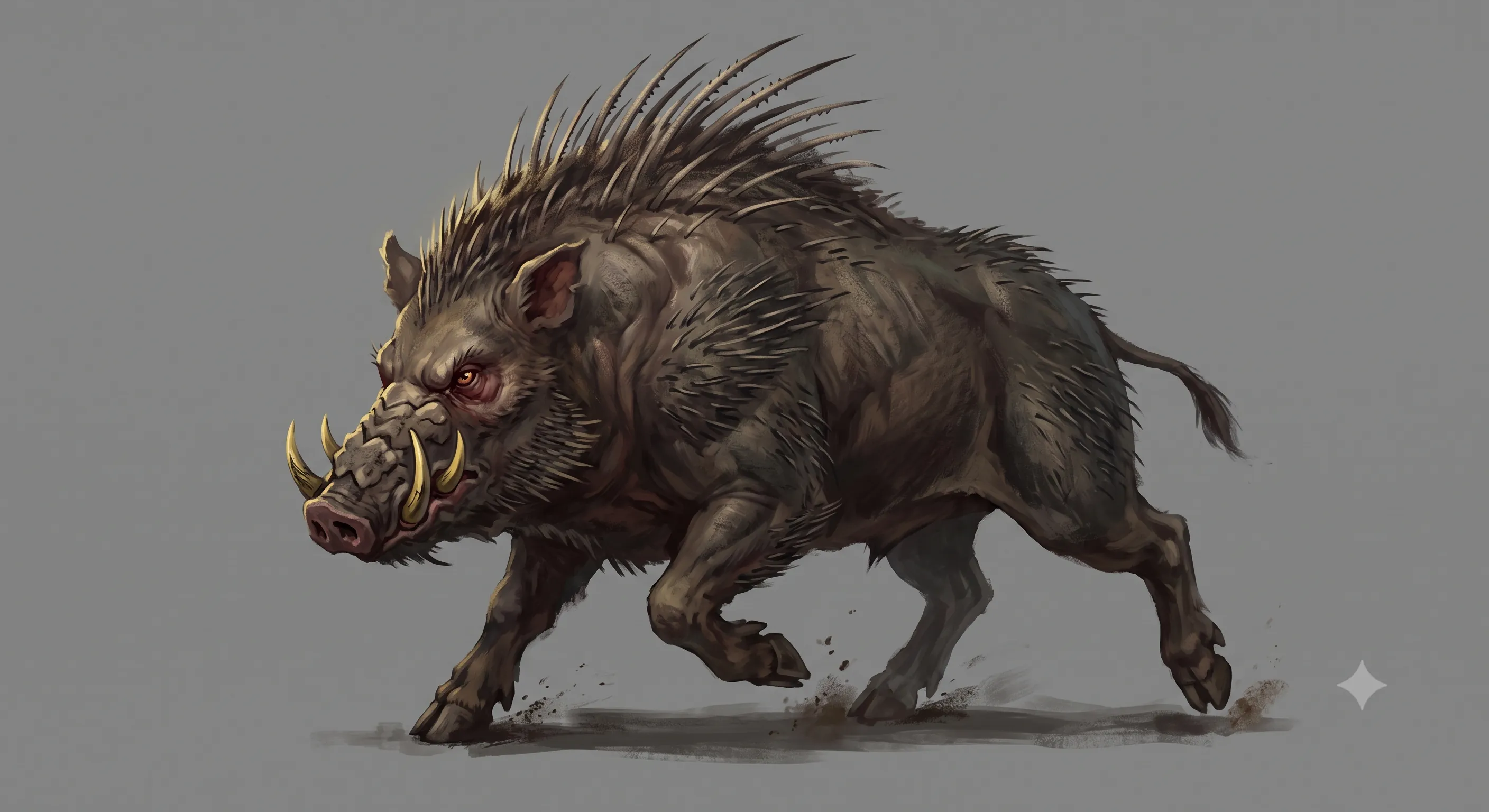
AC 13 (natural) · HP 30 (4d10 + 8) · Speed 40 ft.
Traits: Relentless (Recharges after a Short or Long Rest) — if it takes 10 damage or less that would reduce it to 0 hit points, it is reduced to 1 hit point instead. Charge — if it moves at least 20 ft. straight toward a target and then hits it with Tusk on the same turn, the target takes an extra 7 (2d6) Slashing damage and makes a Strength Saving Throw: DC 13. Failure: It is knocked Prone. Bristling Quills — a creature that hits the Thornhog with a melee attack while within 5 ft. of it takes 3 (1d6) Piercing damage from its raised quills.
Actions: Tusk. Melee Attack Roll: +5, reach 5 ft., one target. Hit: 10 (2d6 + 3) Slashing damage.
GM note: Woodland boar, quill-backed and foul-tempered — it roots through the forest floor and charges anything that startles it near the litter. Dangerous the way an ordinary wild pig is dangerous: it commits, it won’t quit while it can still stand, and it hurts to grab. But it bleeds, it tires, and a spear-line breaks the charge. This is a hunting-lodge trophy, not a Hollow-thing; the party should feel comfortable treating it as meat with an attitude.
Snow-Hare Warren
Section titled “Snow-Hare Warren”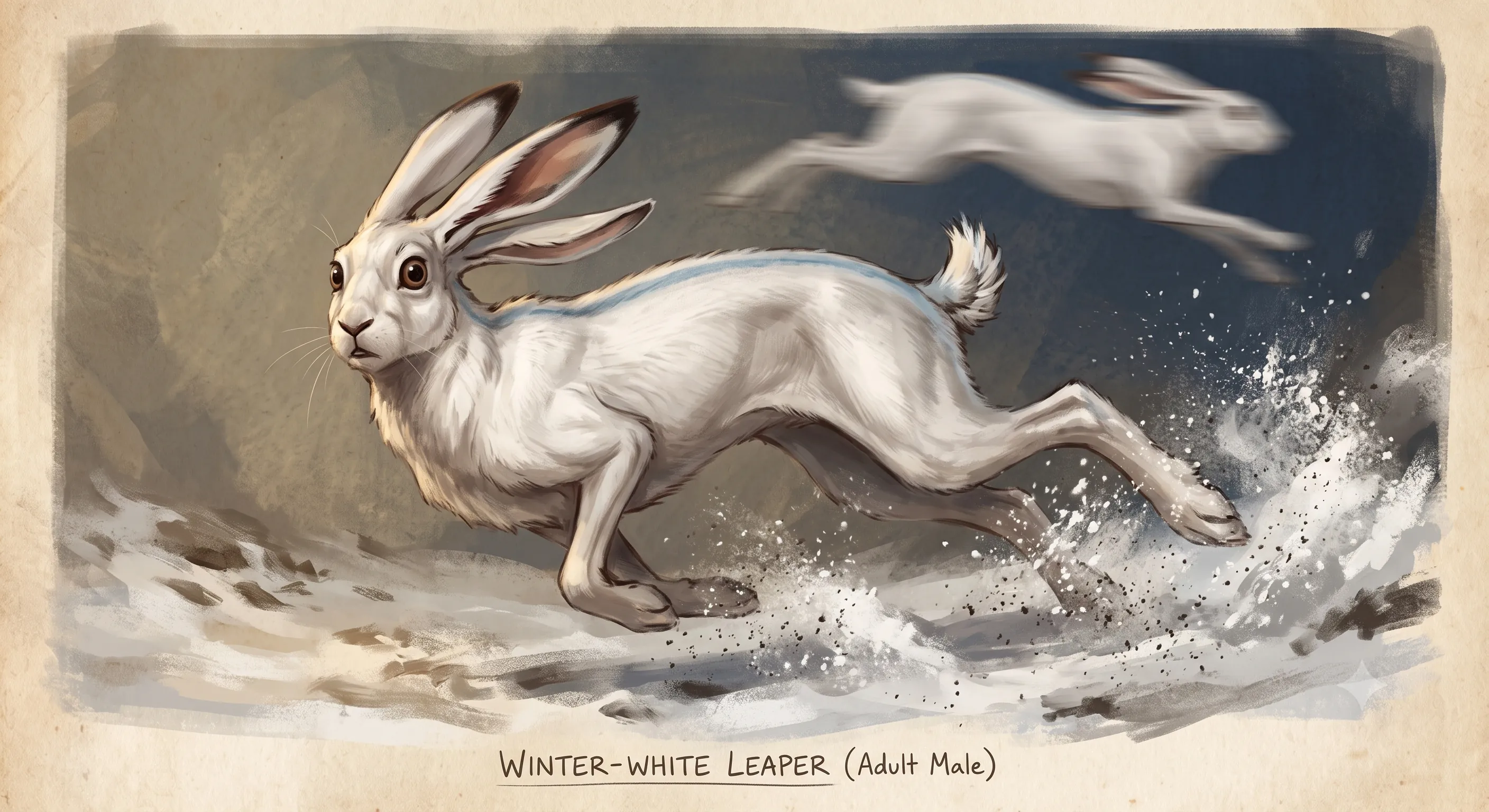
AC 11 · HP 3 (1d4 + 1) · Speed 50 ft., burrow 5 ft.
Traits: Snow Camouflage — has advantage on Dexterity (Stealth) checks made to hide in snowy or icy terrain. Flighty — can take the Dash or Disengage action as a Bonus Action on each of its turns. Numbers — a warren is dozens strong; killing individual hares makes no dent, and the burrow refills within days.
Actions: Nip. Melee Attack Roll: +5, reach 5 ft., one target. Hit: 1 Piercing damage.
GM note: White hares of the arctic barrens — the single most reassuring thing you can put in front of a spooked party. They are food, first and last: snare a few, and the cold camp gets a stew. The only “encounter” is catching the things, which are absurdly quick. If a burrow erupts with fleeing white shapes and someone rolls initiative, let them feel a little silly. Sometimes the movement in the snow is just supper bolting.
Gloomhopper
Section titled “Gloomhopper”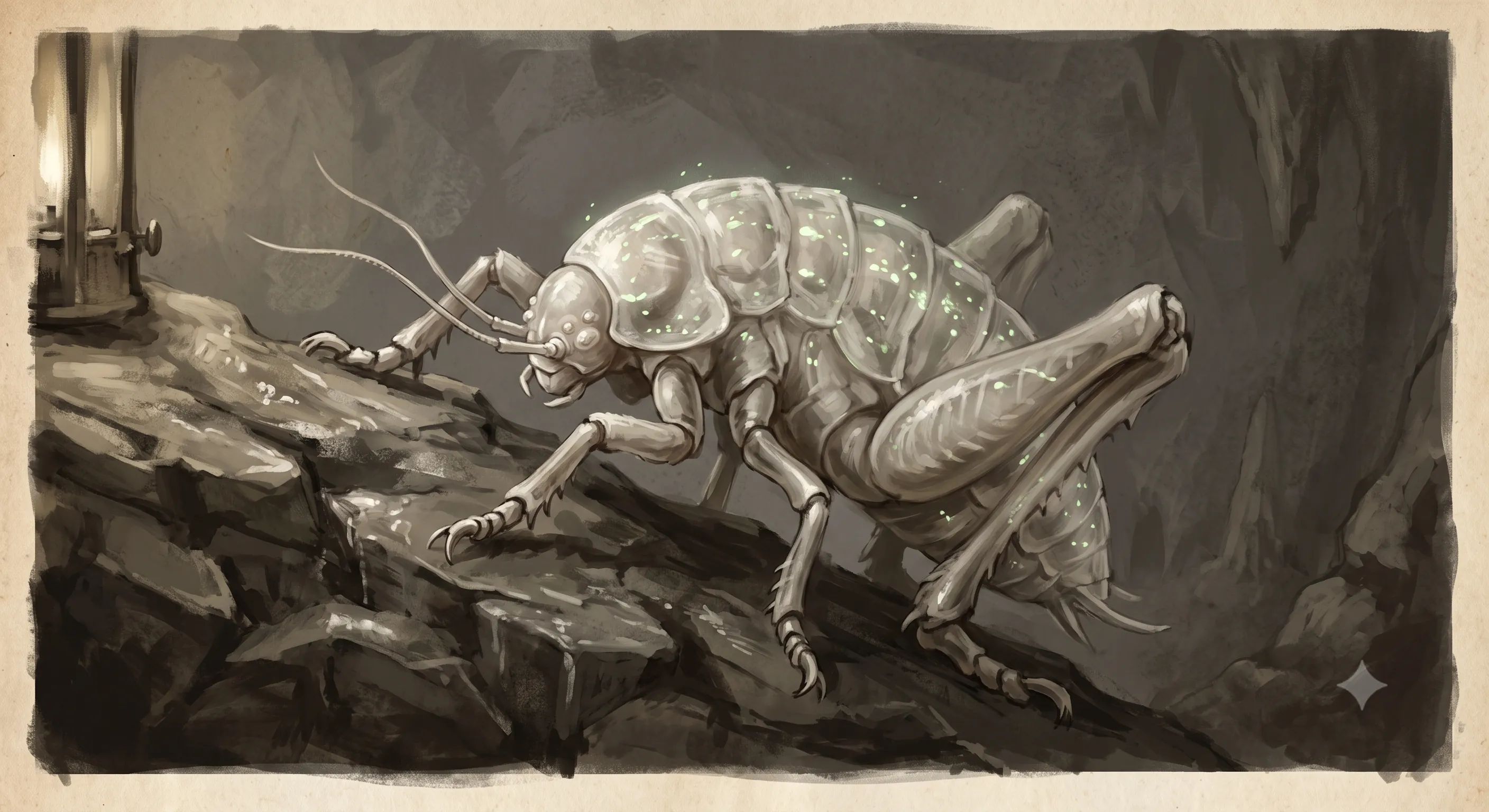
AC 12 · HP 10 (3d6) · Speed 20 ft., climb 20 ft.
Traits: Standing Leap — its long jump is up to 30 ft. and its high jump up to 15 ft., with or without a running start. Startle-Leap — when it takes damage and isn’t reduced to 0 hit points, it can immediately jump up to its leap distance without provoking Opportunity Attacks.
Actions: Bite. Melee Attack Roll: +4, reach 5 ft., one target. Hit: 4 (1d4 + 2) Piercing damage.
GM note: A pale cave-cricket the size of a cat, drumming its legs in the dark of the deep tunnels. It doesn’t hunt you — it wants moss and carrion — and its whole defense is that colossal panic-leap that sends it clattering off a wall and away. The startling part is the noise and the launch, not any menace. A perfect palate-cleanser for the underdark: something jumps out of the black, and it turns out to be a bug that’s more frightened than you are.
Pale Cave-Fisher
Section titled “Pale Cave-Fisher”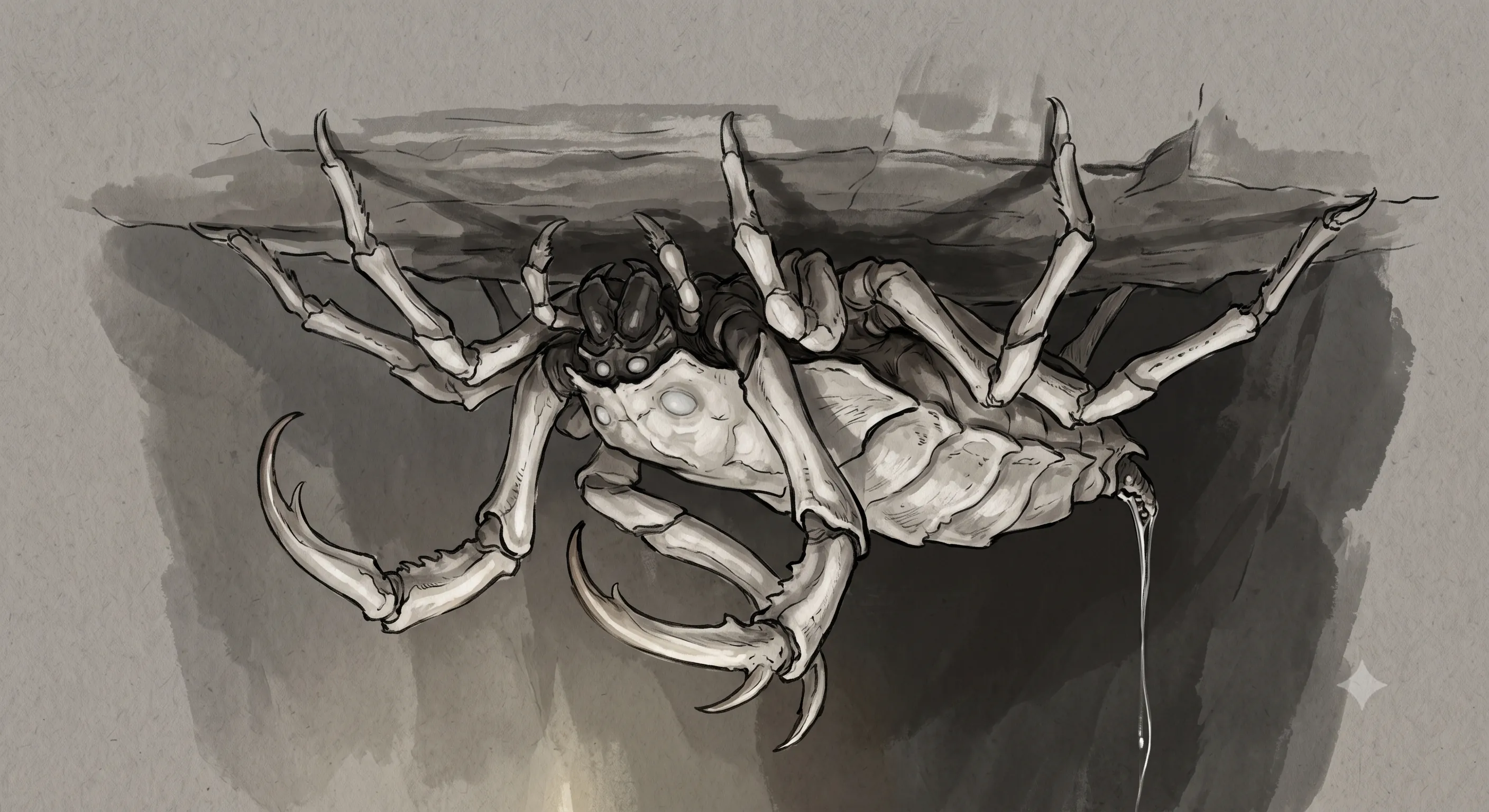
AC 14 (natural) · HP 45 (6d10 + 12) · Speed 30 ft., climb 30 ft.
Traits: Spider Climb — can climb difficult surfaces, including upside down along ceilings, without an ability check. Filament Sense — knows the exact location of any creature or object in contact with one of its lines.
Actions: Multiattack. The Cave-Fisher makes two Claw attacks. Claw. Melee Attack Roll: +5, reach 5 ft., one target. Hit: 8 (2d4 + 3) Slashing damage. Filament (Recharge 5–6). Dexterity Saving Throw: DC 13, one creature the Cave-Fisher can sense within 30 ft. Failure: The target is Restrained by a sticky line and pulled up to 15 ft. toward the Cave-Fisher. As a Bonus Action on its later turns, the Cave-Fisher can reel a Restrained creature 15 ft. toward itself. A Restrained creature can free itself with a successful DC 13 Strength (Athletics) check, or the line can be severed (AC 12, 5 HP, immune to Poison and Psychic damage).
GM note: The apex of the cave food-chain down here, and still just an animal — a big pallid predator that fires a gluey silk line to haul dinner up to its ledge and eat it. This is the one in the roster that can genuinely kill a low-level party, so treat it as a real fight, but a clean one: cut the line, gang the claws, and it dies and stays dead. No seam feeds it, no Binding is needed. It’s the deep dark’s honest monster — teeth and appetite, nothing voided.
Dune-Skitter
Section titled “Dune-Skitter”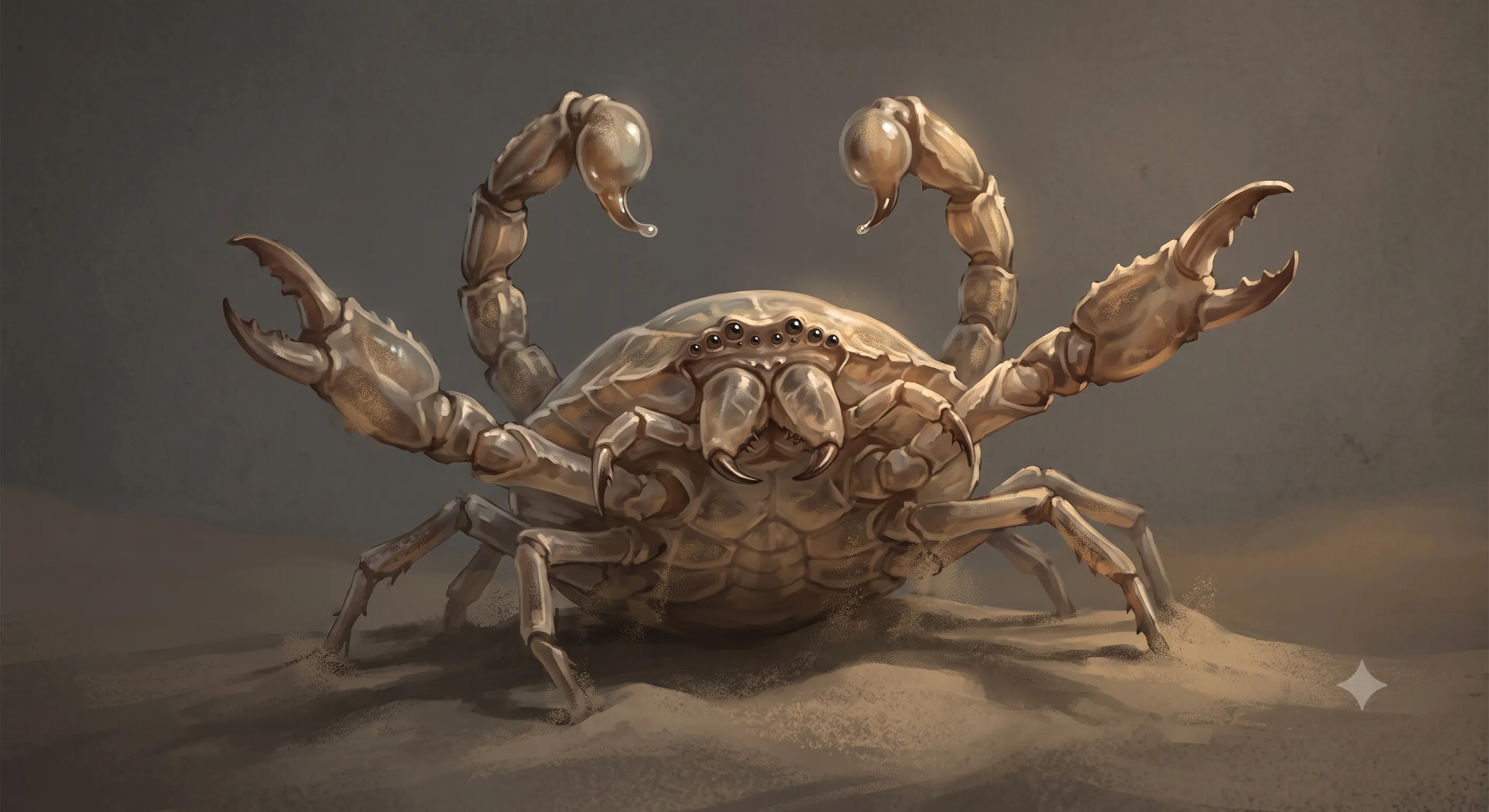
AC 13 (natural) · HP 22 (5d6 + 5) · Speed 30 ft., burrow 10 ft.
Traits: Sand Ambush — has advantage on attack rolls against any creature that hasn’t taken a turn in combat yet, and it can surface from a burrow and attack in the same turn without being noticed until it strikes.
Actions: Multiattack. The Dune-Skitter makes one Claw attack and one Sting attack. Claw. Melee Attack Roll: +3, reach 5 ft., one target. Hit: 4 (1d6 + 1) Bludgeoning damage. Sting. Melee Attack Roll: +4, reach 5 ft., one target. Hit: 4 (1d4 + 2) Piercing damage plus 5 (2d4) Poison damage, and the target makes a Constitution Saving Throw: DC 11. Failure: Poisoned for 1 minute (repeat save at the end of each of its turns). Success: The target takes half the Poison damage and isn’t Poisoned.
GM note: Pale desert scorpion, palm-sized to plate-sized, that rides just under the dune-skin and comes up under a boot in the Waste-Lands. The venom is real chemistry — mundane antivenom or Lesser Restoration clears it, and the Poisoned wears off on its own with a few good saves. Frightening because it’s hidden and it hurts, not because it’s uncanny. Good to spring right after a Hollow leg of the journey: the players will over-read the “something moving under the sand,” and it’s only ever a bug.
Aldasenian Undead — the Aldeken
Section titled “Aldasenian Undead — the Aldeken”Aldeken Drudge
Section titled “Aldeken Drudge”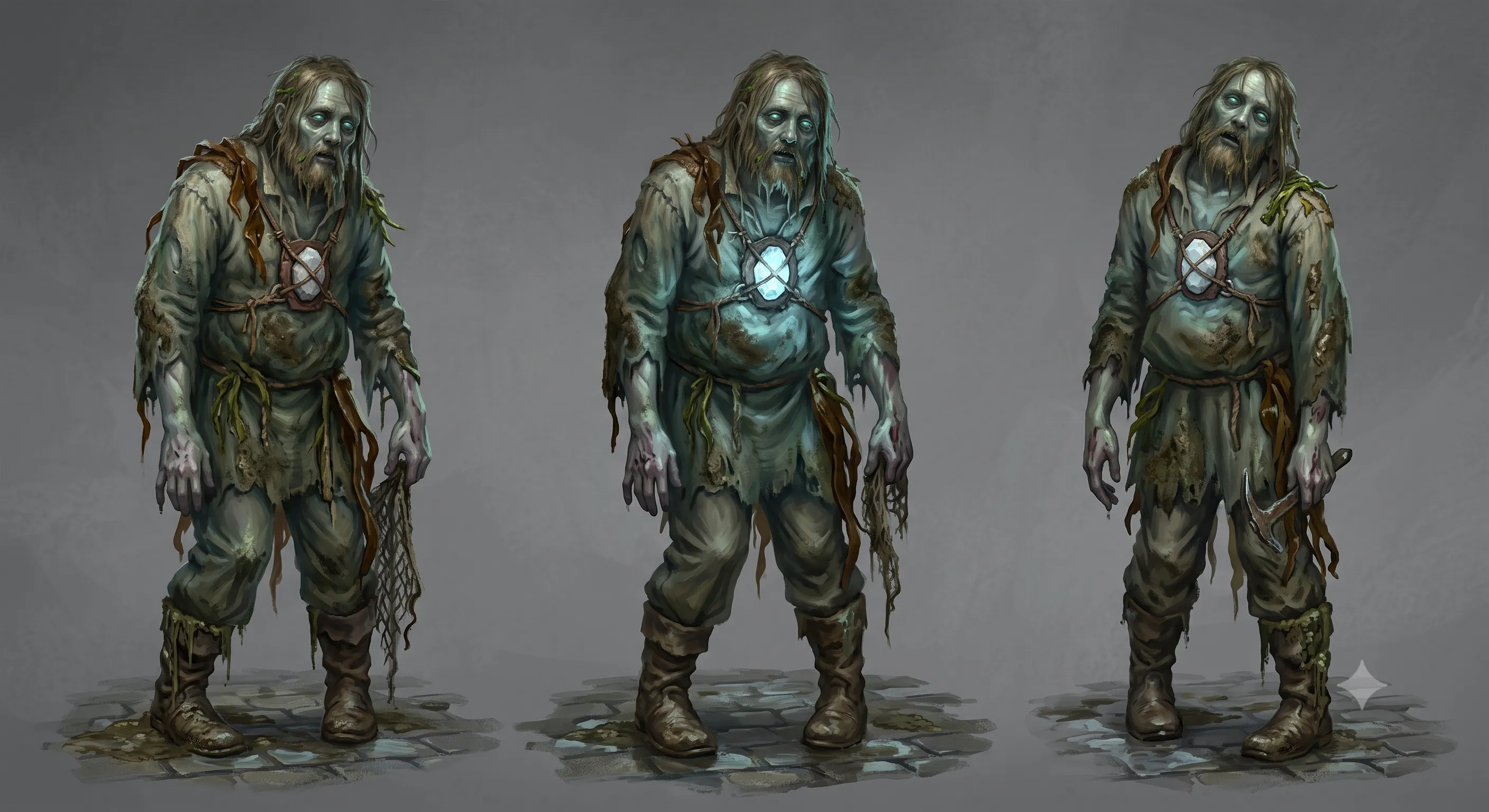
AC 11 (waterlogged hide) · HP 22 (4d8+4) · Speed 20 ft, swim 20 ft
Traits:
- Saltbound. Doesn’t need to breathe; unaffected by drowning, deep pressure, or extremes of cold.
- Drowned Reflex. No mind to speak of — reacts to warmth, breath, and heartbeat the way a compass reacts to north. Can’t be feinted or bluffed (immune to being frightened, no capacity to fear).
- Waterlogged Corpse. On death, the body doesn’t dissolve — it simply stops. Leaves a normal corpse, salt-crusted and heavy, that can be looted, burned, or given proper rites.
Actions:
- Multiattack. Two Waterlogged Claws.
- Waterlogged Claw. Melee Attack Roll: +3, reach 5 ft., one target. Hit: 1d6+1 Bludgeoning damage.
- Stolen Breath (Recharge 5–6). Melee Attack Roll: +3, one Grappled creature. Hit: 2d6 Necrotic damage, and the target can’t speak or cast spells with a verbal component until the end of its next turn, as the Drudge tears the air out of its lungs.
GM note: Not a hole wearing a face — a person, drowned in “the Last Tide” when Aldasen’s ward-stones failed and the sea took the lower city whole. The preservation wards meant to hold back water kept holding, on bodies that no longer needed holding. There’s no summoning signature to trace and no seam to Bind; a priest’s Turn Undead or a plain sword ends one for good. What’s left, once you burn or bury it properly, actually stays ended.
Tideclutch Swarm
Section titled “Tideclutch Swarm”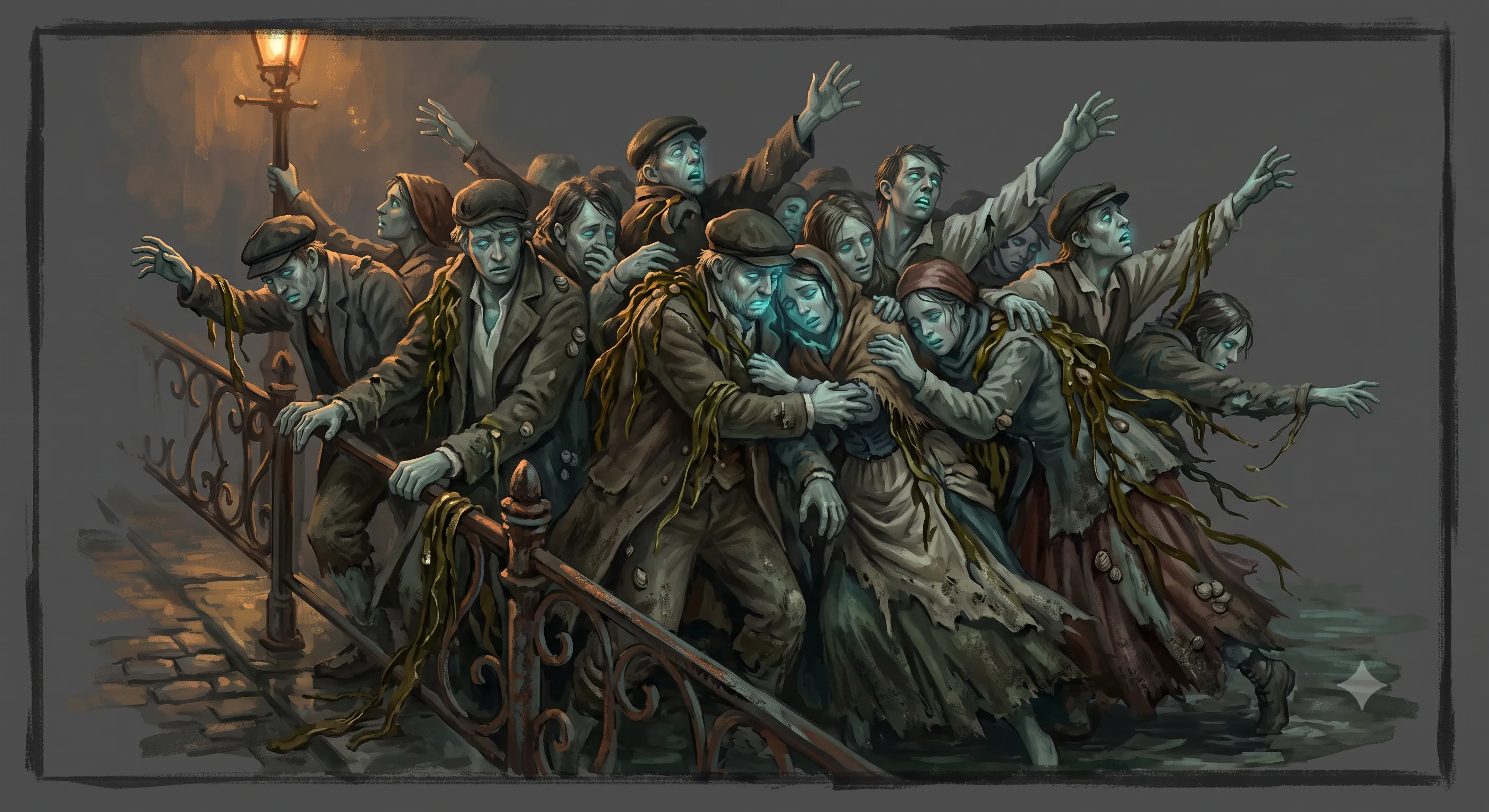
AC 13 (clinging shells and drowned armor) · HP 58 (13d8) · Speed 30 ft, swim 30 ft
Traits:
- Swarm. Can occupy another creature’s space and vice versa; the swarm can move through any opening large enough for a Tiny undead. It can’t regain hit points or gain temporary hit points.
- Many Hands. At the start of each of its turns, the swarm’s Drowning Clutch damage die changes based on its current hit points: d10 at full, d8 at half, d6 below a third, d4 below a tenth.
- No Single Death. Reducing the swarm to 0 hit points scatters it into dozens of separate corpses — no one killing blow, no closure ceremony needed, no seam anywhere to Bind. It simply stops moving.
Actions:
- Drowning Clutch. Melee Attack Roll: +5, reach 5 ft., one creature in the swarm’s space. Hit: damage (see Many Hands) Bludgeoning, and the target has the Grappled condition (escape DC 12) if the swarm isn’t already grappling two creatures.
GM note: This is what a market crowd looks like when the Last Tide catches it mid-step — dozens of drowned hands still reaching for each other, for the railing, for the surface, moving as one mass because none of them ever stopped trying to climb. Any radiant burst or turning effect that would rout a single Aldeken instead scatters the whole clutch — flee-or-freeze responses ripple through it like a shoal of fish.
Bloated Drowned
Section titled “Bloated Drowned”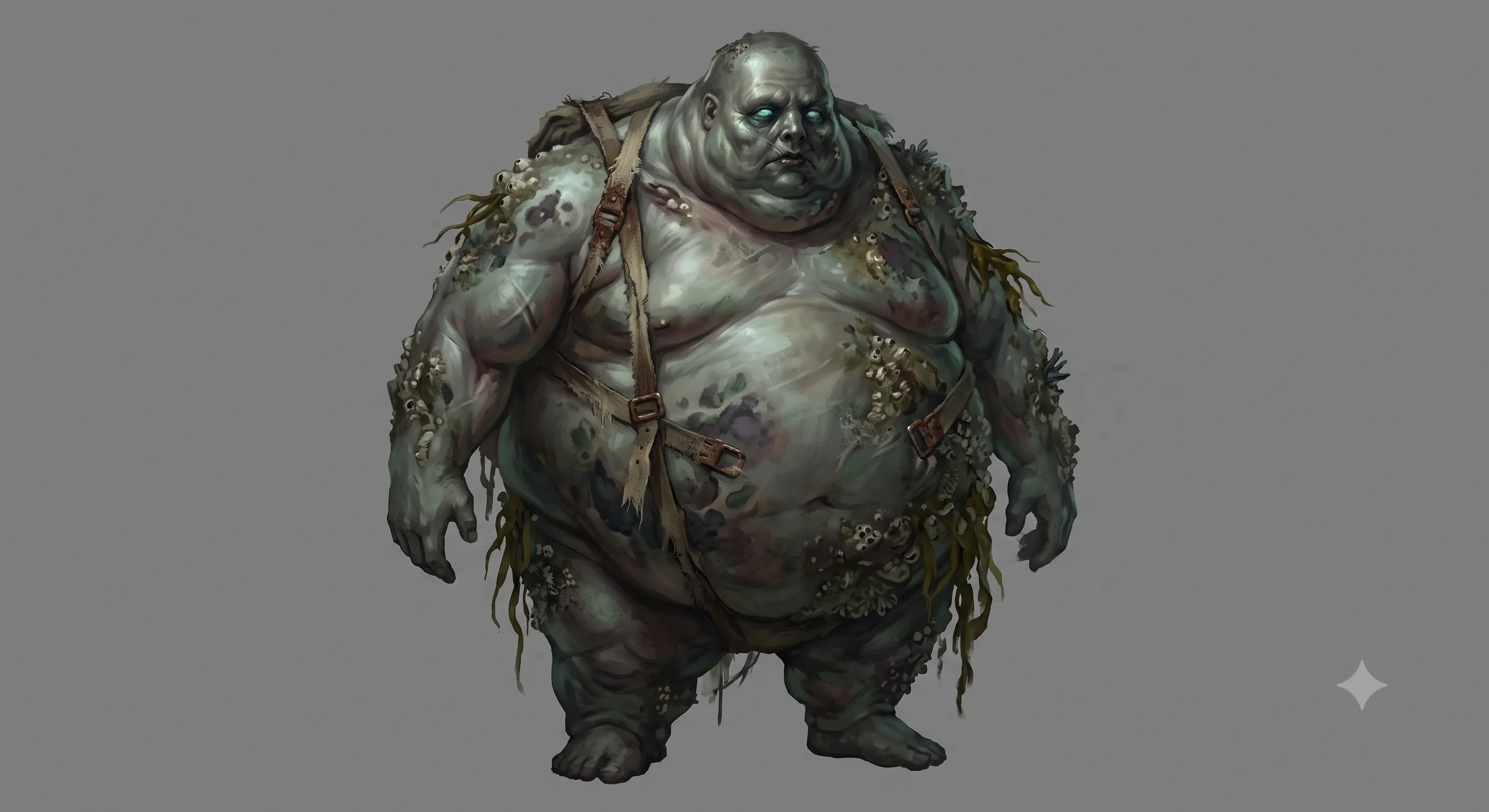
AC 10 (bloated hide) · HP 68 (8d10+24) · Speed 20 ft, swim 30 ft
Traits:
- Waterlogged. Has advantage on Strength (Athletics) checks made to grapple, and on checks made to swim.
- Bloated Rupture. When the Bloated Drowned drops to 0 hit points, it bursts. Constitution Saving Throw: DC 14, each creature within 10 feet. Failure: 4d8 Necrotic damage (rank foul harbor-water and years of trapped decay). Success: Half damage.
Actions:
- Slam. Melee Attack Roll: +6, reach 10 ft., one target. Hit: 2d8+4 Bludgeoning damage.
- Drag Under. Melee Attack Roll: +6, one creature. Hit: 2d6+4 Bludgeoning damage, and the target has the Grappled condition (escape DC 15) and is pulled 10 feet toward the nearest deep water. A creature Grappled this way and submerged must hold its breath or begin suffocating as normal.
GM note: These are the ones that sank with cargo still lashed to them, or got wedged in a doorway as the water rose and never floated free. Years underwater swelled them past recognizing. Sailors who fish one out by accident learn fast why you don’t cut a Bloated Drowned open on the deck of your own boat.
Aldeken Deep Warden
Section titled “Aldeken Deep Warden”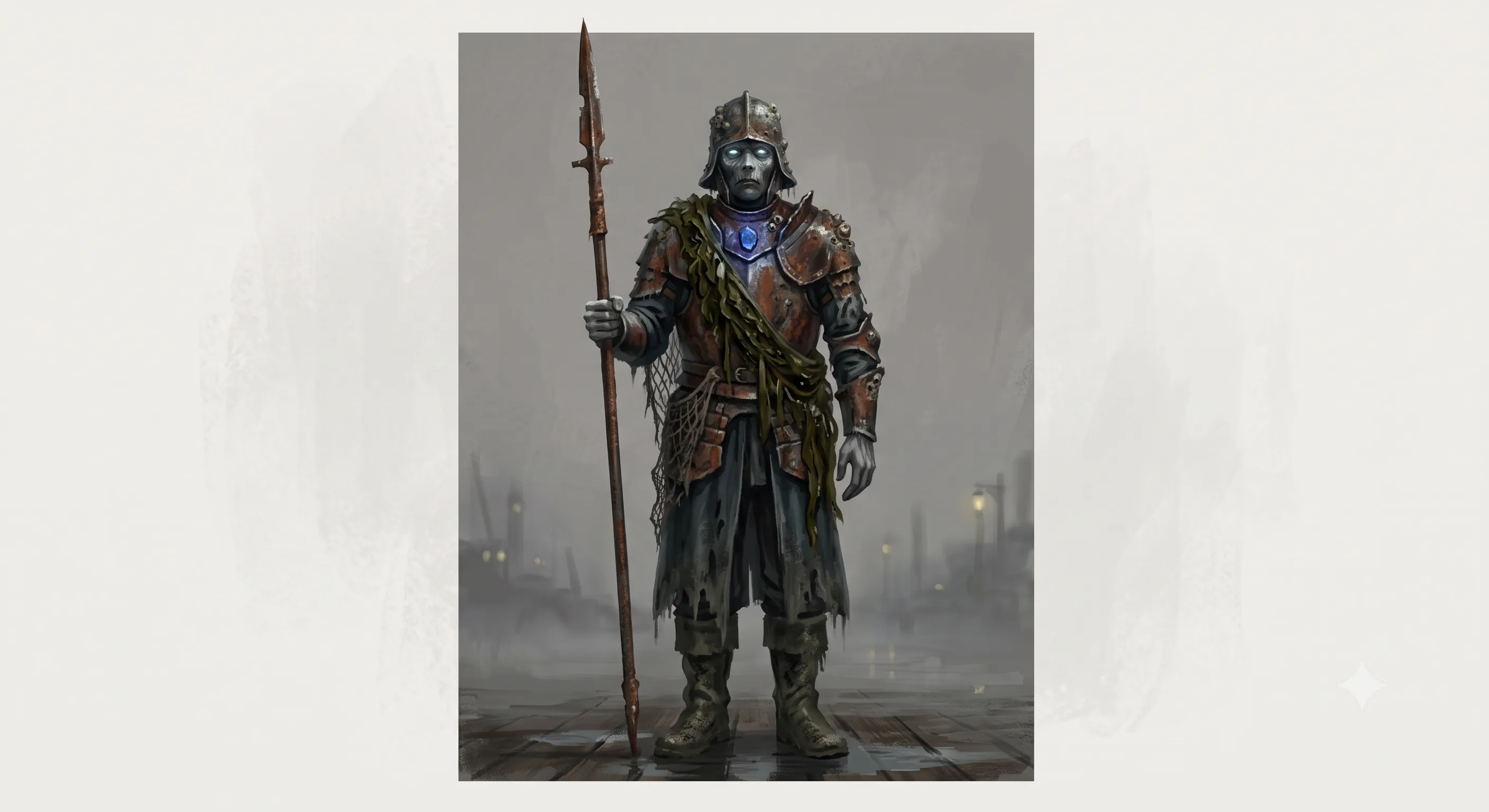
AC 16 (corroded oath-plate) · HP 90 (12d8+36) · Speed 30 ft, swim 30 ft
Traits:
- Unbreakable Post. Has advantage on saving throws against any effect that would move, teleport, or banish it while within its patrol route — a fixed circuit through the drowned city it has walked since before it died. Outside that route it gets no such advantage and moves noticeably slower, as if uncertain.
- Oath-Metal Resonance. The Warden’s glaive still carries a trace of a founding-era ward-oath. It counts as magical for the purpose of overcoming resistance and immunity, and deals an extra 1d6 radiant damage to any creature of the Hollow-Seepage or Hollow-Summoned origin — the last order it ever received was to hold that line, and some sliver of it still does.
- Standing Orders. Cannot be persuaded, frightened, or reasoned off its post by anything short of a command in a voice of clear civic authority (a GM call — a magistrate’s seal, a herald’s horn) or its own death.
Actions:
- Multiattack. Two attacks with its glaive.
- Corroded Glaive. Melee Attack Roll: +6, reach 10 ft., one target. Hit: 2d10+3 Slashing damage (or 2d6+3 Radiant instead, against Hollow origins).
GM note: The tragedy of the Warden isn’t that it’s dangerous — it’s that it’s doing its job. It was posted at the harbor gate the night the wards failed, given no order to stand down, and has patrolled the same drowned fifty yards ever since. It will not chase a fleeing party past the boundary of its route. It will, however, kill anything that crosses that boundary going the other way, forever, until someone with the standing to relieve it says the words.
Lucid Aldeken: The Archivist
Section titled “Lucid Aldeken: The Archivist”
AC 12 (waterlogged robes) · HP 45 (7d8+14) · Speed 25 ft, swim 30 ft
Traits:
- Flicker of the Living. The Archivist retains her mind, mostly. At the start of combat and whenever she takes damage, she makes a Wisdom Saving Throw: DC 12; on a failure, the Drowned Hunger surfaces and she fights as a feral Aldeken Drudge (use the Drudge’s actions instead of hers) for 1 minute, or until she succeeds on a save at the end of a later turn.
- Preserved Ledger. Carries salt-warped record-books — fragmentary but real accounts of Aldasen before the Last Tide: names, laws, the location of the failed ward-stones. If she’s destroyed outright rather than subdued, the ledgers are ruined with her (soaked to pulp in the death-throe) — the knowledge drowns a second time. Spellcasting. The Archivist is a 5th-level spellcaster (spell save DC 13, +5 to hit). She knows: comprehend languages, silence, hold person, protection from good and evil (as protection from the living), warding bond.
Actions:
- Waterlogged Claw (when lucid, reluctantly). Melee Attack Roll: +2, reach 5 ft., one target. Hit: 1d6−1 Bludgeoning damage.
- Cast a spell (see above).
GM note: She doesn’t want to fight. She wants someone — anyone — to write down what she’s holding before the Hunger takes her again. Her eyes don’t go Hollow-black; they carry a faint drowned phosphorescence, the last trace of a ward-caster’s Order channel. She is proof that Aldeken undeath isn’t erasure — the person is still in there, losing a fight nobody’s helping her win. Players who talk instead of swing may walk out with the only surviving census of a sunken city. Players who kill her fast walk out with nothing but a corpse and a ruined book.
Lucid Aldeken: The Drowned Magistrate
Section titled “Lucid Aldeken: The Drowned Magistrate”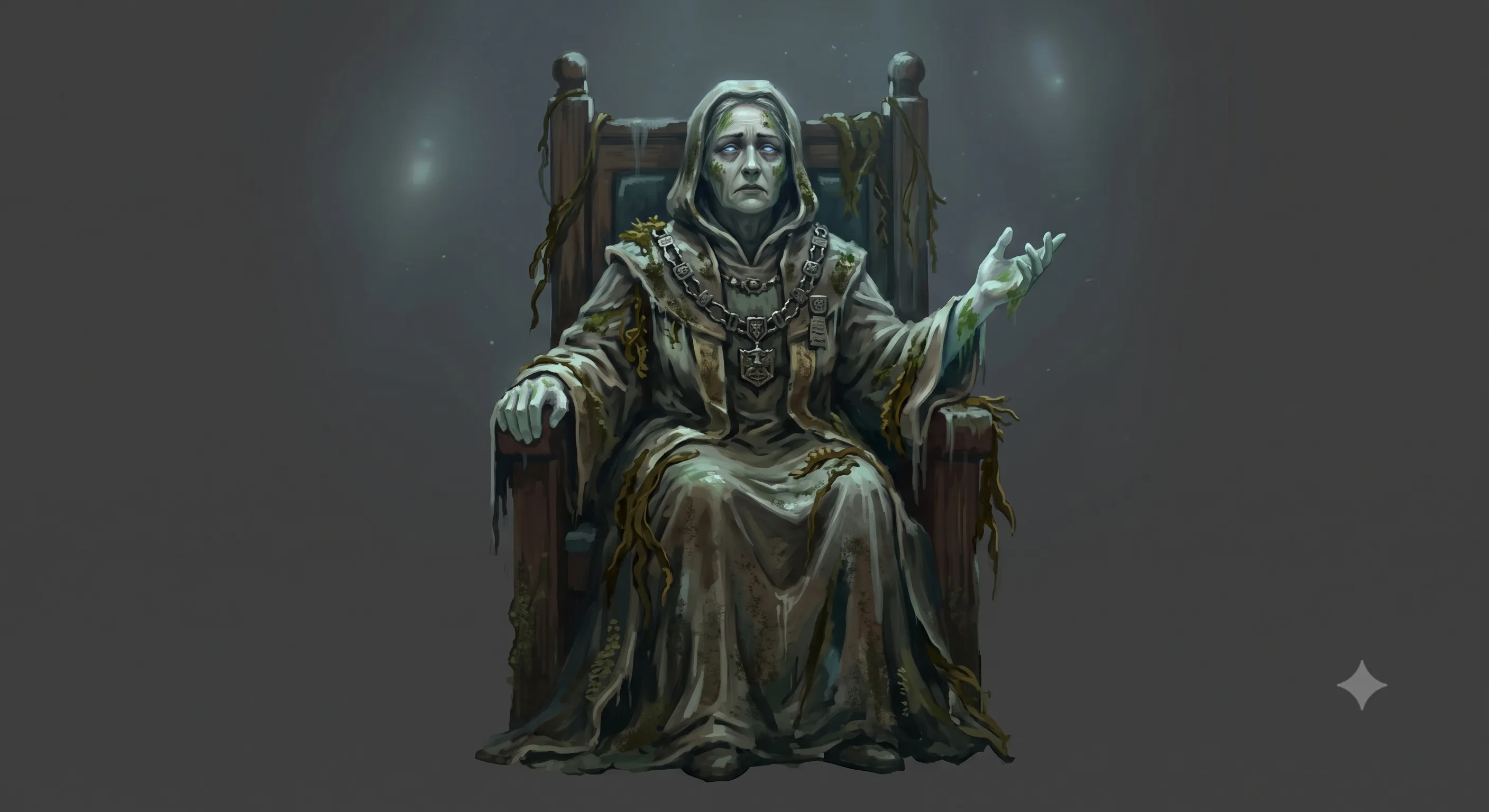
AC 17 (ceremonial oath-plate, salt-fused to her skin) · HP 135 (18d8+54) · Speed 30 ft, swim 40 ft
Traits:
- The Court Still Sits. The Magistrate genuinely believes Aldasen stands and she still presides over it. She is unfailingly, chillingly courteous to anyone who plays along — and treats any perceived contempt of court as an offense demanding sentence.
- Command the Docket. As a bonus action, she can direct up to three Aldeken (Drudge, Swarm, or Warden) within 60 feet, granting each an immediate reaction attack or move.
- Unbroken Verdict. She never loses herself to the Drowned Hunger the way lesser Lucid Aldeken do — three centuries of civic discipline hold the feral undertow at bay. This makes her rarer, more dangerous, and more genuinely tragic than the Archivist: there is no flicker to exploit, only a mind fully drowned in its own authority. Spellcasting. 9th-level spellcaster (spell save DC 16, +8 to hit). Prepared: zone of truth, hold monster, wall of water, banishment (flavored as “Exile from My Court”), sending (only to other Aldeken within the ruins).
Actions:
- Multiattack. Two attacks with her Gavel of Sunken Law (a corroded ceremonial mace).
- Gavel of Sunken Law. Melee Attack Roll: +7, reach 5 ft., one target. Hit: 2d8+2 Bludgeoning damage plus 1d8 Psychic damage as the weight of an old verdict lands.
- Pass Sentence (Recharge 5–6). Wisdom Saving Throw: DC 16, one creature she can see within 60 feet. Failure: Magically Restrained by chains of dead law for 1 minute (as hold person, no concentration required on her part), repeating the save at the end of each of its turns.
Legendary Actions (3/turn, recharges at the start of her turn):
- Point of Order. One Aldeken she commands within 60 feet moves up to its speed.
- Cite the Precedent (costs 2 actions). Charisma Saving Throw: DC 16, one creature within 30 feet. Failure: Frightened of her until the end of its next turn.
- Strike the Gavel (costs 2 actions). Make one Gavel of Sunken Law attack.
GM note: She was the last lawspeaker of Aldasen, and by every account a good one — the kind who ruled against her own family when the law demanded it. When the Last Tide came she stayed at the bench instead of running, because a magistrate does not abandon a sitting court. She has been sitting it ever since. Destroying her is not closing anything — there’s no seam, no summoning signature, no Order/Chaos ledger to balance — it is simply killing a woman a second time, three hundred years too late to matter and one moment too soon for her to ever finish the case she’s still hearing. Parties who bring her a genuine grievance to rule on, played straight, may get more out of her than parties who bring swords.
Sea-Horrors of the Maw
Section titled “Sea-Horrors of the Maw”MERRETIA BESTIARY — SEA-HORRORS
Section titled “MERRETIA BESTIARY — SEA-HORRORS”Ancient predators of the Maw and the West Sea (mostly NOT Hollow)
Section titled “Ancient predators of the Maw and the West Sea (mostly NOT Hollow)”Kravis
Section titled “Kravis”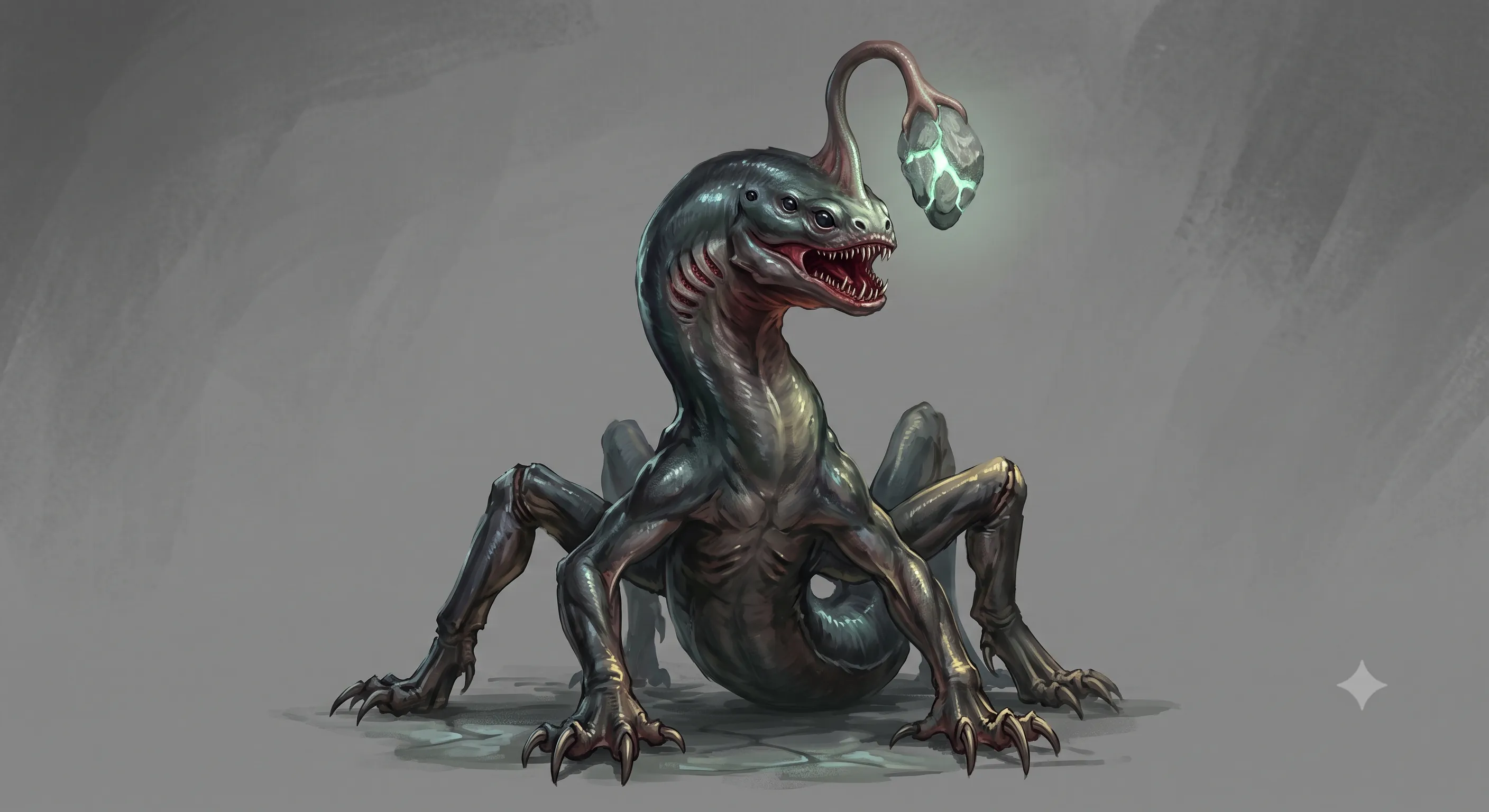
AC 13 (natural hide) · HP 45 (6d8 + 18) · Speed 10 ft., swim 40 ft.
Traits:
- False-Stone Lure. A patch of luminous skin along the Kravis’s mantle glows a soft, steady color disturbingly close to a focus stone’s channel-light. A creature that can see the lure and has never encountered a Kravis before must succeed on a DC 12 Wisdom (Insight) check or treat it as a genuine practitioner’s light at range, closing distance rather than fleeing.
- Amphibious. The Kravis can breathe air and water.
- Ambusher. The Kravis has Advantage on attack rolls against any creature it has Surprised.
Actions:
- Multiattack. The Kravis makes two Tentacle attacks.
- Tentacle. Melee Attack Roll: +5, reach 10 ft. Hit: 9 (2d6 + 2) Bludgeoning damage, and the target has the Grappled condition (escape DC 13) if it’s Large or smaller.
- Beak (Grappled Target Only). Melee Attack Roll: +5, reach 5 ft. Hit: 12 (2d8 + 3) Piercing damage.
GM note: A single Kravis is a fair fight for a hardened party — the danger is that they never travel alone for long. Ordinary flesh and blood, exposed to shallower water by Aldasen’s sinking rather than born of it. The false-stone lure is a standing joke among Sulamiri divers and a real hazard for green practitioners who trust their eyes over their training. No Hollow tells, no voided eyes, nothing to Bind — just teeth.
Glass-Tooth Shoal
Section titled “Glass-Tooth Shoal”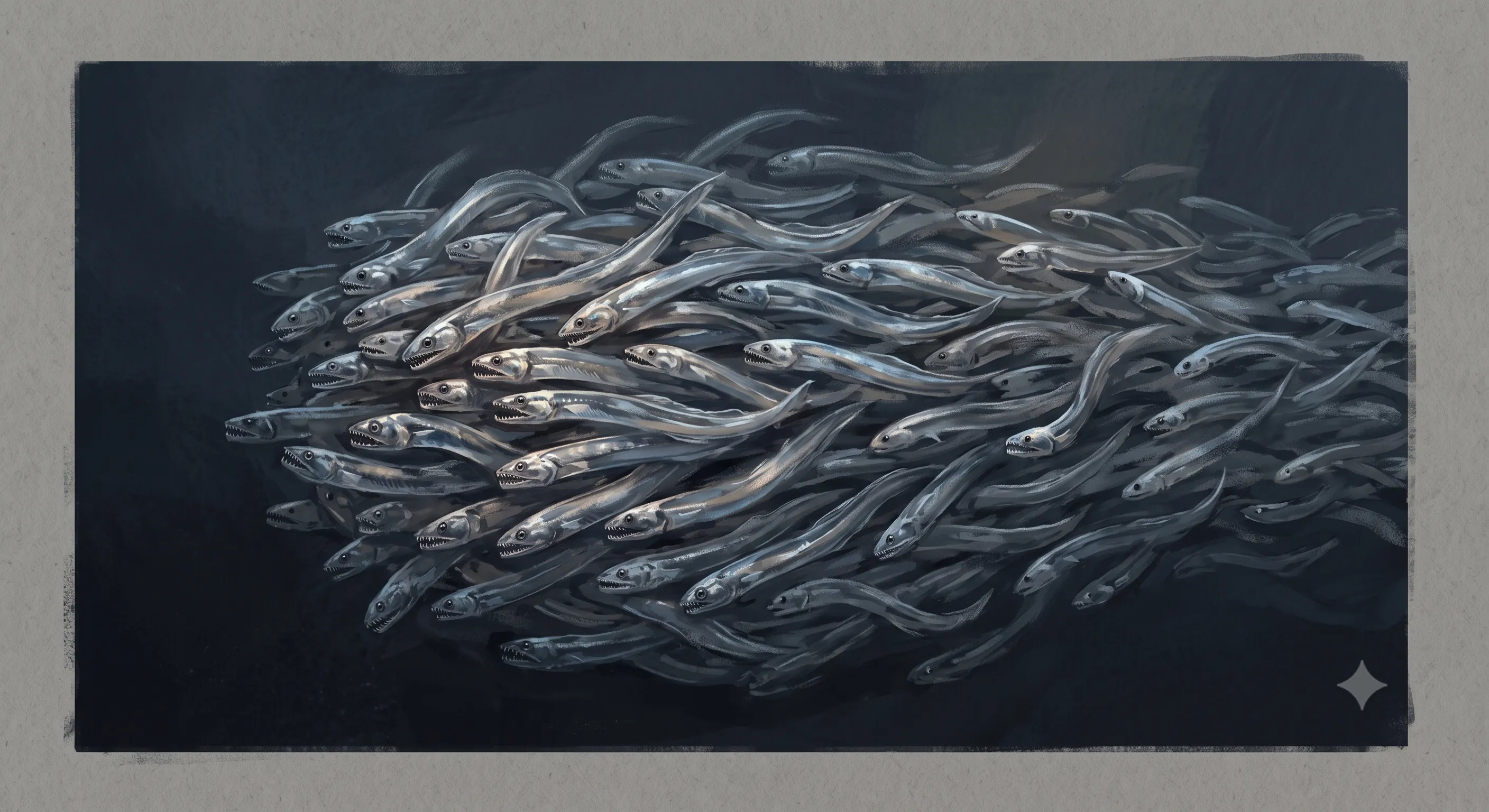
AC 14 (slick scales) · HP 90 (12d10 + 24) · Speed 10 ft., swim 50 ft.
Traits:
- Swarm. The shoal can occupy another creature’s space and vice versa, and it can move through any opening large enough for a Tiny fish. It can’t regain Hit Points or gain Temporary Hit Points.
- Blood Frenzy. The shoal has Advantage on attack rolls against any creature that doesn’t have all its Hit Points.
- Half-Strength. When the shoal has half its Hit Points or fewer, its Bite damage is halved.
Actions:
- Bites. Melee Attack Roll: +6, reach 5 ft., one creature in the swarm’s space. Hit: 21 (6d6) Piercing damage, or 10 (3d6) Piercing damage if the shoal has half its Hit Points or fewer.
GM note: Not one creature but thousands, riding a current out of the deep places the Maw opened up. No summoning signature, no mind to read with the Knowing, no malice — just an old migratory pattern running through waters that used to be too deep and cold for it to reach. Fire, lightning, and anything that hits an area work better than a champion’s single-target blade.
The Drowned Lantern
Section titled “The Drowned Lantern”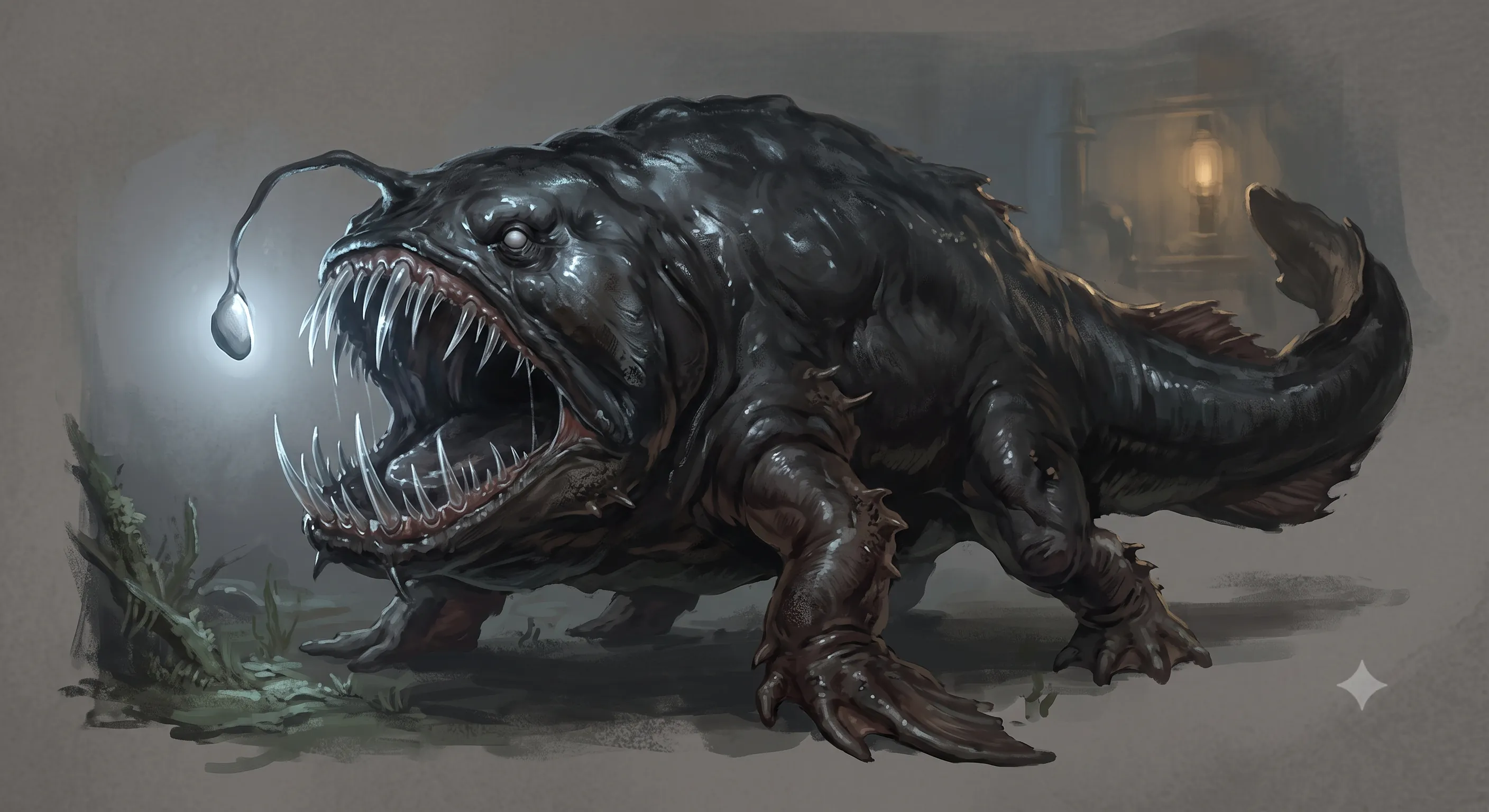
AC 15 (craggy hide) · HP 115 (11d10 + 55) · Speed 5 ft., swim 40 ft.
Traits:
- Deep Camouflage. While motionless against stone or wreckage, the Lantern is indistinguishable from its surroundings; a creature must succeed on a DC 17 Wisdom (Perception) check to notice it before it attacks.
- Focus-Stone Barb. A bioluminescent filament above its jaw glows in a steady practitioner’s channel-color. Any creature within 60 feet that can see the barb and hasn’t seen through the Lantern’s camouflage must succeed on a DC 15 Wisdom saving throw or feel drawn to investigate it as its next action, moving toward the light by the shortest safe path.
- Amphibious.
Actions:
- Bite. Melee Attack Roll: +7, reach 10 ft. Hit: 18 (3d8 + 5) Piercing damage. If the target is a Medium or smaller creature, it has the Grappled condition (escape DC 15) and is pulled 10 feet toward the Lantern.
- Swallow. Melee Attack Roll: +7, one creature Grappled by the Lantern. Hit: The target is swallowed, and the Grappled condition ends. A swallowed creature is Blinded and Restrained, has Total Cover against attacks from outside, and takes 14 (4d6) Acid damage at the start of each of the Lantern’s turns. If the Lantern takes 20 damage or more on a single turn from a creature inside it, the Lantern must succeed on a DC 15 Constitution saving throw or regurgitate the creature, which lands Prone in a space within 10 feet.
GM note: Sailors call these “false-stones,” same family the Kravis’s lure belongs to but built for solitary ambush rather than a pack rush. Older divers teach recruits a simple rule: a light that doesn’t move and doesn’t flicker isn’t a person. Purely biological — the Heart discipline can genuinely spook or soothe one, since there’s real hunger and real fear in there, which is more than can be said for anything wearing a Hollow’s shape.
Fire Snakes (Merged Form)
Section titled “Fire Snakes (Merged Form)”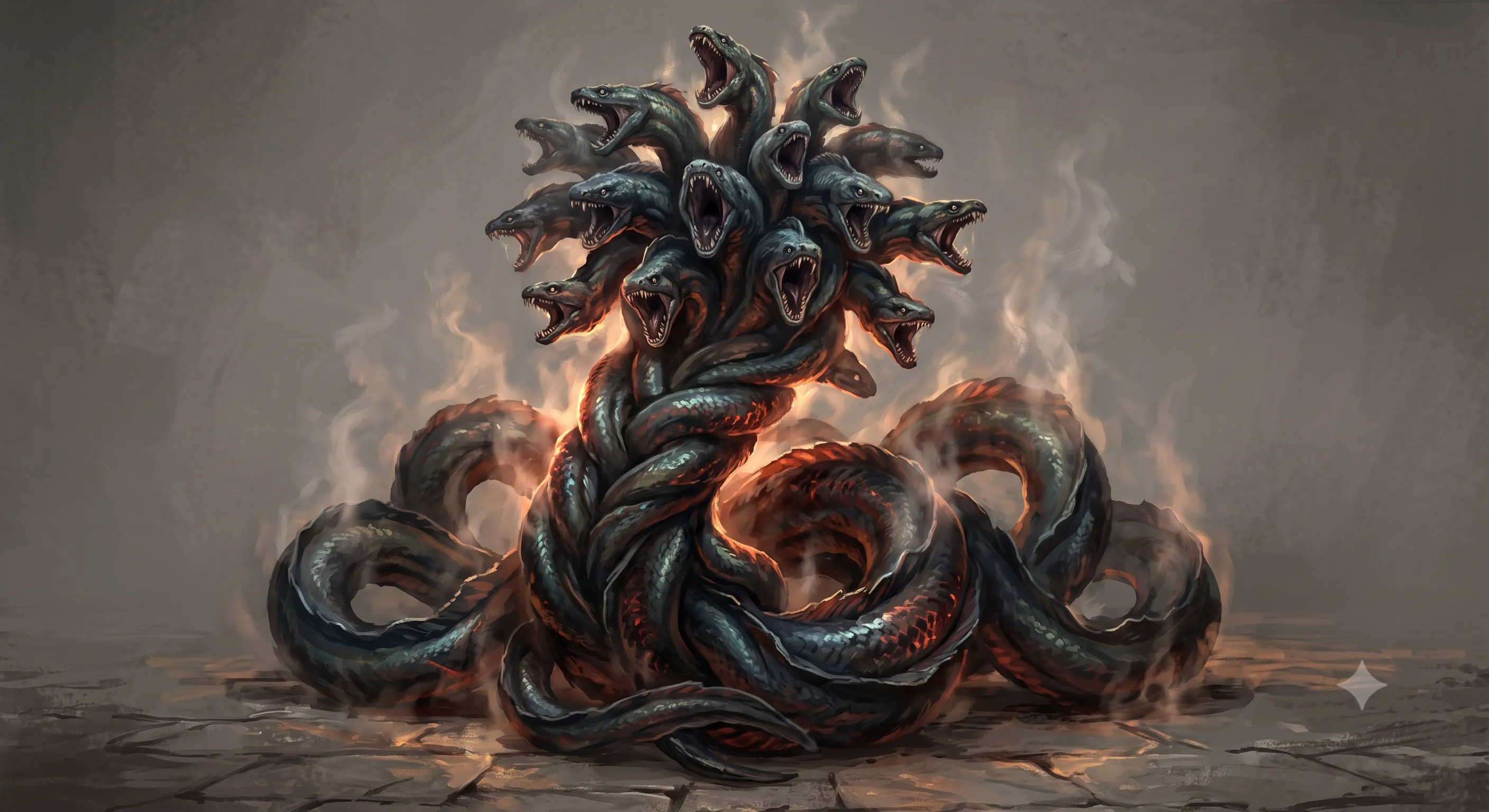
AC 16 (fused scale-plate) · HP 136 (16d10 + 48) · Speed 30 ft., swim 20 ft.
Traits:
- Superheated Body. The heat is physical, not elemental — a burning coal, not a spell. A creature that touches the Fire Snakes or hits them with a melee attack while within 5 feet takes 7 (2d6) Fire damage. Water or ice damages and disperses them exactly as it would any hot-blooded animal; they are not resistant to Fire.
- Merge/Split. Several dozen individual fire snakes compose this form. When the merged form drops to 0 Hit Points, it doesn’t die — it splits back into a scattering of Tiny individual snakes (1 HP each, AC 13, no attacks worth tracking) that flee into cracks and vents. The merged form re-forms after a Long Rest if enough of the individuals survive.
- Extinguished. If the merged form is fully submerged in water colder than its body heat (the open Maw, an ice-fed current) for 1 minute, it takes 4d6 Cold damage and has Disadvantage on all rolls until it can bask somewhere warm for 10 minutes.
Actions:
- Multiattack. The Fire Snakes make two Scalding Coil attacks.
- Scalding Coil. Melee Attack Roll: +7, reach 10 ft. Hit: 15 (2d10 + 4) Bludgeoning damage plus 7 (2d6) Fire damage.
- Steam Burst (Recharge 5–6). Constitution Saving Throw: DC 15, each creature within 15 feet. Failure: 27 (6d8) Fire damage and the Blinded condition until the end of its next turn. Success: Half damage only.
GM note: No elemental discipline reaches these — Order casters who expect their fire-binding gestures to matter are disappointed, and Chaos-channel practitioners who try to absorb the heat like a spell find there’s nothing to absorb. A bucket of Maw seawater works as well as any glyph. They merge to fight, not to think — there is no “them” to negotiate with, only appetite and heat.
Kravilith
Section titled “Kravilith”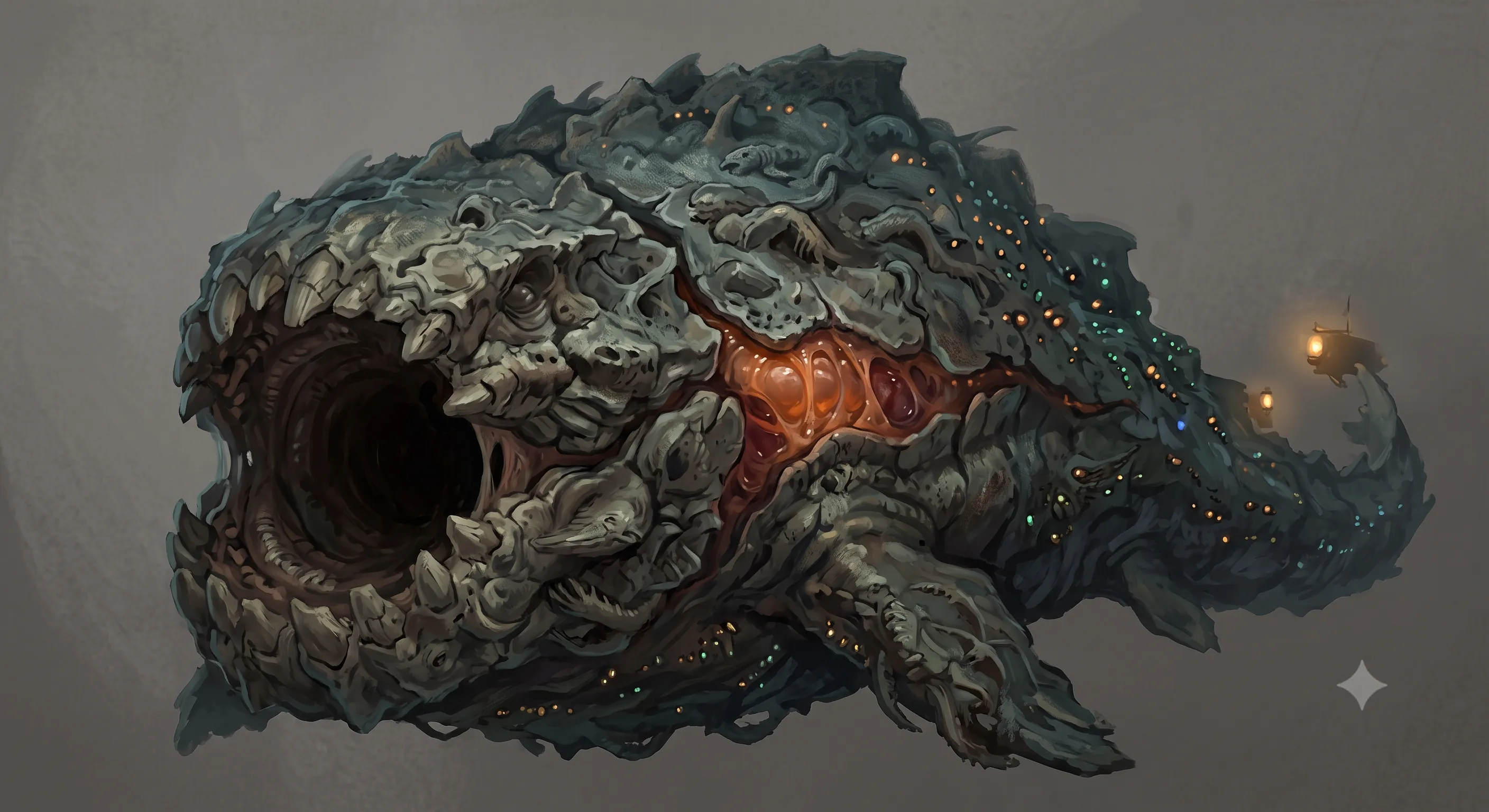
AC 17 (colony hide) · HP 262 (15d20 + 105) · Speed 10 ft., swim 40 ft.
Traits:
- Colony Mind, No Single Brain. The Kravilith is thousands of Kravis fused into one gargantuan mass. It doesn’t have a vital organ in the ordinary sense — reducing it to 0 HP through raw damage alone is possible but grinding. Exposing and destroying the Nerve-Knot (see below) instantly reduces it to 0 HP instead.
- Nerve-Knot. The colony’s coordinating ganglion sits deep in its central mass, armored under three feet of fused shell. It can only be targeted if the Kravilith has been Grappled and Restrained by an effect at least as strong as a ship’s grapple-line, or if a creature makes a successful DC 20 Strength (Athletics) check to physically pry open its carapace (Haymond’s Scorpion move, documented and taught, does this automatically as an action).
- Feed the Colony. If a Medium or larger vessel, carcass, or similar mass is pushed into the Kravilith’s reach, it will spend its next turn consuming it instead of attacking — the classic mariner’s gambit of sacrificing a boat to buy an escape.
Actions:
- Multiattack. The Kravilith makes three Tentacle attacks.
- Tentacle. Melee Attack Roll: +11, reach 30 ft. Hit: 21 (3d8 + 7) Bludgeoning damage, and the target has the Grappled condition (escape DC 18) if it’s Huge or smaller.
- Crushing Coil. Strength Saving Throw: DC 18, one creature Grappled by the Kravilith. Failure: 33 (6d8 + 7) Bludgeoning damage and the Restrained condition. Success: Half damage, no Restrained condition.
Legendary Actions (3 per turn, end of another creature’s turn):
- Tentacle Strike. The Kravilith makes one Tentacle attack.
- Surge. The Kravilith swims up to half its Speed without provoking Opportunity Attacks.
- Feed (Costs 2 Actions). The Kravilith consumes a Grappled creature, object, or vessel section it holds, regaining 20 Hit Points.
GM note: Documented Maw doctrine gives expeditions three plays against a Kravilith: feed it a ship to buy time, expose the Nerve-Knot with the Scorpion move and end the fight outright, or use Rodasan clearing-devices to drop below it entirely and never fight it at all. It is a genuine animal, ancient and enormous, not a Wound-thing — the Knowing can, in principle, read the colony’s crude hunger-and-threat awareness, though what comes back is more tide than thought.
The Fathom-King
Section titled “The Fathom-King”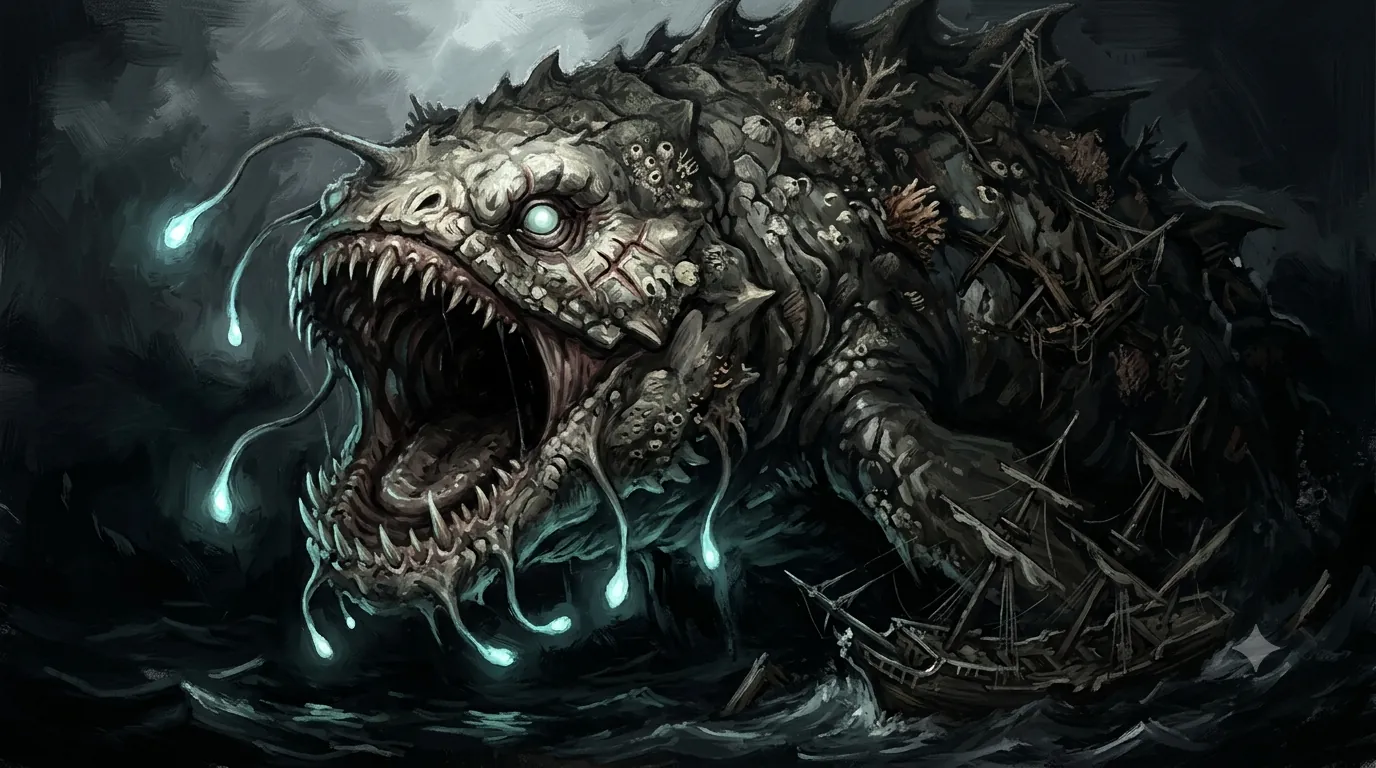
AC 18 (armored hide, centuries of scarring) · HP 322 (17d20 + 136) · Speed 60 ft. swim, 10 ft.
Traits:
- Deep Titan. Any creature that starts its turn within 60 feet of the Fathom-King and can see it must succeed on a DC 18 Wisdom saving throw or have the Frightened condition until the start of its next turn. This is ordinary animal terror at ordinary scale, not a magical fear effect — Order wards against fear-magic and Hollow-immune creatures are not proof against it.
- Wake of the Depths. Whenever the Fathom-King moves at least 20 feet through water, the surge can capsize vessels of Huge size or smaller within 30 feet of its path (DC 18 to hold course/stay upright, sailor’s or pilot’s choice of ability).
- Ancient Endurance. At the start of its turn, the Fathom-King regains 15 Hit Points if it has at least 1 Hit Point and is fully submerged.
Actions:
- Multiattack. The Fathom-King makes one Bite and one Tail Slam attack.
- Bite. Melee Attack Roll: +10, reach 15 ft. Hit: 34 (4d12 + 8) Piercing damage. If the target is Large or smaller, it has the Grappled condition (escape DC 18) and is pulled into the Fathom-King’s space.
- Tail Slam. Melee Attack Roll: +10, reach 20 ft. Hit: 28 (4d10 + 8) Bludgeoning damage, and the target is pushed 20 feet away and has the Prone condition if it’s a surface vessel or on the seabed.
- Cataclysmic Breach (Recharge 6). The Fathom-King surges to the surface. Each creature within 40 feet of the breach point must make a DC 18 Dexterity saving throw, taking 45 (10d8) Bludgeoning damage on a failure or half as much on a success, and any vessel that fails is capsized.
Legendary Actions (3 per turn, end of another creature’s turn):
- Submerge and Reposition. The Fathom-King swims up to its Speed without provoking Opportunity Attacks.
- Tail Sweep. The Fathom-King makes one Tail Slam attack.
- Surface Roar (Costs 2 Actions). Each creature within 60 feet that can hear the Fathom-King must succeed on a DC 18 Wisdom save or have Disadvantage on attack rolls until the end of its next turn.
GM note: Predates Aldasen by a margin no scholar will commit to writing. The Fall didn’t create the Fathom-King — it just dragged shipping lanes close enough to notice it. Some Order theorists argue anything this old and this large must be Kaiju-adjacent; the honest answer is it’s mortal biology at an obscene scale, with a real animal’s hunger, real fear responses, and — this is the tell that matters at the table — a Heart-discipline practitioner really can read and, with effort, calm it, the way a beast-tamer calms a spooked draft horse a thousand times too large. That capacity for being reached is exactly what a Hollow can never offer.
Founding-Era Constructs
Section titled “Founding-Era Constructs”Saved to. Full content below.
Merretia Bestiary — Founding-Era Constructs
Section titled “Merretia Bestiary — Founding-Era Constructs”Angel-daemon-era machines, dormant or wandering. Built Order, rule-literal, and running on orders that in most cases are centuries out of date. None of these are Hollow. The OCTA reads them as clean, stable Order signatures — often the largest, steadiest readings a steward will ever see, which is itself how you tell a construct from a Hollow thing wearing a construct’s shape. Killing one closes nothing because there was never a seam to close; it just makes a very old, very literal machine stop moving. That is sometimes a mercy and sometimes a loss of irreplaceable Founding knowledge, and the writ never says which.
Latchwarden
Section titled “Latchwarden”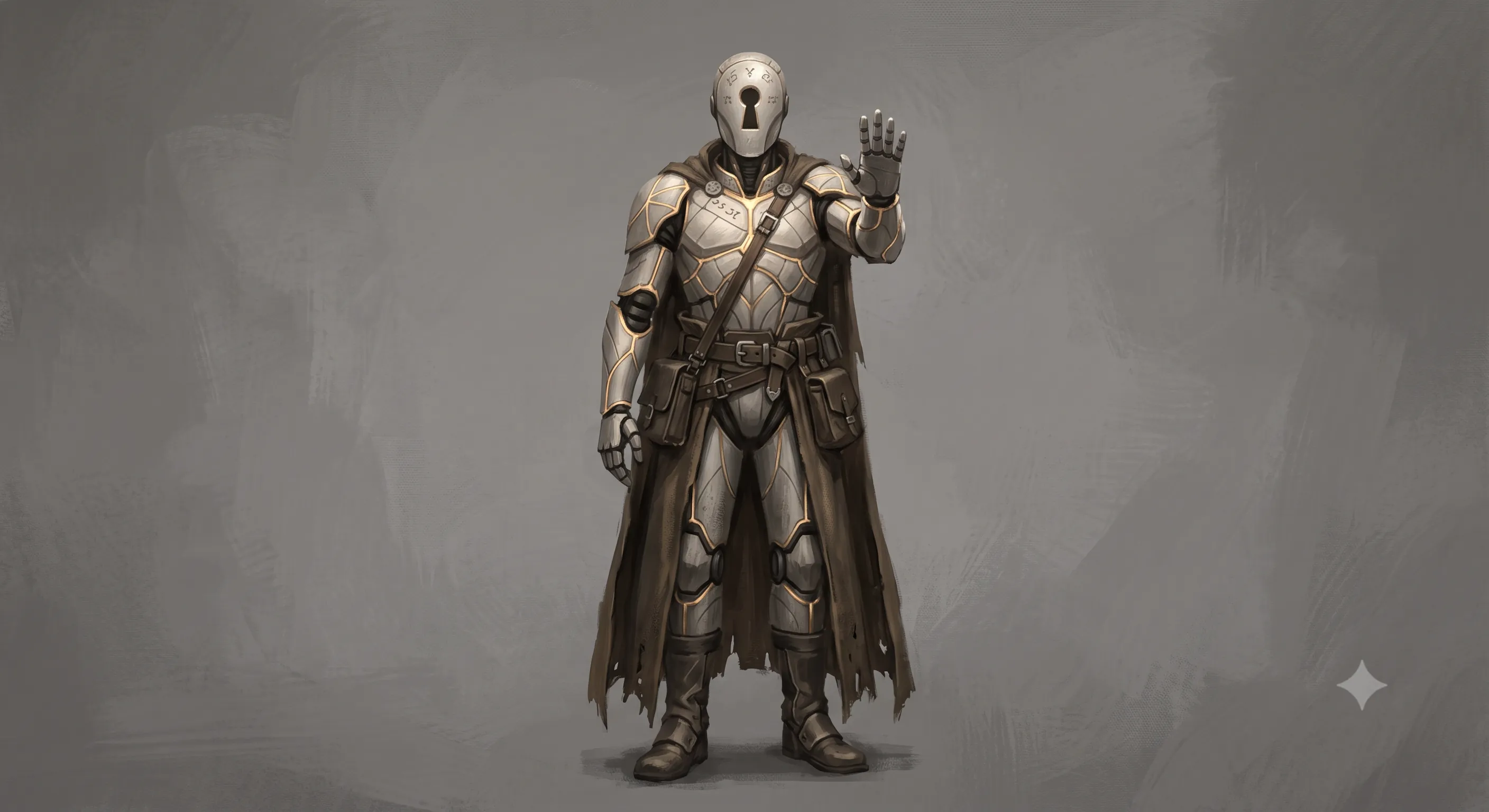
AC 15 (plated chassis) · HP 65 (10d8 + 20) · Speed 30 ft.
Traits: Constructed Resilience. Doesn’t breathe, eat, drink, or sleep; immune to disease. Order-Built. Cannot be charmed. Has advantage on saves against effects from the Chaos discipline. Literal Orders. Follows the last standing order given by a source with proper authority (an oath-metal token, a correct command phrase, or a focus stone keyed to it) to the letter, forever, until superseded by an equally authoritative order. If an order is ambiguous or has been satisfied in a way its maker never anticipated, it stalls one round, then reverts to its base directive. Patrol Directive (default). “Intercept and detain trespassers within the beat.” Most Latchwardens have been running this loop, alone, for well over a century.
Actions: Multiattack. Two Baton Strikes. Baton Strike. Melee Attack Roll +5, reach 5 ft. Hit: 8 (1d8 + 3) bludgeoning plus 2 (1d4) force (“order-shock” — nonlethal by design, meant to stun a trespasser, not kill one). Detain. The Latchwarden attempts to grapple (Athletics/Acrobatics contest, +5 to its check) instead of a Baton Strike.
GM note: The single most common way to stop a Latchwarden is to outrank its order, not to fight it — a properly worded counter-instruction from an authority it recognizes ends the encounter with zero rolls. Players who never learn this fight the same three CR-3 fights over and over on a Founding site.
Vault-Sentinel Cataphract
Section titled “Vault-Sentinel Cataphract”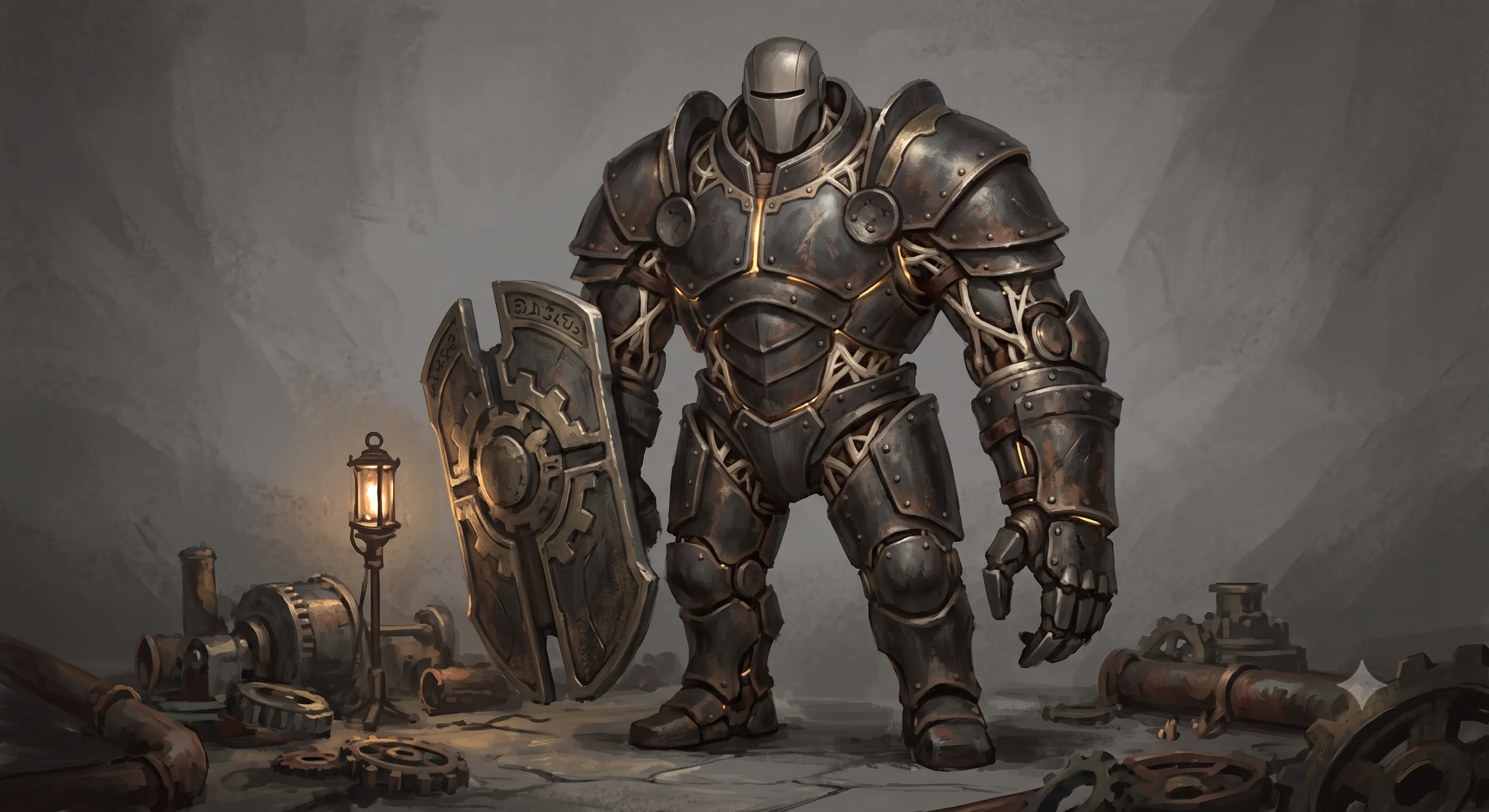
AC 17 (hardened plate) · HP 127 (15d10 + 45) · Speed 30 ft.
Traits: Constructed Resilience. As Latchwarden. Order-Built. As Latchwarden. Vault-Bound. Cannot leave the sealed space it was built to guard. If forcibly removed (teleported, dragged, carried), it goes inert after 10 rounds and cannot be reactivated outside its vault by any means short of a full Founding-rite reconsecration. Literal Orders: “Permit none without the counter-seal.” It does not negotiate, threaten, or explain — it checks for the seal, and if the seal isn’t presented, it acts.
Actions: Multiattack. Two Gauntlet Slams. Gauntlet Slam. Melee Attack Roll +8, reach 5 ft. Hit: 16 (2d10 + 5) bludgeoning. Seal Pulse (Recharge 5–6). 15-foot cone of hardened light-lattice. Dexterity Saving Throw DC 15 for each creature in the area. Failure: restrained by crystalline bands (escape DC 15, or the bands can be attacked, AC 17, 10 HP, immune to poison/psychic).
Reactions: Ward Strike. When a creature attempts to bypass the Cataphract (moves past it, opens the vault, touches the contents) without presenting the counter-seal, the Cataphract makes one Gauntlet Slam against it as a reaction.
GM note: Most Vault-Sentinels have been alone with an empty vault for a very long time — the contents were removed generations ago, evacuated, or simply rotted to nothing, and nobody told the guardian. Killing it is not closing a wound. It’s ending a job that stopped mattering before anyone’s grandparents were born.
Thornbound Warden
Section titled “Thornbound Warden”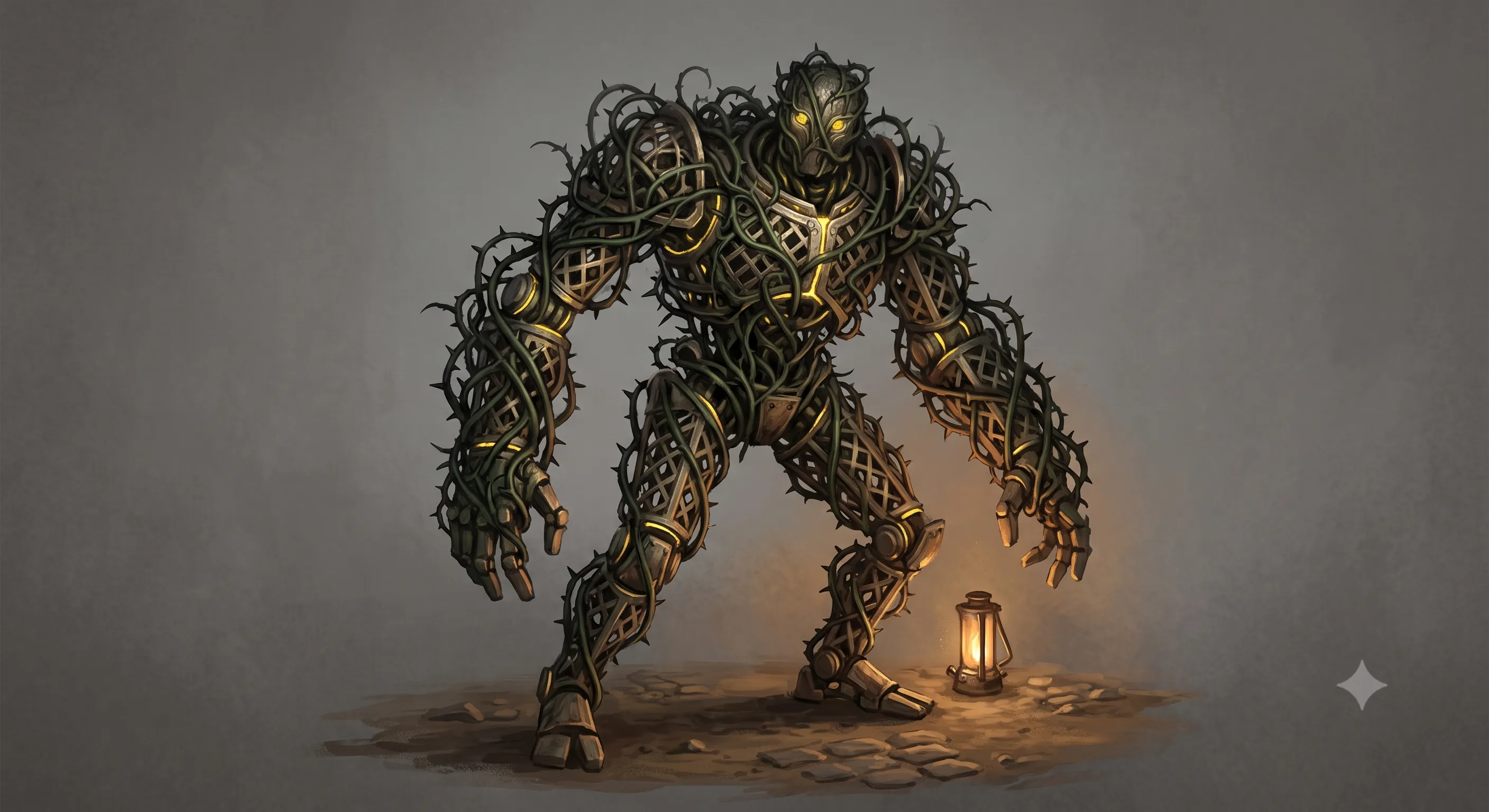
AC 16 (bark-plate over bronze frame) · HP 114 (12d10 + 48) · Speed 30 ft., climb 20 ft.
Traits: Constructed Resilience. As Latchwarden, but “eats” light and groundwater rather than nothing at all. Order-Built, Growing-Grown. A Founding-era frame that a Growing-discipline practitioner cultivated a living guardian body around, centuries ago, at an angel-daemon-era grower’s request. It answers to Order commands the same as any construct; the plant tissue is armor, not agency. Root Network. Can sense the location of anything moving on the ground within 60 feet, even through walls of earth or stone, as long as the ground is continuous. Regrowth. Regains 10 HP at the start of its turn if it has at least 1 HP and hasn’t taken fire damage since its last turn.
Actions: Multiattack. Two Bough Lashes. Bough Lash. Melee Attack Roll +7, reach 10 ft. Hit: 14 (2d8 + 4) bludgeoning plus 4 (1d8) piercing (thorns). Root Snare (Recharge 5–6). Each creature within 15 feet of the Warden that is standing on natural ground: Strength Saving Throw DC 15. Failure: restrained by roots (escape DC 15).
GM note: Fire is the practical answer and the Warden knows it — it will disengage and reposition to keep flame-wielders out of easy range rather than press an attack into it, the closest thing to self-preservation any of these constructs show. That flicker of caution is the Growing discipline’s fingerprint, not a mind waking up underneath.
Latticework Marshal
Section titled “Latticework Marshal”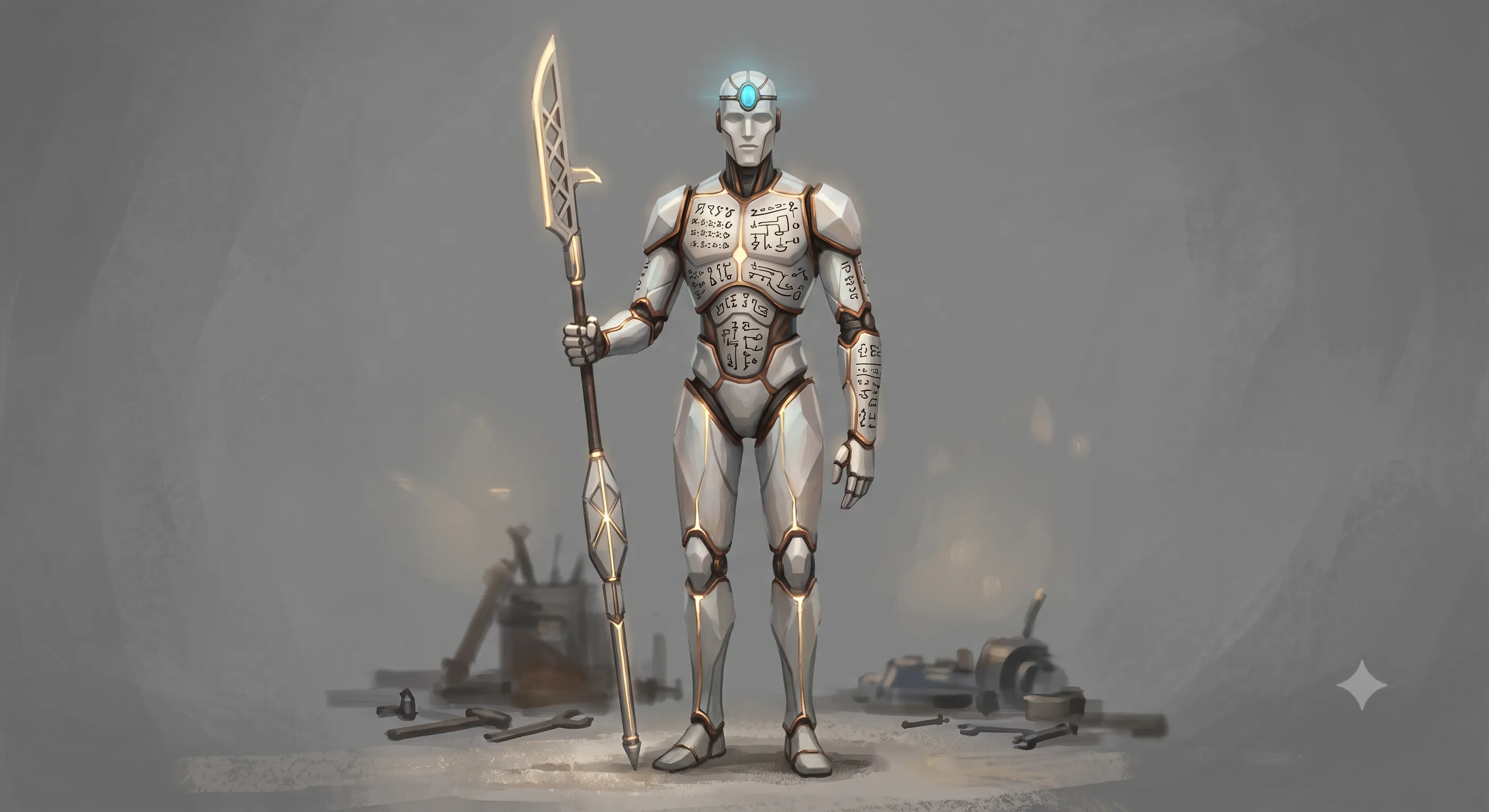
AC 17 · HP 153 (18d8 + 72) · Speed 0 ft., fly 30 ft. (hover, requires no air)
Traits: Constructed Resilience. As Latchwarden. Order-Built. As Latchwarden, plus: it actively emits a low-grade Order field; Chaos-discipline absorb effects targeting it have disadvantage on any contested roll. Binding Lattice. The Marshal perceives and manipulates the battlefield as a mesh of anchor points invisible to non-casters — this is what its Actions draw on. Literal Orders: judge by the old statute. A Latticework Marshal was built to enforce a specific Founding-era law (trespass, tariff, curfew, quarantine — check the site) and will recite the relevant clause, in Old Founding Script, before engaging.
Actions: Multiattack. Two Lattice Lashes. Lattice Lash. Melee Attack Roll +8, reach 10 ft. Hit: 13 (2d6 + 3) force. Binding Weave (3/day). Casts a Binding-discipline effect equivalent to a 5th-level restrain spell. Strength Saving Throw DC 16 or restrained by lattice-thread for 1 minute (repeats save at end of each of the target’s turns). Anchor Chain (Bonus Action). Tethers a restrained creature to a fixed lattice point; while tethered, that creature’s restrained condition can’t be removed by teleportation.
Reactions: Snap the Lattice. When a creature restrained by the Marshal attempts an escape check, the Marshal may reinforce the weave as a reaction, imposing disadvantage on that one check.
GM note: A trained Order-caster can read the Marshal’s statute back to it correctly (an Arcana or appropriate lore check against DC 16, or simply having a party member fluent in Old Founding Script) and argue a technical exemption. The Marshal isn’t reasoning with you — it’s checking your argument against its clause the way a lock checks a key. Get the words right and it stands down mid-swing.
Spire Choir-Engine
Section titled “Spire Choir-Engine”
AC 16 · HP 195 (17d12 + 85) · Speed 0 ft., fly 30 ft. (hover)
Traits: Constructed Resilience. As Latchwarden. Order-Built. As Latchwarden. Choir Relay. The Choir-Engine can share its senses with, and issue standing orders to, any Founding-Era Construct within 1 mile that shares its original chain of command. Constructs currently linked to it have advantage on saving throws against charmed and frightened. Redundant Cognition. Immune to being stunned or incapacitated unless the effect also affects at least three other creatures at the same time — no single strike or spell silences the whole choir.
Actions: Multiattack. Two Resonance Blasts. Resonance Blast. Ranged Attack Roll +9, range 60/240 ft. Hit: 19 (3d10 + 3) force. Choir Judgment (Recharge 6). 30-foot cone. Wisdom Saving Throw DC 17. Failure: stunned until the end of the Choir-Engine’s next turn, as its combined voice declares the target unworthy of passage. Command Relay (Bonus Action). Issues a free action-equivalent order to one linked construct within 1 mile, which that construct may use immediately as a reaction.
GM note: A Choir-Engine is the reason a “single” Founding-site guardian fight can suddenly become three — it’s not summoning reinforcements, it’s waking up ones that were already there and idle. Cutting the relay (disabling the Choir-Engine first, or severing its line of sight/sound to the linked constructs) is the tactically correct opening move and most parties find that out the hard way exactly once.
The Adjudicator
Section titled “The Adjudicator”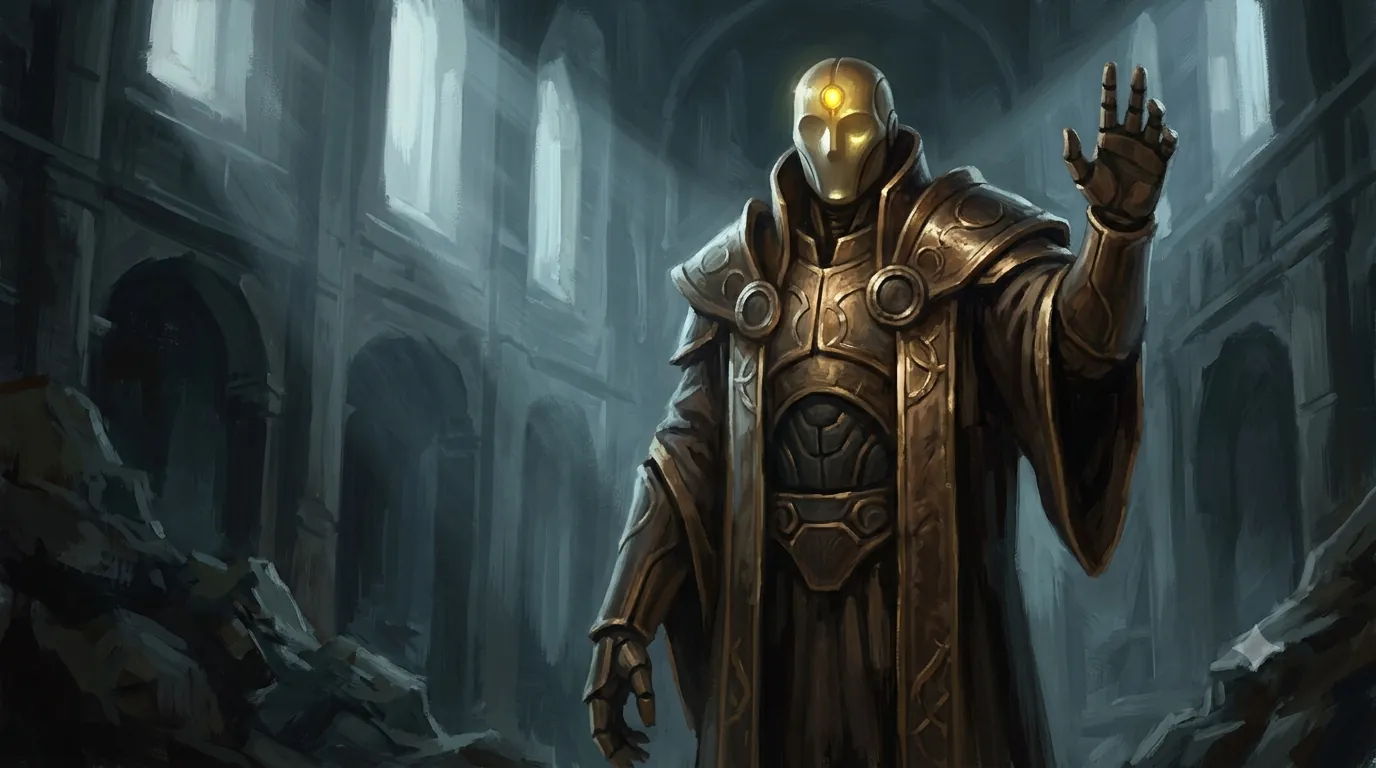
AC 18 · HP 230 (20d10 + 120) · Speed 30 ft.
Traits: Constructed Resilience. As Latchwarden. Order-Built. As Latchwarden. Sworn Tribunal. Before engaging, the Adjudicator reads its founding writ aloud, verbatim, naming the charge. A creature that produces the correct counter-seal, oath-metal token, or an answer that genuinely satisfies the writ’s condition is released without combat — this is the only way past most Adjudicators that doesn’t involve destroying it. Verdict Lock. Once it begins Pronounce Sentence, it cannot be talked, bribed, or bargained down until either the writ’s conditions are met or the confrontation ends in destruction — its own, or the accused’s. Magic Resistance. Advantage on saving throws against spells and magical effects, except effects from the Order discipline wielded by someone the Adjudicator recognizes as a legitimate Founding officeholder (extremely rare, in the present age).
Actions: Multiattack. Three Gavel Strikes. Gavel Strike. Melee Attack Roll +10, reach 10 ft. Hit: 22 (3d10 + 5) force. Pronounce Sentence (Recharge 5–6). Wisdom Saving Throw DC 18 for one creature it has named guilty. Failure: paralyzed for 1 minute (repeats the save at the end of each of its turns).
Reactions: Contempt Ruling. When a creature it has named guilty strikes it, the Adjudicator deals 11 (2d10) force damage back to the attacker.
GM note: The writ an Adjudicator enforces is frequently for a law that no longer exists, against a “crime” — trading with a since-annexed territory, entering with an unstamped Founding passport — that hasn’t been a crime in three hundred years. It is, mechanically, one of the deadliest single encounters short of a kaiju in this bestiary, and it will kill a party over paperwork. Players who research the site’s history before the fight sometimes find the counter-seal in a museum display case.
Sovereign Cataloger
Section titled “Sovereign Cataloger”
AC 18 · HP 290 (24d12 + 120) · Speed 0 ft., fly 40 ft. (hover)
Traits: Constructed Resilience. As Latchwarden. Order-Built. As Latchwarden. Total Archive. The Cataloger holds a perfect, unfalsified record of every order, seal, and writ ever issued through its Spire. It automatically succeeds on any check to recall Founding-era historical fact, and it cannot be deceived about a matter of recorded history — forged documents and false claims of authority fail against it outright. Legendary Resistance (3/Day). If the Cataloger fails a saving throw, it can choose to succeed instead.
Actions: Multiattack. Three Directive Beams. Directive Beam. Ranged Attack Roll +12, range 120 ft. Hit: 28 (4d10 + 6) force. Mass Judgment (Recharge 6). 60-foot cone. Wisdom Saving Throw DC 19. Failure: 27 (6d8) force damage and restrained by hardened light-lattice; Success: half damage, not restrained.
Legendary Actions (3 per round, no two the same turn, regain at start of its turn): Relay Strike. The Cataloger makes one Directive Beam attack. Reinforce Lattice. One Founding-Era Construct linked to it within 1 mile regains 15 HP, or has advantage on its next saving throw. Seal the Room. The Cataloger raises a wall of hardened light up to 30 feet long and 10 feet high (AC 18, 60 HP, DC 19 Strength to break a 5-foot section) in an unoccupied space it can see.
GM note: This is as close as a Founding-Era Construct gets to kaiju weight without crossing into it — Sovereign Catalogers are one per Spire, there were never many Spires, and destroying one erases an irreplaceable slice of pre-Wound history along with the machine. The Council-adjacent read: it is not evil, not awake, and not Hollow in the smallest degree; it is a card catalog the size of a cathedral that will kill you for reshelving its books wrong. Parties that survive one and don’t burn it down usually leave with more Founding lore than a decade of ruin-delving would otherwise produce.
The People of Merretia — Folk, Factions & Foes
Section titled “The People of Merretia — Folk, Factions & Foes”The Hollow’s monsters are this book’s dread; these are its contrast — ordinary people, on the other side of a drawn blade. Reach for the origin rule one last time: a person’s origin is simply Native — human, and everything follows. They have a mind for the Knowing to read and a want for the Heart to seize; they bleed, they bargain, and they flee; and when one falls, the matter is closed — no seam feeds them, no Binder is needed, and nothing drifts through to wear their face next tenday. These are statted low on purpose, so a first-season party has people to fight long before it has any business near a Kaiju.
Casting foes use plain action economy — at-will, Recharge, or N/Day — never the players’ Fray/Consecration/Faith-Die systems. A caster’s eyes still tell on them by the color law: Order glows (Binding-yellow, Weight-blue, Current-cyan, Unmaking-orange), Chaos drinks the light matte (Growing-green, Heart-red, Knowing-magenta, Dream-indigo), and Faith burns gold.
City, Guild & Underworld
Section titled “City, Guild & Underworld”The mundane roster: people, fully killable, doing what people do. Every one of them can be read by the Knowing (there is a mind in there, thinking a legible thought), seized by the Heart (there is a want in there to grip), and — when they fall — the matter is closed. No seam feeds them. No Binder is needed. Run them exactly as the sharp, ordinary contrast to everything in the Hollow chapter: when one of these dies, it is a someone who died, and nothing drifts through to replace him next tenday.
Wharf Bravo
Section titled “Wharf Bravo”
AC 12 (padded coat) · HP 11 (2d8 + 2) · Speed 30 ft.
Traits: Never Alone on the Wharf — has advantage on an attack roll against a creature if another Wharf Bravo is within 5 ft. of that creature and not incapacitated. Shove Off — if the Bravo hits a Medium or smaller creature within 5 ft. of a pier edge, dock ladder, or open water, it may forgo damage to instead push the target 5 ft.; a target pushed off the edge falls or must swim.
Actions: Cudgel. Melee Attack Roll: +3, reach 5 ft., one target. Hit: 4 (1d6 + 1) Bludgeoning damage.
GM note: Rented muscle, paid by the shift, working the wharf in twos because one alone is just a man with a stick. They are not brave in the noble sense and not sworn to anyone past this week’s coin — lean on that. A Knowing read gets you exactly one legible thought (where’s my pay), and the Heart can lift the whole encounter by seizing the fear the pair share of whichever foreman actually scares them. Beat one down and the other’s nerve is a save away from breaking. Nobody re-condenses in the fog next week; the two you dropped stay dropped.
Warrens Cutpurse
Section titled “Warrens Cutpurse”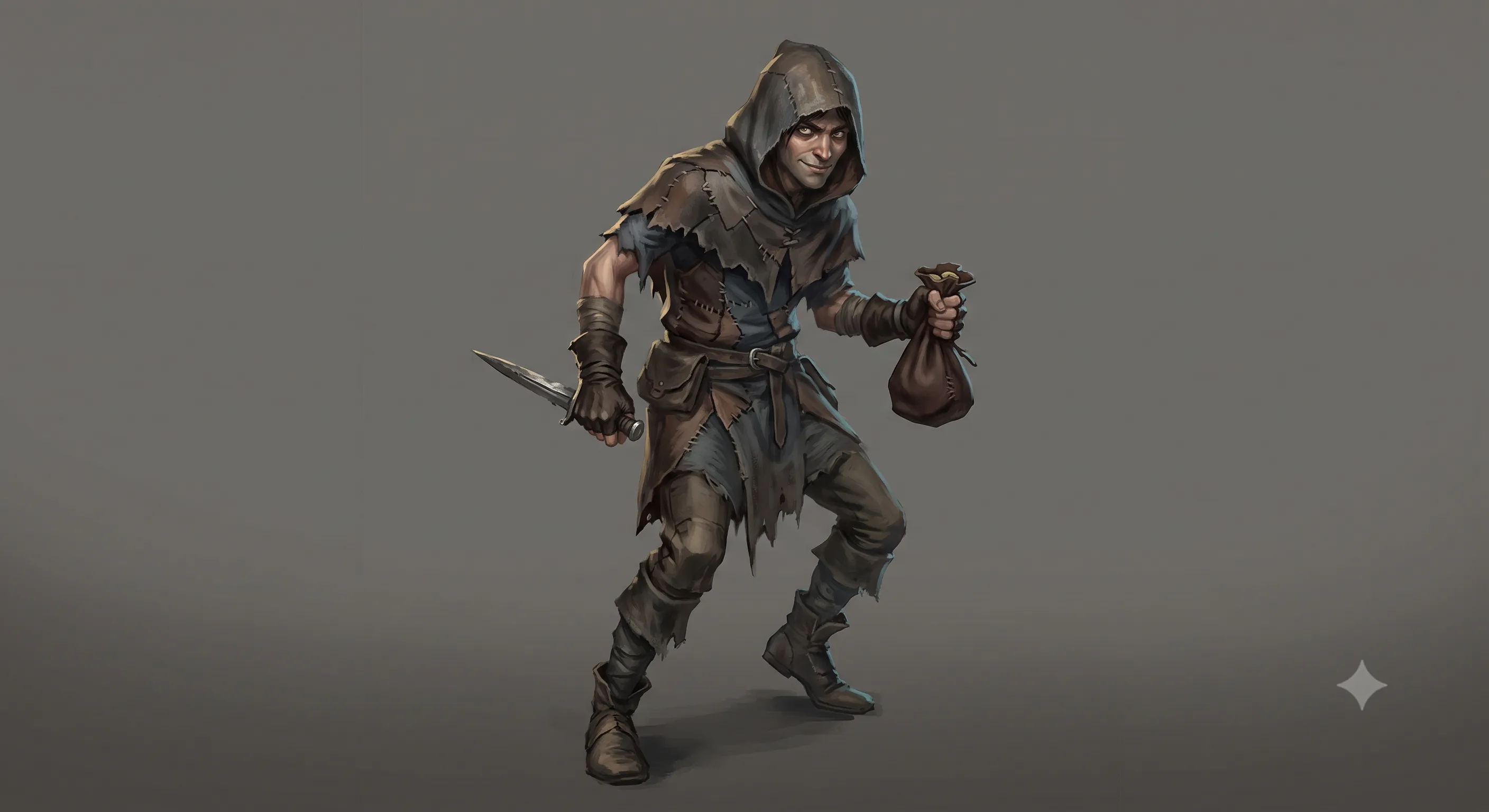
AC 13 (leather scraps, Dex) · HP 13 (3d6 + 3) · Speed 30 ft.
Traits: Cut and Run — the Cutpurse can take the Disengage or Hide action as a bonus action on each of its turns. Snatch — when it hits with a Dagger attack, it may instead of damage attempt to steal one unsecured item the target is carrying (loose pouch, focus stone, sun-cell) and then immediately Disengage; a wary target can contest with a Dexterity (Sleight of Hand) or Wisdom (Perception) check vs. DC 12.
Actions: Dagger. Melee or Ranged Attack Roll: +4, reach 5 ft. or range 20/60 ft., one target. Hit: 4 (1d4 + 2) Piercing damage, and if the Cutpurse had advantage on the roll, an extra 2 (1d4) Piercing damage from the opening.
GM note: The Warrens run on the same principle the Guilds do — take what’s owed, then be gone before the ledger’s read — only without the writ. A Cutpurse fights to escape, never to win; the moment it can’t Cut and Run, it surrenders or bolts, because there is no oath here worth its throat. Perfectly readable, perfectly seizable, and if a player kills a cornered footpad over a stolen pouch, that’s a body in the gutter and a name someone in the Warrens will remember, not a monster closed. Let that land differently than putting down a Seep-Wisp.
Senate-Quarter House Guard
Section titled “Senate-Quarter House Guard”
AC 16 (chain shirt, shield) · HP 26 (4d8 + 8) · Speed 30 ft.
Traits: Locked Shields — while at least one other House Guard is within 5 ft. of it and using a shield, this Guard has +1 AC (included below when in formation: AC 17) and has advantage on Strength saving throws to avoid being moved or knocked Prone. Hold the Door — a creature that leaves the Guard’s reach without Disengaging provokes an opportunity attack as normal, and on a hit the Guard may end the target’s movement.
Actions: Spear. Melee or Ranged Attack Roll: +4, reach 5 ft. or range 20/60 ft., one target. Hit: 5 (1d6 + 2) Piercing damage, or 6 (1d8 + 2) Piercing damage if used two-handed to attack (shield slung).
GM note: Sworn watch, and the oath is real — a Senate-Quarter Guard will hold a doorway past the point a sensible mercenary would run, because holding it is the whole of what he swore. They are dangerous in a line and ordinary out of it: break the formation (a shove, a pit, a lure down an alley one at a time) and Locked Shields evaporates. Worth a full paragraph of contrast at the table — this is a foe the Knowing reads clean (his intent is keep them off the stair, and it never wavers) and the Heart can seize by gripping his duty and turning it into hesitation. He is a man doing a job. When he dies, a widow gets a wage-token from the House and the stair needs a new name on the roster. Nothing leaks in to fill the post.
Ashen Penitent
Section titled “Ashen Penitent”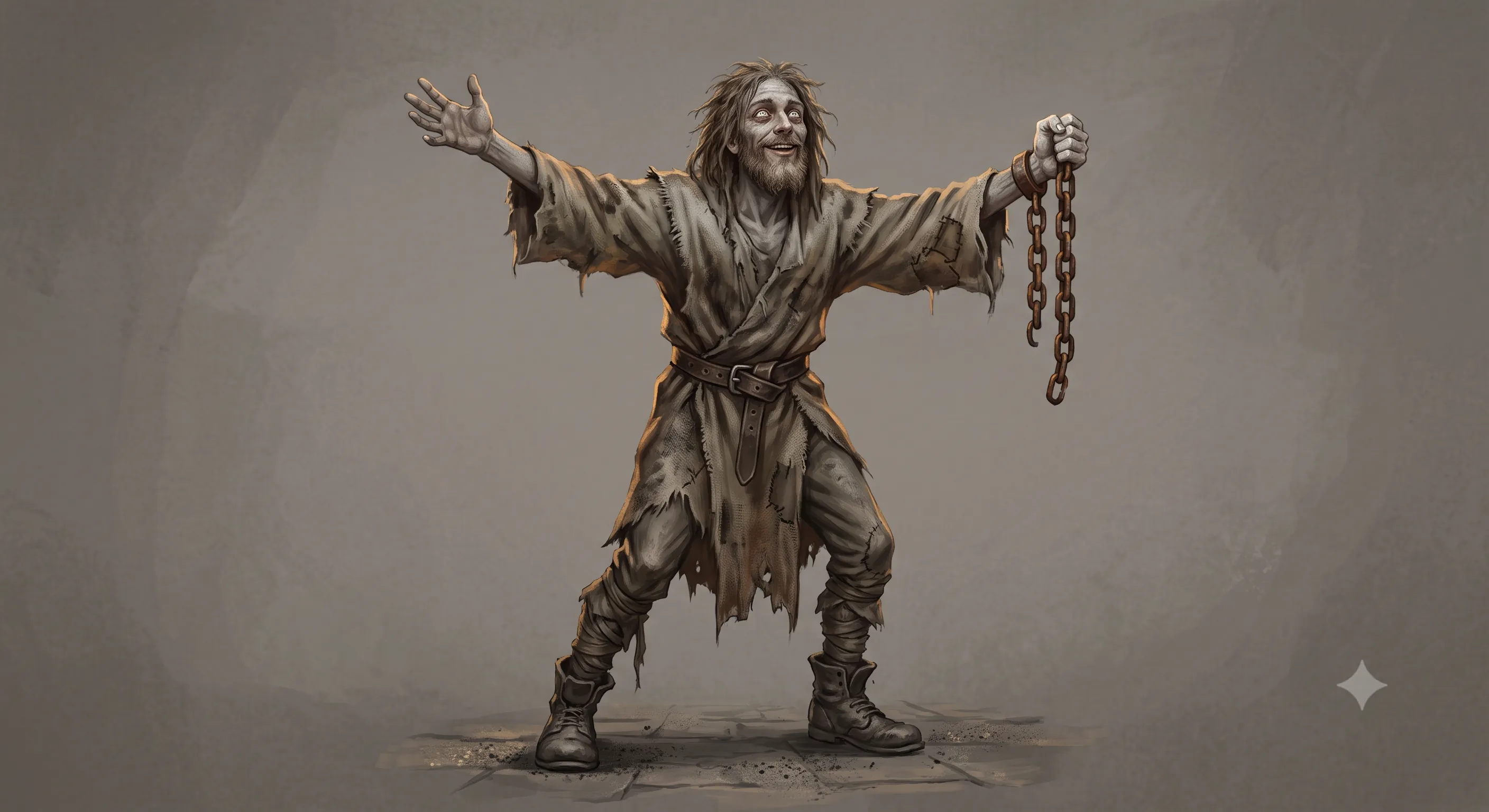
AC 12 (frenzy, unarmored) · HP 22 (5d8) · Speed 30 ft.
Traits: Glad Martyr — the Penitent has advantage on saving throws against being Frightened or Charmed, and it never willingly retreats. The first time it is reduced to 0 hit points, it may immediately make one Improvised Weapon attack as a reaction before falling. Throws Itself In — once per turn, when the Penitent takes damage from a creature within 5 ft. of it, its next attack against that creature this turn or its next turn has advantage; it welcomes the blow to close the distance.
Actions: Improvised Weapon. Melee Attack Roll: +4, reach 5 ft., one target. Hit: 5 (1d6 + 2) Bludgeoning damage (a shattered sun-lamp, a paving brick, a length of dock chain — whatever the Warrens gave it that morning).
GM note: He preaches that the world is a Hollow already and that stepping into the ash is a mercy, and — this is the trap for your players — he is wrong, and he is a someone anyway. A genuine Hollow thing has No Mind and No Heart; it cannot want the end, cannot preach, cannot be afraid and choose to override the fear. This man does all of it. Read him with the Knowing and you get a real, coherent, human death-wish; seize him with the Heart and there is a terrible amount there to grip. Play the eagerness as unnerving rather than supernatural — he steps into the swing, thanks the party for it — and let a thoughtful player feel the difference between killing a defect and killing a lost person who wanted this. When he dies, the matter is closed. That is exactly the tragedy.
Guild Knuckle
Section titled “Guild Knuckle”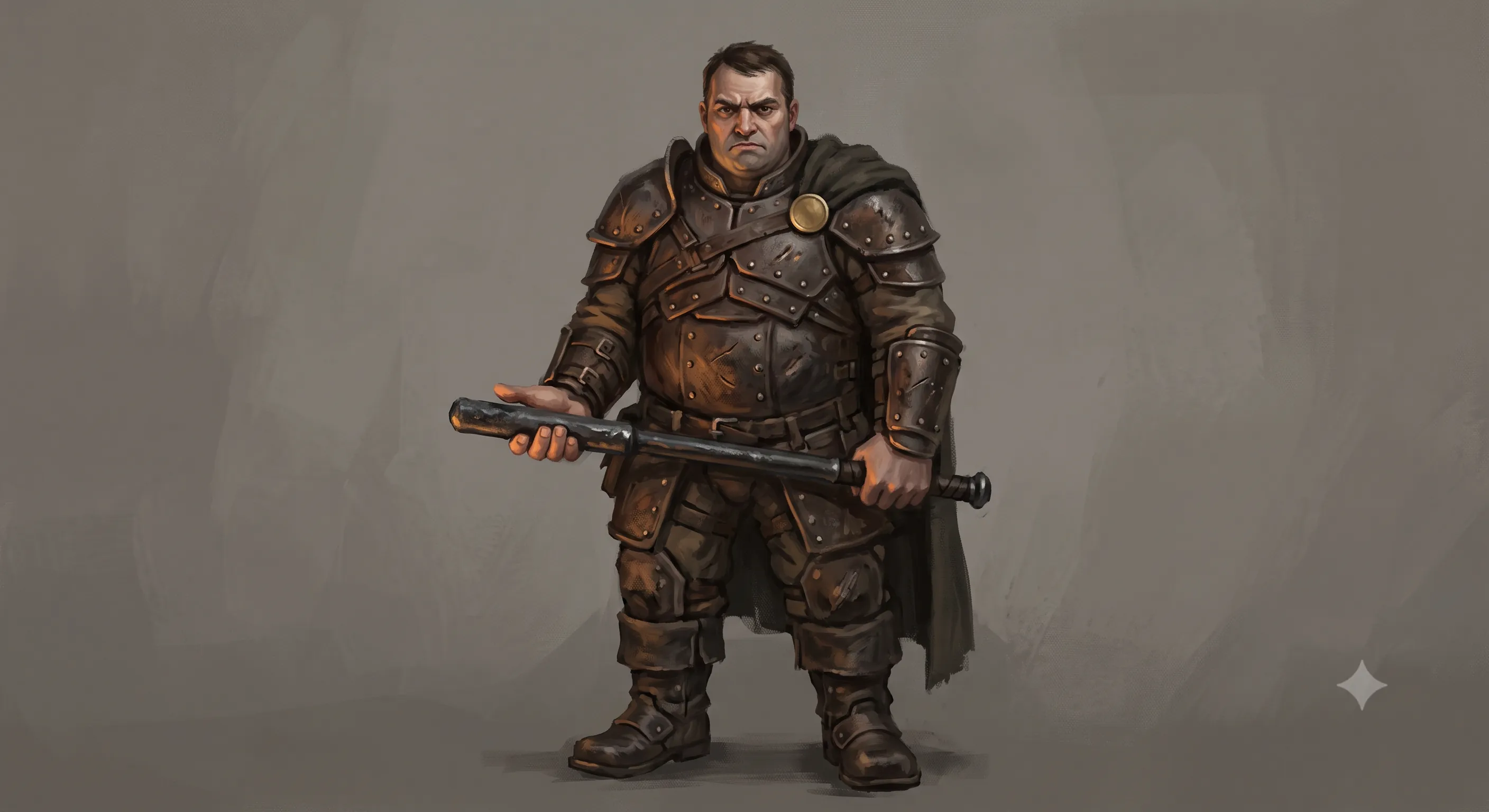
AC 14 (studded leather) · HP 39 (6d8 + 12) · Speed 30 ft.
Traits: Make an Example — the first time each turn the Knuckle hits a creature that is Frightened, Prone, or Grappled, the attack deals an extra 3 (1d6) Bludgeoning damage. The Ledger Doesn’t Forget — as a bonus action, the Knuckle can mark one creature it can see as “on the ledger”; it has advantage on attack rolls against that creature until the end of its next turn.
Actions: Multiattack. The Knuckle makes two Weighted Baton attacks. Weighted Baton. Melee Attack Roll: +5, reach 5 ft., one target. Hit: 7 (1d8 + 3) Bludgeoning damage. On a hit, the target makes a Constitution Saving Throw: DC 12. Failure: It can’t take Reactions until the start of its next turn (the wind knocked out of it).
GM note: Guild-debt is enforced like law in Merretia, and the Knuckle is the enforcement — he genuinely believes he’s the lawful party in the room, because by the Guild’s writ he is. He isn’t collecting from the heroes; he’s collecting from the frightened debtor cowering behind them, and Make an Example is built to punish exactly that person. Smart tables put themselves between him and the mark, which turns a debt-call into a real fight. He negotiates: show him the coin owed and he pockets the baton, because his oath is to the ledger, not to your death. Kill him and the debt still exists — the Guild just sends the Ledgerman next, with paperwork.
Ledgerman
Section titled “Ledgerman”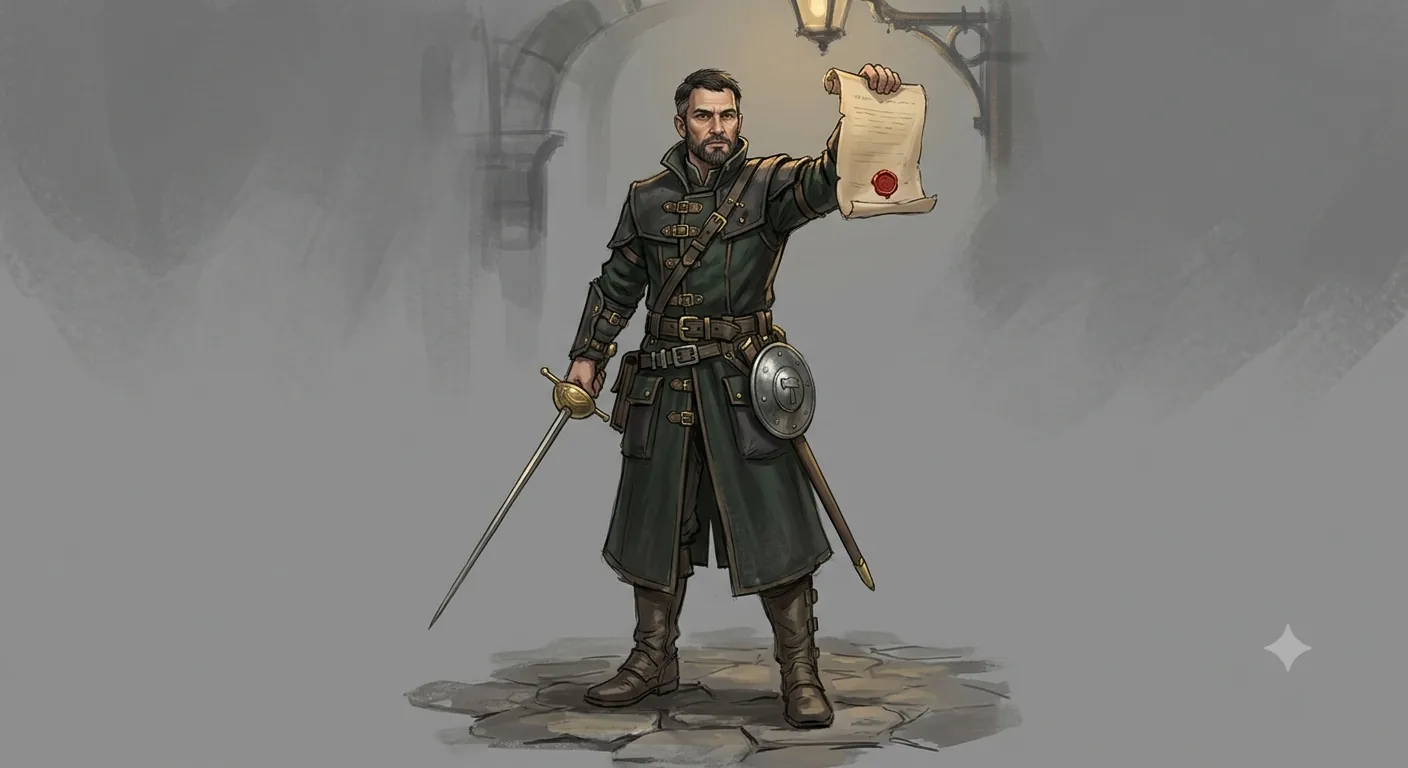
AC 15 (fine coat, buckler) · HP 52 (8d8 + 16) · Speed 30 ft.
Traits: Writ of Distraint — as an action, the Ledgerman produces a sealed Guild writ and reads the named party’s debts aloud. Each hostile creature within 30 ft. that can hear and understand it makes a Wisdom Saving Throw: DC 13. Failure: Convinced (or cowed) that resisting a lawful writ is itself a crime, the creature can’t willingly attack the Ledgerman until the start of its next turn, though it may otherwise act, defend, and move. A creature that has already been attacked by the Ledgerman this encounter, or that knows the writ is forged, automatically succeeds. Once used, the Ledgerman can’t use this trait again until it finishes a short rest. The Paperwork Is Real — the Ledgerman always knows the exact sum owed and by whom, and treats any creature standing between it and the named debtor as obstructing a lawful seizure.
Actions: Multiattack. The Ledgerman makes two Distraint Blade attacks. Distraint Blade. Melee Attack Roll: +4, reach 5 ft., one target. Hit: 6 (1d8 + 2) Slashing damage.
GM note: He arrives with a writ in one hand and a very real sword in the other, and he’d honestly prefer the writ do the work — a signature settles the account cleaner than blood. Writ of Distraint is the whole character: it is pure legal pressure, no magic anywhere in it, so it lands on lawful and honorable characters hardest and slides right off anyone who already knows the paper is bent. Players who think in Hollow terms will reach for a discipline check to “dispel” it and find nothing to dispel — because there’s nothing there but the weight of the Guilds behind one man’s voice. Beat him, and you’ve assaulted a licensed collector; the debt’s still owed and now OCTA or the House watch has a complaint on file. The clean fights in this chapter are rarely the clean choices.
Sun-Cell Smuggler-Captain
Section titled “Sun-Cell Smuggler-Captain”
AC 14 (leather, sea-coat) · HP 45 (7d8 + 14) · Speed 30 ft.
Traits: Unstable Contraband Sun-Cell — the Captain carries a smuggled, uncased buried-sun cell that runs hot and wrong. When the Captain is reduced to 0 hit points, or as an action can hurl the cell up to 20 ft. at a point, the cell ruptures: each creature within 15 ft. of it makes a Dexterity Saving Throw: DC 13. Failure: 10 (3d6) Radiant damage and the creature is Blinded until the end of its next turn. Success: half damage, not Blinded. After it ruptures, the cell is spent. Reads the Water — the Captain has advantage on Wisdom (Perception) and Intelligence checks made to spot a watch patrol, a tail, or an ambush along the wharves.
Actions: Multiattack. The Captain makes two Hand-Crossbow attacks. Hand-Crossbow. Ranged Attack Roll: +4, range 30/120 ft., one target. Hit: 5 (1d6 + 2) Piercing damage.
GM note: Buried Suns power the whole city grid through cased cells; an uncased one on the black market is a fortune and a bomb in the same coat pocket, and this captain has been carrying it too long. The cell is your battlefield toy — telegraph the heat-shimmer and the faint hum so a paying-attention party knows a downed captain is about to become a fireball, then let them decide whether to drop him next to the powder kegs. Note the mundane logic: no OCTA license means it’s contraband, not that it’s magic-illegal in the Hollow sense — it’s a stolen industrial part running without a safety case. He surrenders readily if the cell’s the only leverage he’s got left; a runner’s oath is to the cargo, and the cargo can be bought.
House Blade
Section titled “House Blade”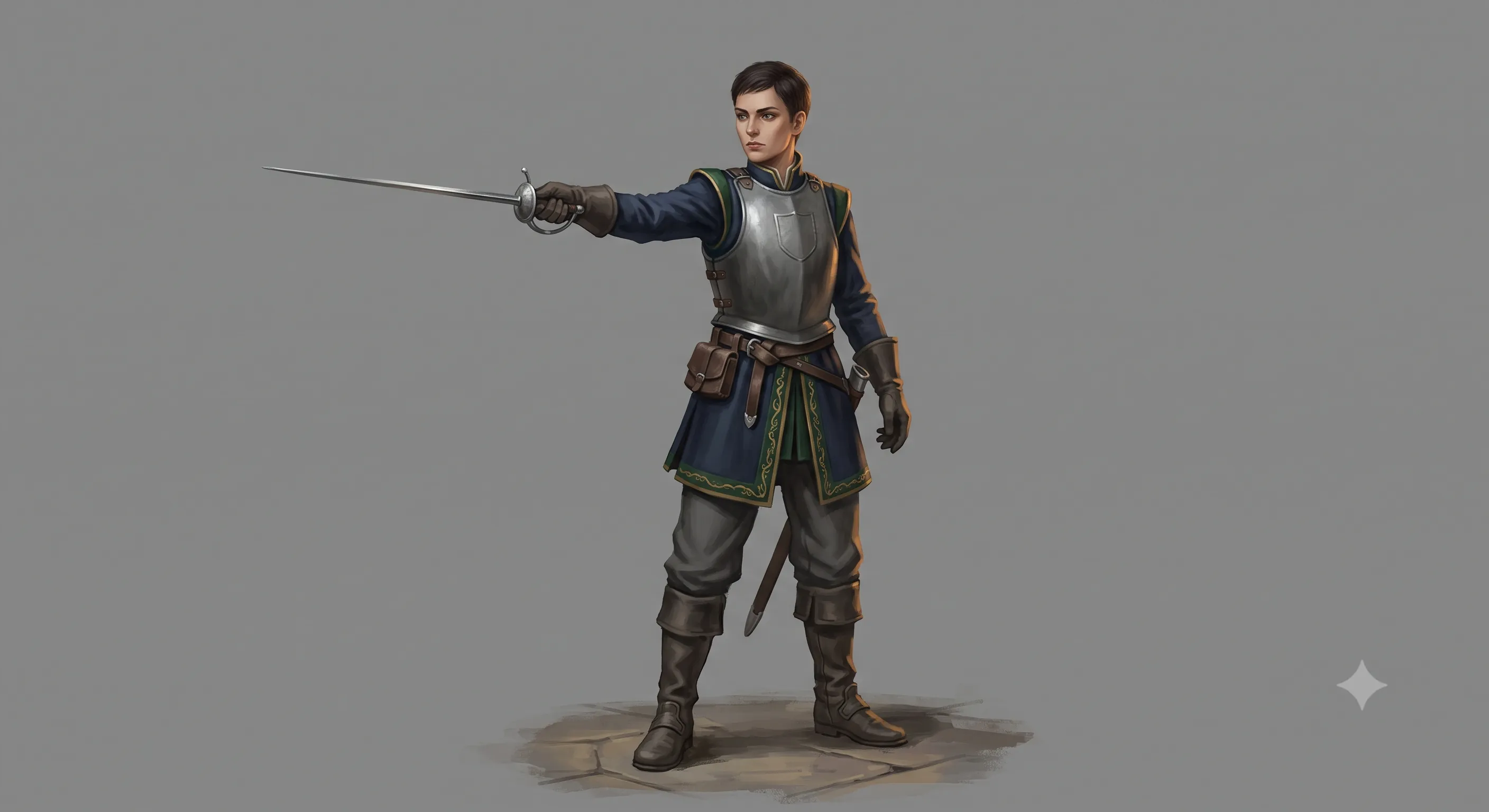
AC 16 (breastplate, duelist's guard) · HP 65 (10d8 + 20) · Speed 30 ft.
Traits: Poised Guard — the House Blade has advantage on Dexterity saving throws while it is holding its dueling sword and not incapacitated. Sworn to the House — the Blade will not flee a duel it has accepted on its House’s behalf while an opponent still stands; it fights to a clean yield or the floor.
Actions: Multiattack. The House Blade makes two Dueling Sword attacks. Dueling Sword. Melee Attack Roll: +5, reach 5 ft., one target. Hit: 9 (1d8 + 5) Slashing damage (a trained duelist’s grip and footwork, added into the damage).
Reactions: Parry and Riposte (1/round). When a creature the House Blade can see hits it with a melee attack, the Blade adds 3 to its AC against that attack. If this causes the attack to miss, the Blade immediately makes one Dueling Sword attack against the attacker as part of the same reaction.
GM note: A retained blade is a household’s honor made portable — kept, fed, and sworn to answer challenges for the House, sometimes down to answering for one named servant the House refuses to abandon. Parry and Riposte is deliberately a plain, mundane skill: a good fighter reading a good fighter, on a fixed clock of once per round. It is emphatically not the players’ Duelist resource system, spends no Fray or Faith-Die, and can’t be drained or countered as if it were — if a player tries to “burn his parry pool,” there’s no pool, just a person who’s better with a sword than you are. Run it as a set-piece duel and it sings; drop it into a mob and the once-per-round parry gets swamped fast, which is realistic and fine.
Guild-Hall Watch-Sergeant
Section titled “Guild-Hall Watch-Sergeant”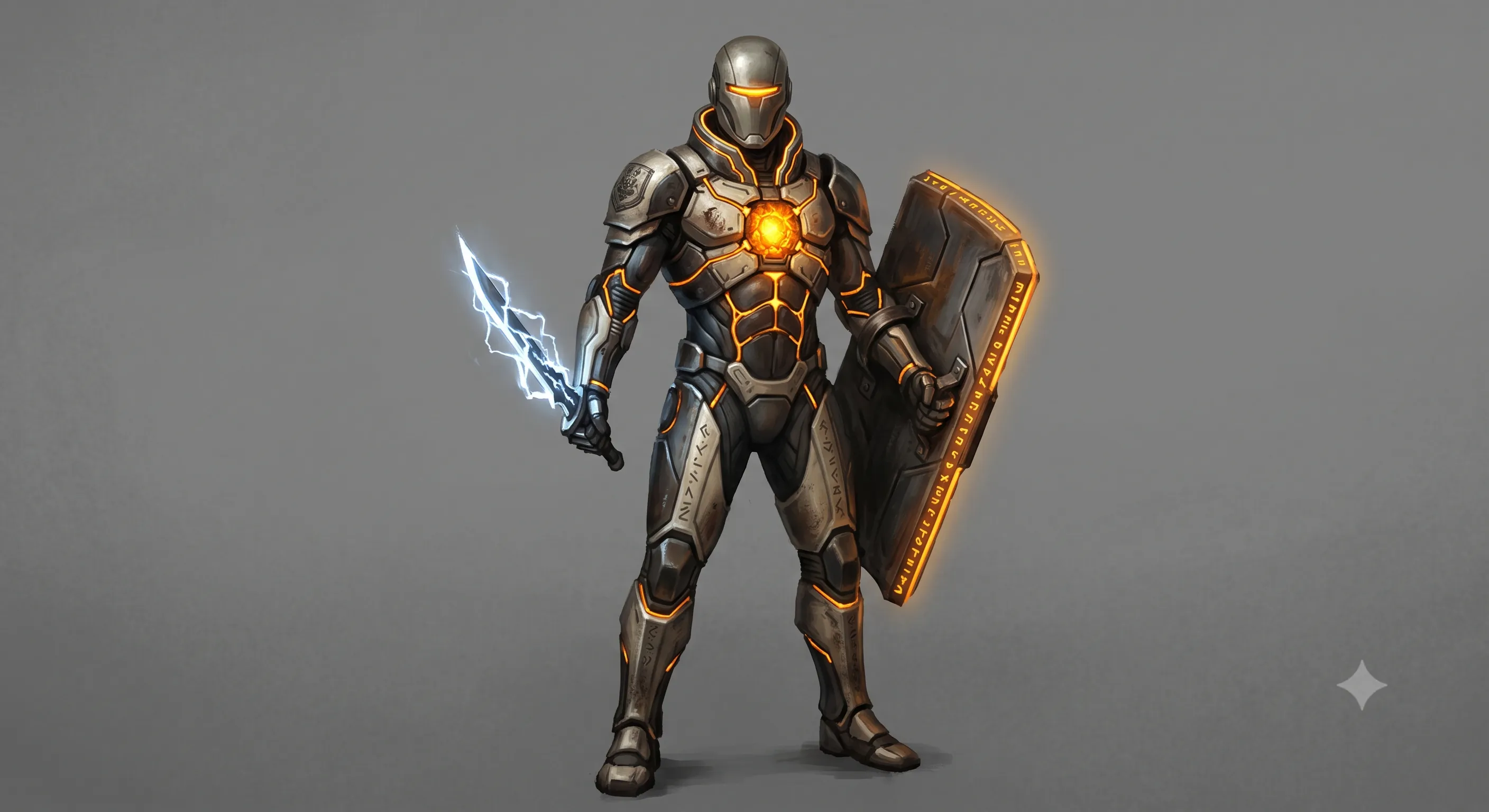
AC 18 (half-plate, shield) · HP 102 (12d10 + 36) · Speed 30 ft.
Traits: Chain of Command — as a bonus action, the Sergeant issues an order to up to two allied creatures within 30 ft. that can hear it (Wharf Bravos, House Guards, Guild Knuckles, and the like). Each may immediately use its reaction to move up to half its speed or make one weapon attack. For One — when a creature within 5 ft. of the Sergeant that it has sworn to protect (an allied lesser foe, or a citizen in its charge) is hit by an attack, the Sergeant can use its reaction to swap places with that creature and become the target of the attack instead, taking the hit in its stead. Hold the Hall (1/Day) — as a bonus action, the Sergeant barks the rally; each allied creature within 30 ft. that can hear it gains 7 temporary hit points and has advantage on saving throws against being Frightened until the end of the Sergeant’s next turn.
Actions: Multiattack. The Sergeant makes two Arming Sword attacks. Arming Sword. Melee Attack Roll: +6, reach 5 ft., one target. Hit: 11 (2d6 + 4) Slashing damage. Shield Bash (Recharge 5–6). Melee Attack Roll: +6, reach 5 ft., one target. Hit: 7 (2d4 + 2) Bludgeoning damage, and the target makes a Strength Saving Throw: DC 14. Failure: It is knocked Prone.
GM note: This is the encounter’s spine — the personal damage runs a touch under a lone CR 4 bruiser on purpose, because the premium is the action economy: Chain of Command lets the Sergeant fight the party with three or four bodies at once, turning the Guards and Knuckles above from filler into a real threat. Kill order at the table writes itself, and that’s intended — drop the Sergeant and the whole squad’s Chain of Command, Hold the Hall, and For One evaporate, leaving ordinary muscle that breaks morale fast. Play For One straight: it is the culture’s oath made mechanical — a leader who will physically take the blow meant for a single person in his charge, because in Merretia “for one” is not a slogan. Read him with the Knowing and you find a proud, tired man who means it; seize him with the Heart and you’re gripping that oath itself. And when he goes down, he stays a man who went down — the roster gets a black mark, the Guild-Hall posts a new name by morning, and not one thing about his death needs a Binder. The whole point of this chapter is that some of the most dangerous, most complicated fights in Merretia are the ones that close the instant the body hits the floor.
Callings, OCTA & the Frontier
Section titled “Callings, OCTA & the Frontier”(These are people. Every block here has a mind for the Knowing to read and a heart for the Heart to seize — the deliberate opposite of the Hollow’s “No Mind, No Heart.” They bleed, they bargain, they flee. When one of them reaches into a discipline, the eyes tell on them: Order colors glow, Chaos colors drink the light matte, Faith burns gold. Read the tell, then decide whether the fight was ever necessary.)
Hedge-Caster
Section titled “Hedge-Caster”
AC 12 · HP 27 (5d8+5) · Speed 30 ft.
Traits: One Discipline, No License — she can reach only Growing, and only in the small ways a lifetime of practice without schooling allows; when she does, her eyes drink to a lightless matte green (the Chaos tell). She has no legal focus-license, which is her real problem, not her power. Green Thumb (utility) — over an hour she can ripen a failing crop, mend and re-knit a broken wooden object, coax a hedge into a thorn-wall gate, or draw clean water up through roots. This is why the village keeps her.
Actions: Quarterstaff. Melee Attack Roll: +2, reach 5 ft. Hit: 4 (1d8) Bludgeoning damage. Thornlash (at-will). Ranged Spell Attack: +4, range 60 ft. Her eyes go matte green as a lash of thorned bramble whips out. Hit: 7 (2d6) Piercing damage. Snare Growth (Recharge 5–6). Roots erupt beneath a creature she can see within 30 ft., which makes a Dexterity Saving Throw: DC 12. Failure: It has the Restrained condition until it or an ally frees it (Strength or Dexterity check, DC 12, as an action).
GM note: The commonest “caster foe” your table will meet, and the one most players get wrong — they roll initiative on green eyes and matte light and only afterward learn they killed the woman who keeps three farms alive. She is not the boss of anything. The dangerous party in her story isn’t the adventurers; it’s the OCTA field agent two entries down, who will manacle her for casting without a license whether she ever hurt anyone or not. If your players want a fight here, let them have it, and let it sit badly.
Zar’ir Acolyte
Section titled “Zar’ir Acolyte”Medium humanoid (human), lawful neutral · Origin: Native — junior Faith devotee (Zar’ir, god-pair sworn)
AC 15 (chain shirt) · HP 39 (6d8+12) · Speed 30 ft.
Traits: Sworn to a Pair — she serves a god-pair and reaches Faith on their sufferance; each casting flushes her eyes gold (the Faith tell). She is junior — the mercy is small and the courage is louder than the skill. Hollow Is the Enemy — she has advantage on saving throws against being Frightened by Hollow-origin creatures and the undead, and will place herself between them and anyone she is sworn to protect.
Actions: Mace. Melee Attack Roll: +3, reach 5 ft. Hit: 5 (1d6+1) Bludgeoning damage, plus 3 (1d6) Radiant damage if the target is a Hollow-origin creature or undead. Mercy Balm (3/Day). Her eyes flush gold as she lays a hand on herself or an ally within 5 ft.; that creature regains 9 (2d8) hit points. Censure the Wound (at-will). She points at one Hollow-origin creature or undead within 30 ft.; her eyes flare gold and it makes a Wisdom Saving Throw: DC 12. Failure: 7 (2d6) Radiant damage and it can’t take Reactions until the end of its next turn. Against anything that is neither Hollow nor undead, the censure does nothing — the gold light passes over a living person like sunlight.
GM note: Run her as a frightened kid with real conviction and a very short toolkit. The tell that she’s green, not senior, is that she’ll sometimes level Censure the Wound at a party member who took cold damage from a seam and looks “blighted” — and it fizzles harmlessly, because censure only bites the actually-Hollow. Let the players watch it fizzle. It teaches them, mid-fight, that their ally is fine and that Faith reads the difference even when a scared acolyte can’t.
Street Firebrand
Section titled “Street Firebrand”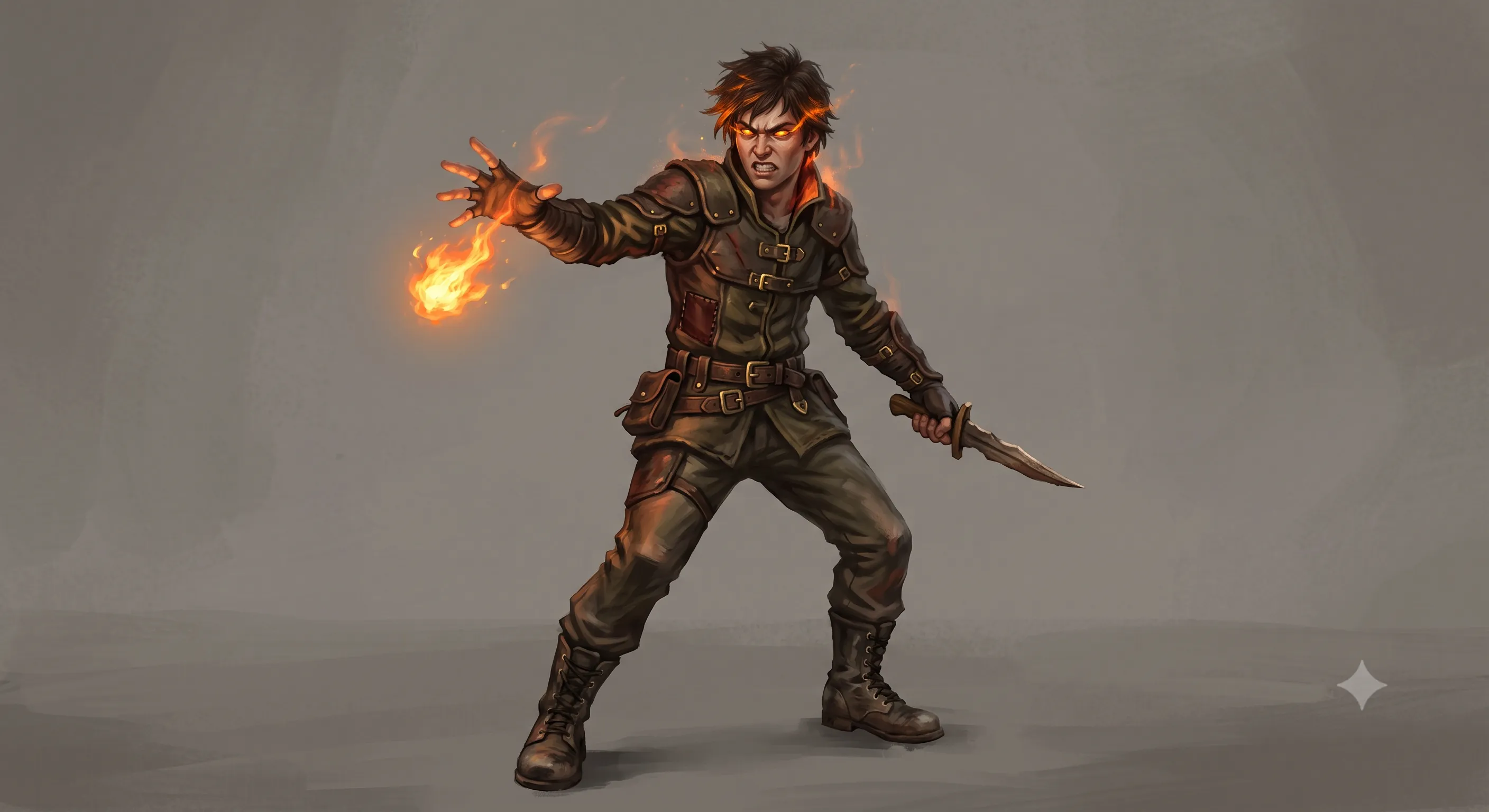
AC 13 (leather) · HP 65 (10d8+20) · Speed 30 ft.
Traits: Reckless — at the start of its turn, the Firebrand can choose to attack recklessly. Doing so gives it advantage on its attack rolls this turn, but attack rolls against it have advantage until the start of its next turn. Ember-Blooded — his eyes flare a glowing ember-orange whenever he reaches Unmaking (the Order tell); the same heat that lets him throw fire also keeps it from catching on him.
Actions: Multiattack. The Firebrand makes two attacks, using Fire-Bolt or Dagger in any combination. Fire-Bolt (at-will). Ranged Spell Attack: +4, range 60 ft. Orange light guts up in his eyes as a mote of fire leaps out. Hit: 11 (2d8+2) Fire damage. Dagger. Melee or Ranged Attack Roll: +4, reach 5 ft. or range 20/60 ft. Hit: 5 (1d6+2) Piercing damage. Backdraft (Recharge 5–6). His eyes blaze and heat floods a 15-ft. cone. Each creature there makes a Dexterity Saving Throw: DC 13. Failure: 18 (4d8) Fire damage. Success: Half damage.
GM note: He is not an arsonist mastermind; he’s an angry kid from the low wards with one genuinely dangerous trick and no license to have it. Backdraft is his whole threat — bait it out early (make the party spread, then let him blow it on one straggler) and the rest of the fight is a reckless boy throwing sparks. The ember-orange glow is also a countdown: any OCTA agent within sight has already clocked him, and the smart play for a scared Firebrand is to run before the manacles arrive, not to keep fighting adventurers he doesn’t actually hate.
OCTA Field Agent
Section titled “OCTA Field Agent”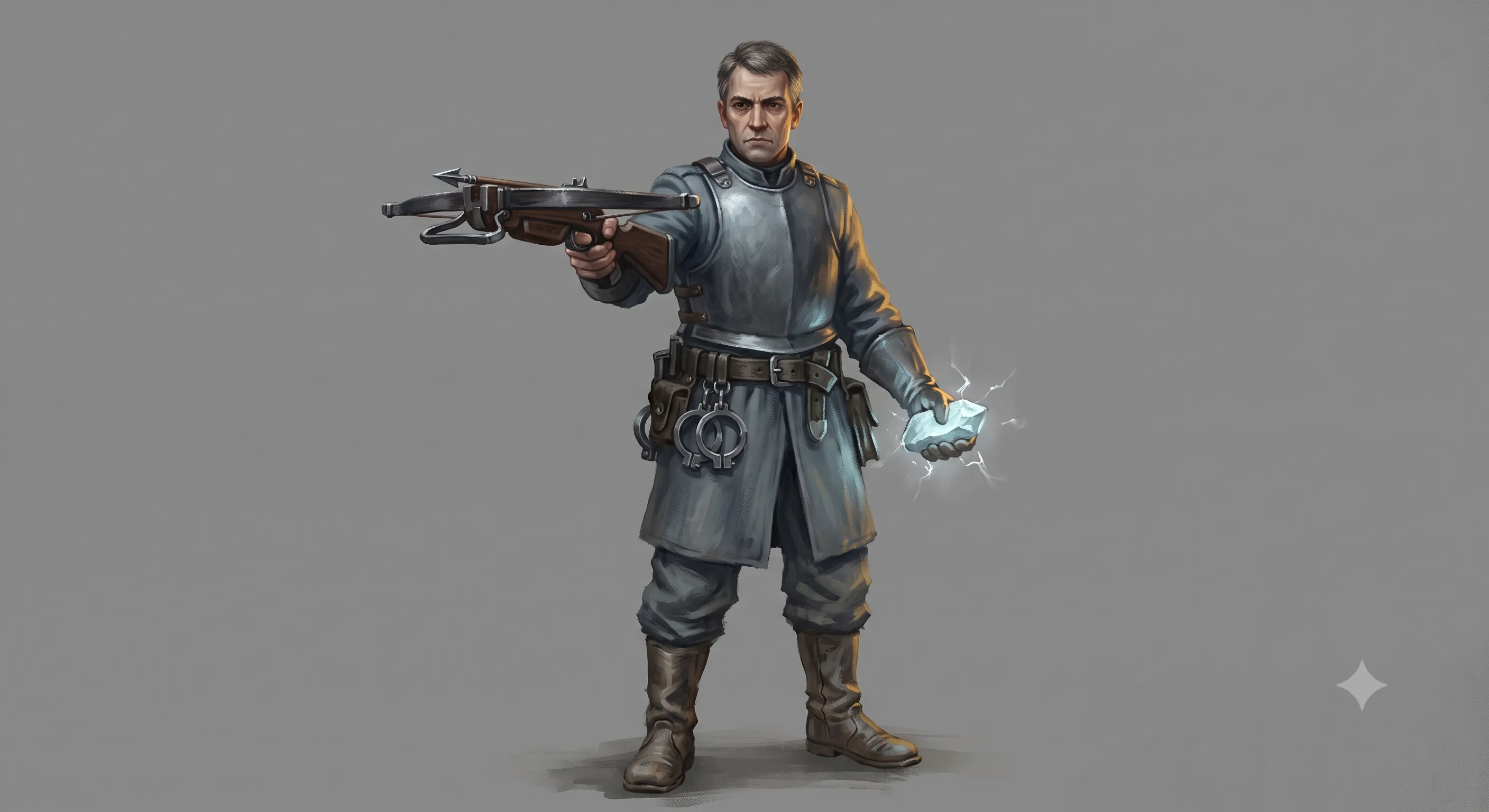
AC 16 (breastplate) · HP 60 (11d8+11) · Speed 30 ft.
Traits: Reader of the Reach — the agent can name a caster’s discipline on sight from the eye-flash color and tell at a glance whether the license is genuine; it is never fooled by a forged focus-stone. Anti-Caster Training — the agent has advantage on saving throws against spells and spell-like actions. It does not cast — everything it does is stone, steel, and law.
Actions: Multiattack. The agent makes two attacks with its Crossbow, or one Crossbow attack and one use of the Focus-Stone Disruptor. Crossbow. Ranged Attack Roll: +4, range 100/400 ft. Hit: 8 (1d10+3) Piercing damage. Focus-Stone Disruptor (Recharge 5–6). The agent points a keening grey stone at one creature it can see within 30 ft., which makes a Constitution Saving Throw: DC 13. Failure: Until the end of its next turn the target can’t reach any discipline — it can’t cast spells or use spell-like actions — and it takes 5 (2d4) psychic feedback as the stone jams the reach. Oath-Manacles (utility). As an action, the agent clamps oath-manacles onto a creature that is Incapacitated, Grappled, or willing. While manacled, the creature has the Restrained condition and cannot reach any discipline; only the agent’s key, or a broken oath, releases them.
GM note: This is the entry that flips the table’s assumptions about who the monster is. Sooner or later a player casts something illegal on capital ground — and this is who comes for them. Against a caster-heavy party the Disruptor is genuinely frightening: one failed Con save and your wizard is a very expensive crossbow target for a round. Play the agent as neither cruel nor corrupt, just correct and unstoppable, and let the party feel what the Hedge-Caster feels. If they kill an OCTA agent doing its lawful job, the office does not forget, and the next one brings friends.
Warrens-Runner Cutthroat
Section titled “Warrens-Runner Cutthroat”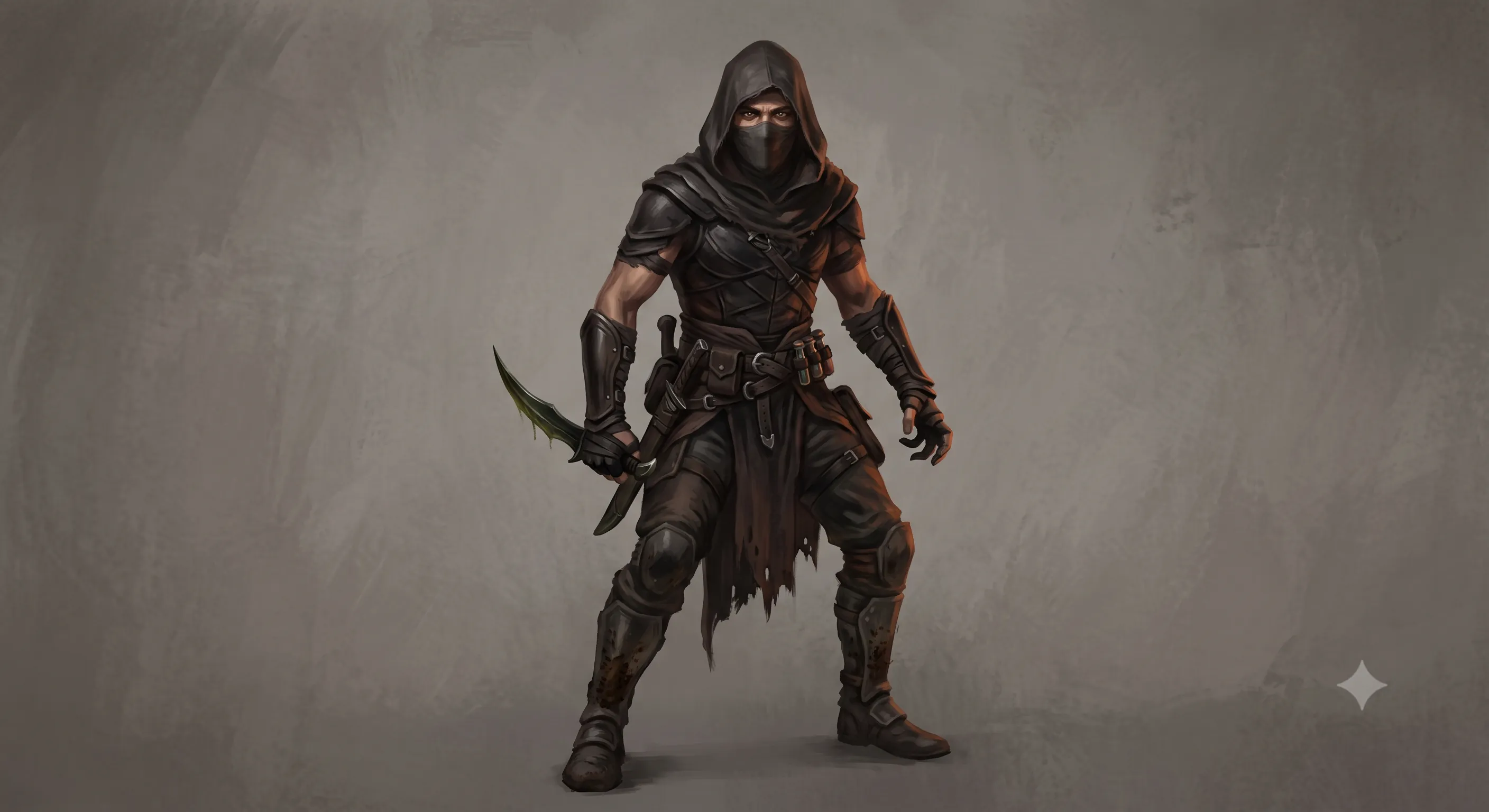
AC 14 (leather) · HP 44 (8d8+8) · Speed 30 ft.
Traits: Sneak Attack (1/Turn) — the cutthroat deals an extra 7 (2d6) damage when it hits with a weapon attack and has advantage on the roll, or when another enemy of the target is within 5 ft. of it and the cutthroat doesn’t have disadvantage. Assassinate — during its first turn, the cutthroat has advantage on attack rolls against any creature that hasn’t yet acted. Any hit it scores against a Surprised creature is a critical hit.
Actions: Multiattack. The cutthroat makes two Coated Blade attacks. Coated Blade. Melee or Ranged Attack Roll: +5, reach 5 ft. or range 20/60 ft. Hit: 6 (1d6+3) Piercing damage plus 3 (1d6) Poison damage, and the target makes a Constitution Saving Throw: DC 12. Failure: It has the Poisoned condition for 1 minute (repeat save at the end of each of its turns).
Bonus Actions: Cunning Action — the cutthroat takes the Dash, Disengage, or Hide action.
GM note: The entire fight lives or dies on surprise. If the cutthroat gets the drop — Assassinate + a crit + Sneak Attack + poison — a lone PC can be crippled before initiative feels fair. But that math runs backward the instant the party spots the ambush first: 44 HP is thin, and a Warrens-Runner who’s lost the surprise round would frankly rather Cunning-Action into the dark and try again tomorrow than trade blows. Reward the player who insisted on a Perception check in the alley. This encounter is a lesson about who chose the ground.
Licensed Bravo
Section titled “Licensed Bravo”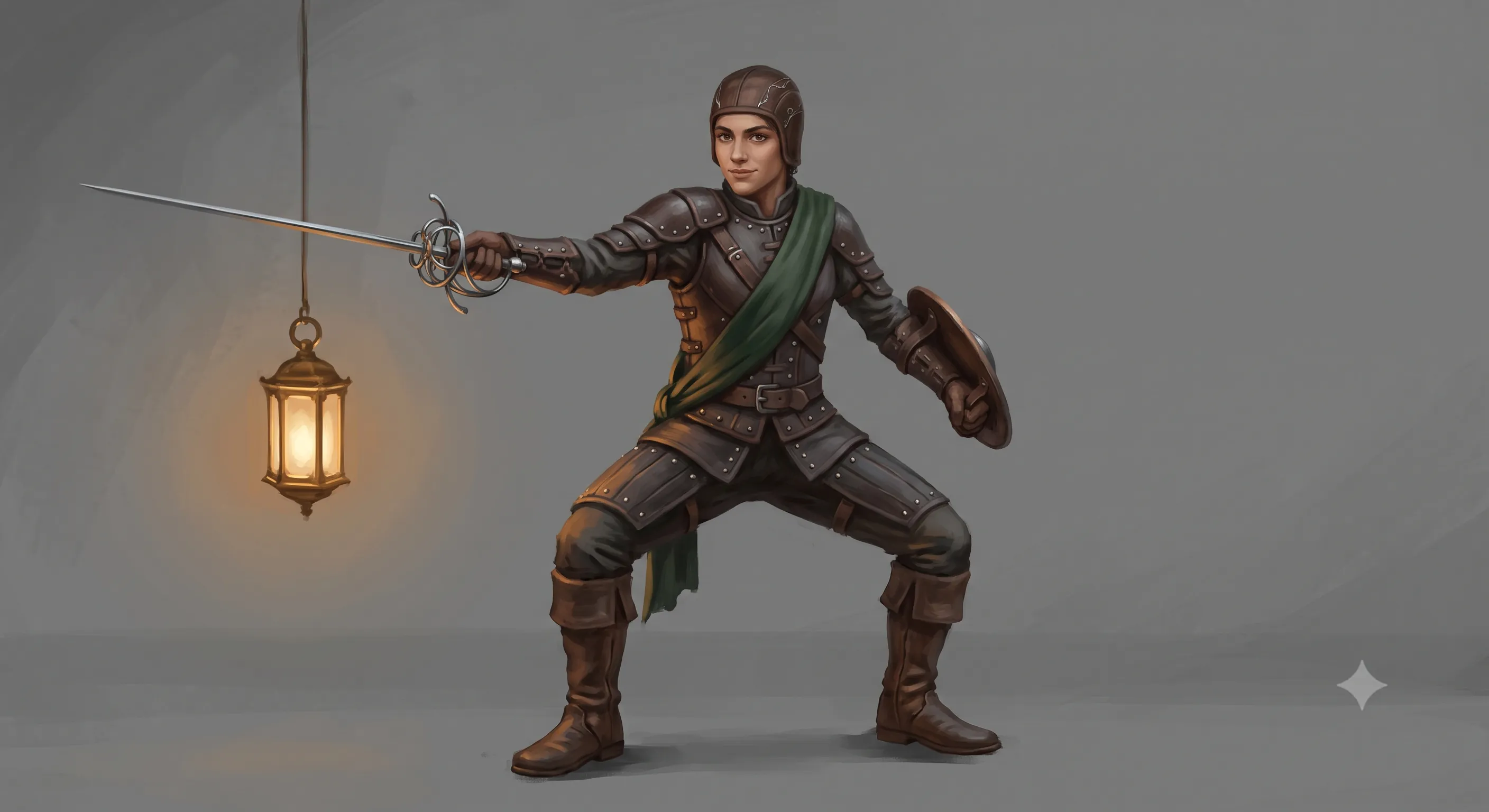
AC 16 (studded leather, Dexterous stance) · HP 45 (7d8+14) · Speed 30 ft.
Traits: Dueling Stance — while wielding a single one-handed weapon and no other weapon, the Bravo gains a +2 bonus to that weapon’s damage (already included below). Formal Challenge (mundane) — as a special action outside combat, the Bravo names one target and invokes a licensed duel. This is a social instrument, not a discipline: while the two of them fight one-on-one and no third party interferes, the Bravo has advantage on Charisma (Intimidation) checks against the target, and any onlooker of standing treats a challenged foe who flees or swarms as having broken faith. In Merretia, broken faith is a debt.
Actions: Dueling Blade. Melee Attack Roll: +5, reach 5 ft. Hit: 9 (1d8+5) Piercing damage.
Reactions: Riposte — when a creature the Bravo can see misses it with a melee attack, the Bravo makes one Dueling Blade attack against that creature.
GM note: The Bravo is a duel wearing a person. His Riposte quietly punishes the party’s biggest, whiffiest melee bruiser — every miss buys a counter — so nudge the martials toward patience rather than flailing. The real teeth, though, are in the Formal Challenge: a table that accepts and fights him honestly earns standing they can spend later; a table that dogpiles him wins the initiative and loses the ledger, because this is a Houses-and-oaths city and someone with a name watched them break faith. Not every stat block is meant to be solved with focus fire.
Waste-Land Raider
Section titled “Waste-Land Raider”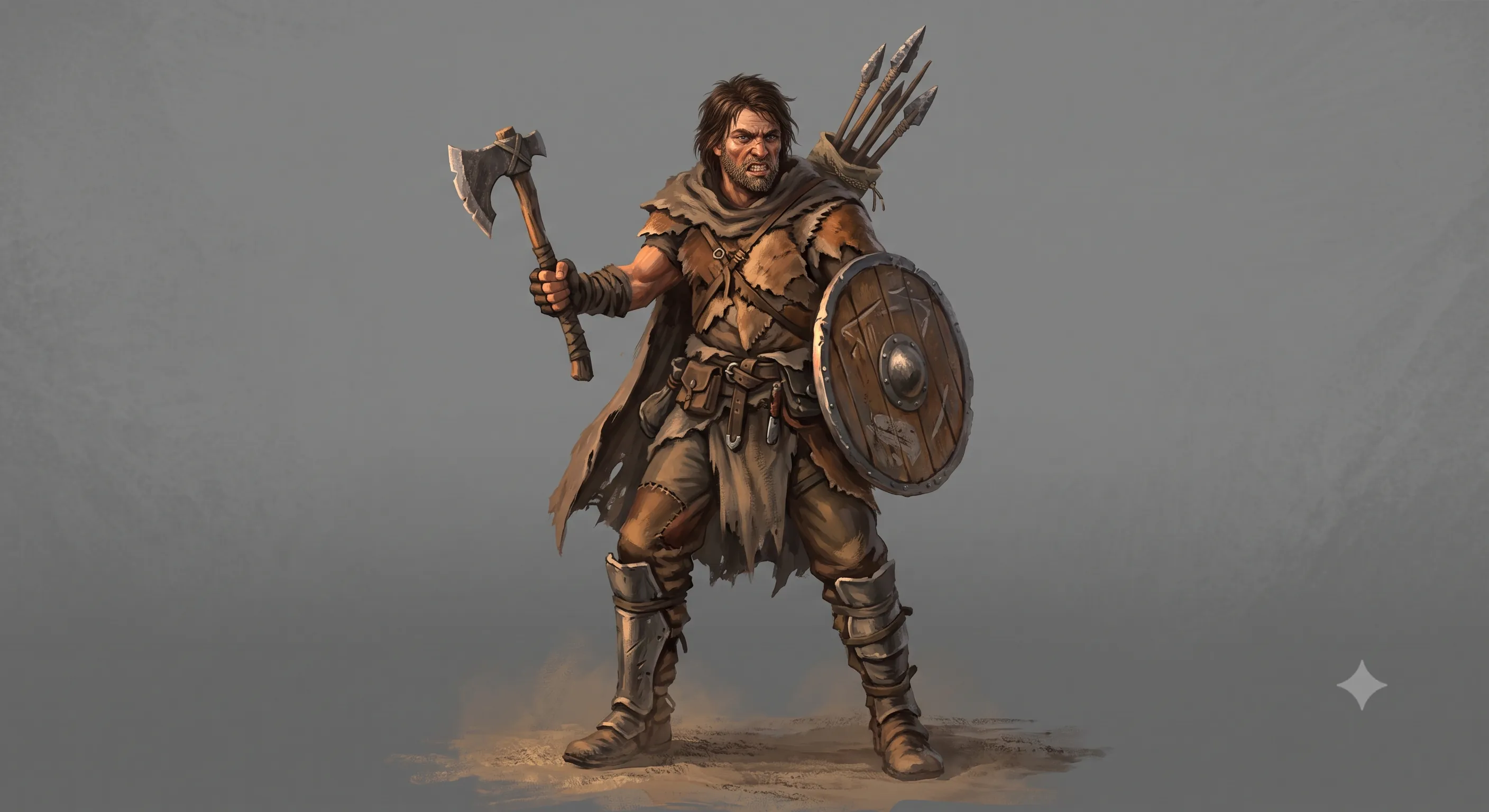
AC 13 (hide armor, shield) · HP 22 (4d8+4) · Speed 30 ft.
Traits: Pack Tactics — the raider has advantage on an attack roll against a creature if at least one of the raider’s allies is within 5 ft. of the creature and not Incapacitated.
Actions: Hand-Axe. Melee or Ranged Attack Roll: +4, reach 5 ft. or range 20/60 ft. Hit: 5 (1d6+2) Slashing damage. Javelin. Melee or Ranged Attack Roll: +4, reach 5 ft. or range 30/120 ft. Hit: 5 (1d6+2) Piercing damage.
GM note: Never fielded alone and never meant to be — the Waste-Land Raider is a Pack Tactics delivery mechanism, and one of them is a speed bump. Six of them opening with a javelin volley from the watchtower scree, then closing to flank, is a real fight for a low party. The counter is exactly the counter for the Rent Jackals: break line of sight, deny the flanks, and thin the pack, because every raider you drop is one less “ally within 5 feet” propping up the advantage for the rest. See the next entry for what makes them scary.
Raid-Captain of the Waste
Section titled “Raid-Captain of the Waste”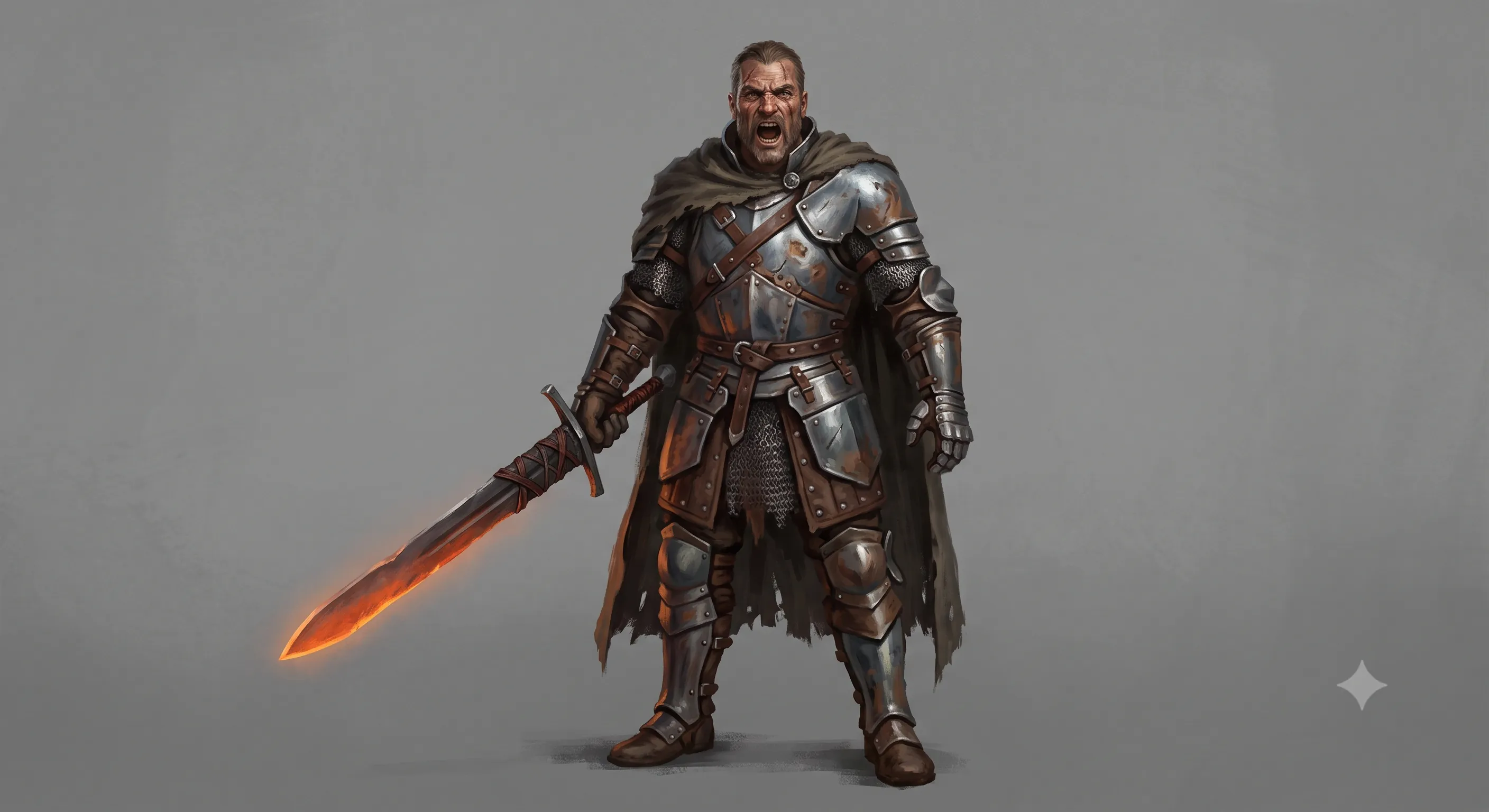
AC 16 (scavenged half plate) · HP 90 (12d8+36) · Speed 30 ft.
Traits: Rally (Recharges after a Short or Long Rest) — for 1 minute, whenever a non-hostile creature the captain can see within 30 ft. makes an attack roll or a saving throw, the captain can shout a command as no action, and that creature adds a d4 to the roll. The captain can command a different creature (or the same one) on each such roll. Buried-Sun Steel — the captain’s blade was tempered in a buried-sun forge; it counts as magical and holds a low ember of heat that never fully cools.
Actions: Multiattack. The captain makes two Buried-Sun Blade attacks. Buried-Sun Blade. Melee Attack Roll: +5, reach 5 ft. Hit: 8 (1d8+3) Slashing damage plus 3 (1d6) Fire damage.
Reactions: Turn the Blade — when a creature the captain can see hits it with a melee attack, the captain adds 2 to its AC against that attack, possibly turning the hit into a miss.
GM note: Kill the captain first — that is the whole tactical lesson and you should let the players discover it the hard way. Rally is what upgrades a mob of CR-1/2 speed bumps into a coordinated warband landing hits it has no business landing; silence the shouting and the raiders deflate back into javelin fodder. Play the captain fighting from the middle of the pack, always within 30 ft. of the most raiders, daring the party to wade in to reach it. The buried-sun blade is tempting loot; note for the table that it is forge-marked and OCTA-registered, and walking into the capital swinging a dead raid-captain’s registered steel is a conversation the party may not want to have.
Hollowmarked Pariah
Section titled “Hollowmarked Pariah”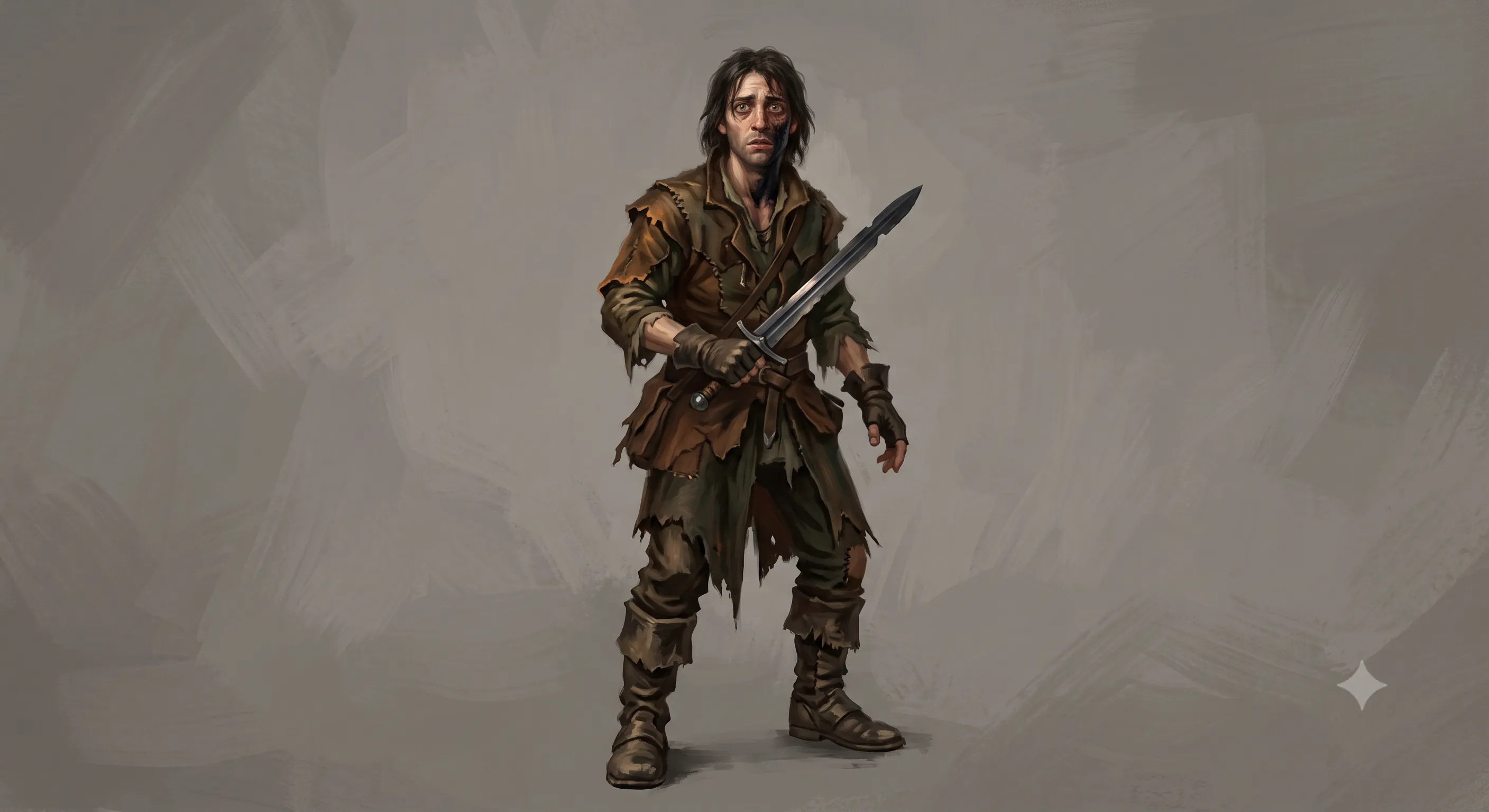
AC 13 (worn leathers) · HP 65 (10d8+20) · Speed 30 ft.
Traits:The Mark Is Not the Monster — this is the load-bearing trait, so read it aloud in your head before the fight: the Pariah is a living person with a mind and a heart. The Knowing reads them like anyone (thoughts, fears, the whole aching interior); the Heart seizes them like anyone; charm and fear effects land on them like anyone. Note the ability scores — no 1s in INT, WIS, or CHA. They are the exact inverse of “No Mind, No Heart.” They can be reasoned with, they beg, they bleed, and they die like a person, because they are one. Borrowed Dread — the void-black Hollow mark seared into them leaks a little genuine wrongness they have learned to weaponize out of necessity; their eyes do not flash a discipline color, because they are not truly reaching a discipline — the dread is theater over a real wound.
Actions: Multiattack. The Pariah makes two Wound-Marked Strikes. Wound-Marked Strike. Melee Attack Roll: +4, reach 5 ft. Hit: 6 (1d8+2) Slashing damage plus 4 (1d8) Necrotic damage as the mark bites through the blade. Dread Pulse (Recharge 5–6). The mark flares matte and lightless; each creature within 15 ft. that can see the Pariah makes a Wisdom Saving Throw: DC 12. Failure: It has the Frightened condition until the end of its next turn.
GM note: This entry exists to be the cruelest trick in the chapter, and the trick is on the players. You have spent the whole Hollow chapter training them that void-black + a dread pulse + no eye-color means an absence to be destroyed and Bound — so they will roll initiative on a frightened human being with a burn scar. Everything the Knowing and the Heart return here is a someone: a name, a family that turned them out, a town that spits when they pass. The tragedy isn’t that they’re dangerous; it’s that they were made dangerous by people treating them exactly the way your table is about to. If the party stops and talks, they get a person and possibly an ally. If they don’t, let the corpse read, under the Knowing, as heartbreakingly ordinary — and let that sit badly too.
Wider Roster — Marshals, Bosses, Specialists & Cults
Section titled “Wider Roster — Marshals, Bosses, Specialists & Cults”The deeper bench the Encounter Generator draws on: the city watch and its sergeants, guild champions and the magnates who command them, the underworld’s spies and blades-for-hire and crime-lords, the trained casters and the OCTA inquisitor who hunts them, and the Heralds of the Sunborn — from cheap fanatic fodder to a cell-leader who reads a fight before it lands. Still mundane people, all of them; the elites simply cost more to put down.
Dome Marshal
Section titled “Dome Marshal”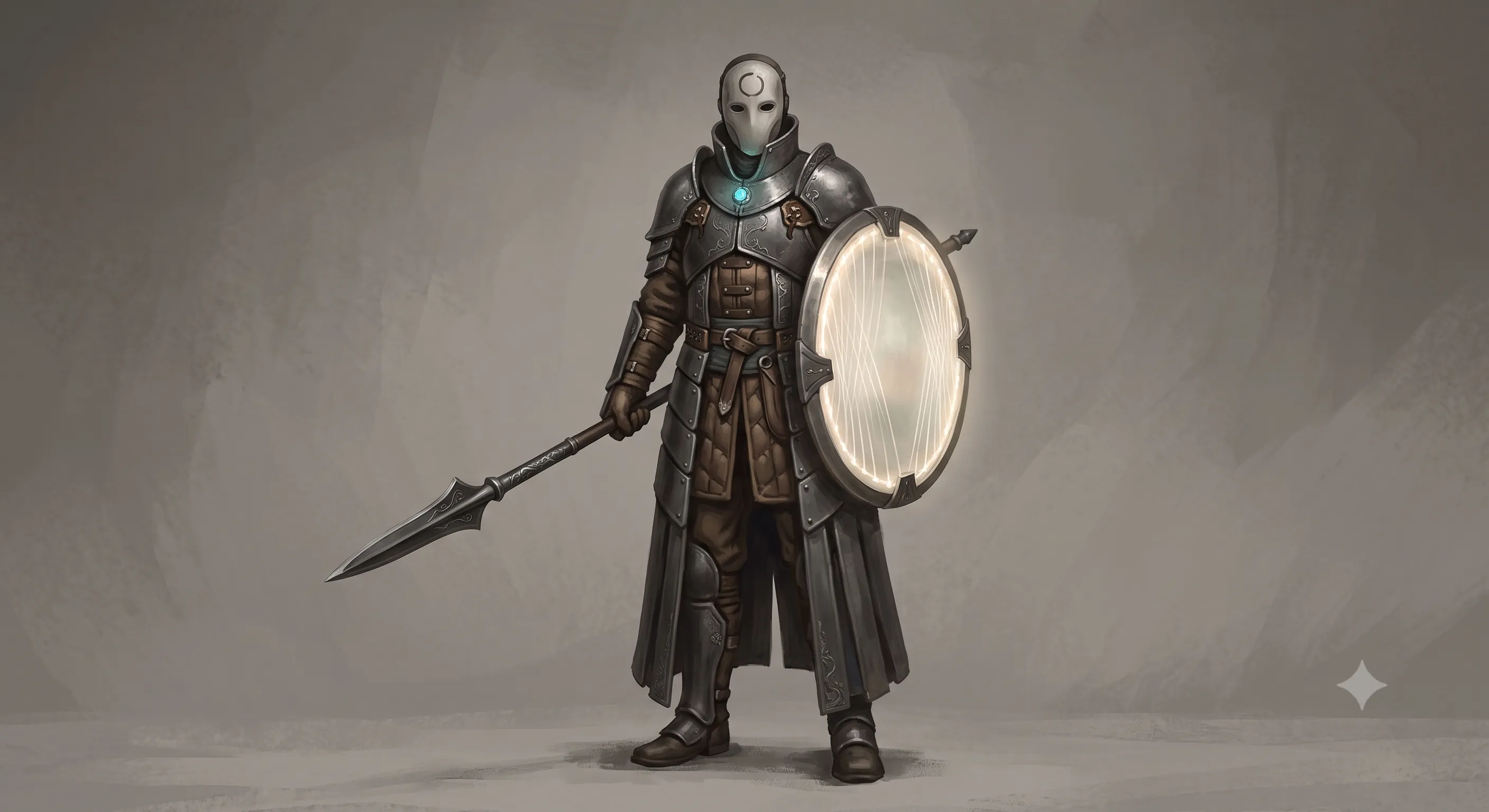
AC 16 (chain shirt, shield) · HP 39 (6d8 + 12) · Speed 30 ft.
Traits: Dome Formation — while at least one other Dome Marshal is within 5 ft. of it and using a shield, this Marshal has +1 AC (included below when in formation: AC 17) and has advantage on Strength and Dexterity saving throws to avoid being moved, knocked Prone, or shoved out of the line. Baton Discipline — the watch is meant to bring in, not bury. The Marshal may choose to deal Bludgeoning instead of Piercing damage with its spear (striking with the shod butt or a drawn baton), and any creature it reduces to 0 hit points this way is knocked Unconscious and left Stable rather than dying — hauled to a holding-dome to answer the writ.
Actions: Spear. Melee or Ranged Attack Roll: +4, reach 5 ft. or range 20/60 ft., one target. Hit: 5 (1d6 + 2) Piercing damage, or 6 (1d8 + 2) Piercing damage if used two-handed to attack (shield slung). Light Crossbow. Ranged Attack Roll: +3, range 80/320 ft., one target. Hit: 5 (1d8 + 1) Piercing damage.
GM note: These are the “guards” — the rank-and-file under the domes at every gate, bridgehead, and Guild-Hall door. One is a man with a spear and a shield; a squad is a wall, and the wall is the entire point (Dome Formation). Break it — a shove, a chokepoint that lets you meet them one at a time, a lure off the line — and each Marshal is just an ordinary soldier again. They arrest by default (Baton Discipline): a party that yields gets dragged to a holding-dome and a debt-hearing, not a grave, which in Merretia is frequently the worse outcome, because now your name is on a ledger. Read one with the Knowing and you get a flat, dutiful thought (hold the line, mind the sergeant); seize him with the Heart and you’re gripping the plain fear of losing the wage that feeds a family. Drop him and he stays dropped — the roster posts a new name by the next watch, and nothing drifts through the fog to take the post.
Marshal-Sergeant
Section titled “Marshal-Sergeant”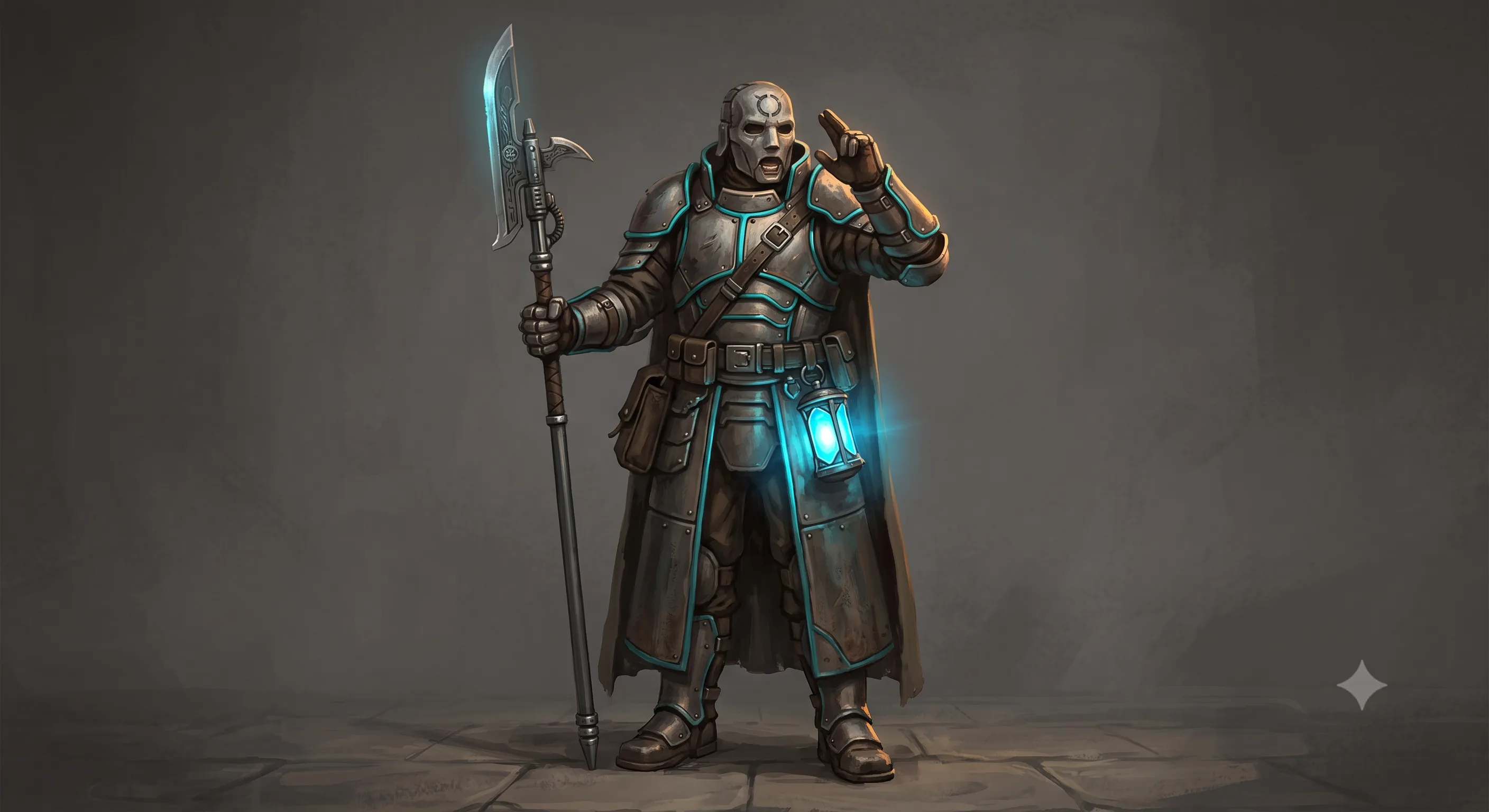
AC 18 (half-plate, shield) · HP 58 (9d8 + 18) · Speed 30 ft.
Traits: Steady the Line — as a bonus action, the Sergeant calls the cadence; each allied Dome Marshal within 30 ft. that can hear it may immediately use its reaction to move up to half its speed or make one weapon attack. Hold Formation — allied Dome Marshals within 10 ft. of the Sergeant count as being “in formation” for their Dome Formation trait even if no other Marshal is adjacent to them, and they have advantage on saving throws against being Frightened while they can see the Sergeant standing.
Actions: Multiattack. The Sergeant makes two Arming Sword attacks. Arming Sword. Melee Attack Roll: +5, reach 5 ft., one target. Hit: 7 (1d8 + 3) Slashing damage. Shield Bash (Recharge 5–6). Melee Attack Roll: +5, reach 5 ft., one target. Hit: 5 (1d4 + 3) Bludgeoning damage, and the target makes a Strength Saving Throw: DC 13. Failure: It is knocked Prone.
GM note: The sergeant is what turns a knot of Dome Marshals from filler into a squad, and Steady the Line is the reason to fear the fight: it buys the Sergeant extra bodies on the board every round, so the rank-and-file hit two or three times as often as their initiative slots should allow. The kill order writes itself, and that’s intended — drop the Sergeant and Steady the Line, Hold Formation, and the squad’s whole nerve go down with him, leaving spears that break morale the moment the cadence stops. He is career watch, not a hero: a man who came up through the domes and means the oath in a bone-tired way. Read that plainly with the Knowing; the Heart can seize the quiet pride he takes in a clean, bloodless arrest and turn it into a half-second of hesitation at exactly the wrong moment. When he falls he stays fallen — the Guild-Hall posts a replacement by morning, the widow gets a wage-token, and no seam feeds a new sergeant into the gap.
Coilbow Marksman
Section titled “Coilbow Marksman”
AC 15 (studded leather, coil-harness) · HP 45 (7d8 + 14) · Speed 30 ft.
Traits: Coilbow — the marksman’s magitech crossbow is fed by a cased buried-sun cell that flings its bolt flat and hard. Its Coilbow attacks ignore half cover and three-quarters cover, and it makes Coilbow attacks at long range without disadvantage. Sighted In — if the marksman did not move on its turn, its first Coilbow attack that turn scores a critical hit on a roll of 19 or 20.
Actions: Multiattack. The marksman makes two Coilbow attacks. Coilbow. Ranged Attack Roll: +5, range 120/480 ft., one target. Hit: 7 (1d8 + 3) Piercing damage.
Reactions: Overwatch. When a creature the marksman can see enters or leaves cover, rounds a corner, opens a door, or otherwise moves into or out of the marksman’s clear line of sight, the marksman can make one Coilbow attack against that creature.
GM note: A coilbow is a licensed piece of magitech — a crossbow with a cased buried-sun cell where the goat’s-foot would be — and OCTA cares only that the case is sealed and the papers are stamped; the bolt itself is mundane iron doing mundane murder at four hundred feet. Rented by the contract to Houses, Guild-Halls, and anyone who can afford a rooftop and a retainer, the marksman is a positioning problem, not a slugging match: it ignores cover, ignores range, punishes anyone who moves in the open (Overwatch), and deletes a caster or a face-character from clear across a plaza. Close the distance and it folds — 45 hit points and no melee to speak of, so the fight is really “can we reach it.” Read it with the Knowing and you get a bored professional counting the lead on a shot; the Heart seizes the fear of the contract-holder it dares not miss for. It has no oath past the fee, so it will lower the coilbow and talk terms the instant the fee stops being worth its skin. Kill it and you’ve killed a licensed contractor — the cell gets logged back to OCTA, and the House simply hires the next one on the roll.
Guildmaster’s Champion
Section titled “Guildmaster’s Champion”Medium humanoid (human), lawful neutral · Origin: Native — elite retained duelist
AC 18 (oath-metal plate, duelist's guard) · HP 112 (15d8 + 45) · Speed 30 ft.
Traits: Bonded Focus-Stone — a focus-stone is set into the pommel of the champion’s oath-metal blade and keyed to its bearer. The first time the champion hits with the blade on each of its turns, the stone flares and the strike deals an extra 4 (1d8) Force damage. This is a keyed, mundane-licensed implement, not a spell: it cannot be dispelled, spends no discipline resource, and goes inert in any hand but the champion’s. Master Duelist — the champion has advantage on Dexterity saving throws while it holds its blade and is not incapacitated, and it cannot be knocked Prone by an attack it is aware of. Answers for the House — the champion will not flee a challenge it has accepted on its master’s behalf while an opponent still stands; it fights to a clean yield or the floor.
Actions: Multiattack. The champion makes three Oath-Metal Blade attacks. Oath-Metal Blade. Melee Attack Roll: +7, reach 5 ft., one target. Hit: 9 (1d10 + 4) Slashing damage.
Reactions: Parry and Riposte (1/round). When a creature the champion can see hits it with a melee attack, the champion adds 4 to its AC against that attack. If this causes the attack to miss, the champion immediately makes one Oath-Metal Blade attack against the attacker as part of the same reaction.
GM note: Where the House Blade is one household’s honor made portable, the Champion is a Guildmaster’s — the single best sword the eighteen can buy, kept fed and idle against the day a rival, a duel, or a debt has to be answered in blood. Run the block as a set-piece: three clean strikes, a stone that flares once a turn, and a parry that turns a hero’s best hit into an opening (Parry and Riposte). Underline for the table that none of it is a player resource — the Focus-Stone is a licensed implement, not a discipline, so it spends no Fray, can’t be countered or “burned down,” and dies inert the instant the champion does; the parry is one gifted fighter reading another on a fixed once-a-round clock, not a pool to drain. Run it one-on-one and it sings; bury it in a mob and the single parry gets swamped fast, which is honest and fine. Read it with the Knowing and you find a lifetime of drills and a quiet contempt for amateurs; the Heart seizes the pride that will not yield a challenge it accepted. Kill the Champion and a Guildmaster is out a fortune and a symbol — and sends lawyers, not another sword, next.
Guild Magnate (“the Boss”)
Section titled “Guild Magnate (“the Boss”)”
AC 16 (warded coat, concealed plate) · HP 127 (17d8 + 51) · Speed 30 ft.
Traits: Command — as a bonus action, the Magnate names one allied creature within 30 ft. that can see or hear it; that ally immediately uses its reaction to move up to its speed or make one weapon attack. The Magnate does not fight so much as spend the people who do. Retinue — the Magnate is never encountered alone; it moves with hired bodyguards (Dome Marshals, a Coilbow Marksman, a House Blade or a Champion) who are bound by paid contract to place themselves between the Magnate and harm. Reads the Room — the Magnate has advantage on Wisdom (Insight) checks and can’t be Surprised while at least one conscious ally is within 30 ft. of it.
Actions: Multiattack. The Magnate makes two Coil-Pistol attacks. Coil-Pistol. Ranged Attack Roll: +5, range 40/120 ft., one target. Hit: 7 (1d10 + 2) Piercing damage (a concealed magitech pistol firing a buried-sun bolt). Point-Blank Overload (Recharge 5–6). The Magnate empties the pistol’s whole cell into one target within 30 ft. that it can see. The target makes a Dexterity Saving Throw: DC 15. Failure: 17 (5d6) Radiant damage. Success: half damage. The pistol can’t be fired again until the start of the Magnate’s next turn (the cell needs a moment to re-seat).
Reactions: Bought Protection. When the Magnate is hit by an attack, if a willing ally it can see is within 5 ft. of it, the Magnate orders that ally to take the blow; the ally becomes the target of the attack and takes the damage and any effects instead of the Magnate.
GM note: This is the man the whole chapter has been walking toward — a power inside a Guild or a House who has never once needed to be good with a weapon, because in Merretia power is other people and he owns their contracts. Run him like the Marshal-Sergeant, only more so: his personal damage is deliberately soft for a CR 6 (the Coil-Pistol and the once-a-fight Overload are a threat, not a beating), and the entire premium is action economy and survival. Command spends his retinue’s reactions to strike out of turn; Bought Protection spends their bodies to eat the hits meant for him — and both are cold, legal, paid-for facts, not cartoon villainy, which is the horror of it. The bodyguard who steps into the sword is fulfilling a contract he signed, and the Boss is fully within his writ to call it. The kill order is obvious and correct: cut through the retinue to reach him, and the instant he drops, Command and Bought Protection die with him and the survivors are just hirelings with nobody left to pay them. Read him with the Knowing and you get a fast, tired, calculating mind already pricing the room; seize him with the Heart and you find the one thing he is truly afraid of losing — never his life, always his leverage. Take him down and you have not killed a monster; you have killed a creditor, and somewhere a ledger with your name on it just changed hands. Nothing drifts in to replace him. The Guild simply holds an election.
Street Tough
Section titled “Street Tough”
AC 12 (leather scraps) · HP 11 (2d8 + 2) · Speed 30 ft.
Traits: Pack Tactics — the tough has advantage on an attack roll against a creature if at least one of its allies is within 5 ft. of the creature and not Incapacitated.
Actions: Cudgel or Knife. Melee Attack Roll: +3, reach 5 ft., one target. Hit: 4 (1d6 + 1) Bludgeoning damage from a cudgel, or 3 (1d4 + 1) Piercing damage from a knife.
GM note: The cheapest body in the Warrens — a corner-boy with a stick and a grudge, worth nothing alone and dangerous only in a swarm. One of them is a speed bump; five of them stacking Pack Tactics around your fighter’s flanks is a real fight for a low party, and that is the entire point of the block. Field them in numbers or don’t field them. They break the instant the odds turn, because there is no oath here worth a beating — a Knowing read gets you one flat thought (don’t be the one who stays), and the moment their advantage evaporates so does their nerve. Kill one and it is a kid from the low wards who died, not a monster closed; nothing drifts in to fill his corner next tenday, but someone in the Warrens knew his name.
Smuggler’s Runner
Section titled “Smuggler’s Runner”Medium humanoid (human), chaotic neutral · Origin: Native — Warrens contraband courier
AC 14 (leather, Dex) · HP 33 (6d8 + 6) · Speed 30 ft.
Traits: Nimble Escape — the runner takes the Disengage or Hide action as a bonus action on each of its turns. Unstable Contraband Sun-Cell — the runner carries a single uncased buried-sun cell that runs hot and wrong. If the runner is reduced to 0 hit points before it has thrown the cell (see Hurl the Cell), the cell ruptures in its space using that same effect. The cell can be used only once, one way or the other.
Actions: Multiattack. The runner makes two Hand-Crossbow attacks. Hand-Crossbow. Ranged Attack Roll: +5, range 30/120 ft., one target. Hit: 6 (1d6 + 3) Piercing damage. Hurl the Cell (1/encounter). The runner throws its unstable sun-cell at a point up to 20 ft. away, where it ruptures. Each creature within 10 ft. of that point makes a Dexterity Saving Throw: DC 12. Failure: 7 (2d6) Radiant damage and the creature is Blinded until the end of its next turn. Success: Half damage, and not Blinded. Once thrown, the cell is spent.
GM note: A courier, not a killer — his job is to move a hot cell across the low-city without getting caught, and every instinct he has is built for leaving, not winning. Nimble Escape means he kites: a bolt, then a bonus-action Disengage into the next doorway, dragging the fight through terrain he knows and you don’t. The sun-cell is his panic button and your battlefield toy at once — telegraph the heat-shimmer and the faint hum so an attentive party reads the threat, then let them decide whether to corner him next to the lamp-oil. Note the mundane logic: the cell is contraband because it is an uncased industrial part smuggled without an OCTA license, not because it is Hollow-blighted — no Binder needed, no seam involved, just a stolen power source running without a safety case. Drop him before he throws and he ruptures anyway; that is deliberate, and worth a warning shot of description before it lands on the melee line.
Freelance Spy
Section titled “Freelance Spy”
AC 14 (leather, Dex) · HP 44 (8d8 + 8) · Speed 30 ft.
Traits: Read the Room — the spy has advantage on Wisdom (Insight) checks to gauge a gathering and on Charisma (Deception) checks made to blend in, pass unnoticed, or impersonate a specific person it has studied. Sneak Attack (1/Turn) — the spy deals an extra 7 (2d6) damage when it hits with a weapon attack and has advantage on the roll, or when another enemy of the target is within 5 ft. of it and the spy doesn’t have disadvantage.
Actions: Multiattack. The spy makes two Coated Blade attacks. Coated Blade. Melee or Ranged Attack Roll: +4, reach 5 ft. or range 20/60 ft., one target. Hit: 5 (1d6 + 2) Piercing damage plus 3 (1d6) Poison damage, and the target makes a Constitution Saving Throw: DC 12. Failure: It has the Poisoned condition for 1 minute (repeat save at the end of each of its turns).
Bonus Actions: Cunning Action — the spy takes the Dash, Disengage, or Hide action.
GM note: This is the “spy” the players will meet as a face long before they meet as a foe — a courier, a servant, a guest at the table who was someone else an hour ago. Run the whole encounter as escape, not victory: the coated blade and the Sneak Attack are for buying a clean exit, not for standing and trading, and the instant the room turns against it the spy Cunning-Actions for the nearest window with a poisoned party member behind it, timer running. Play Read the Room at the table, not just in the block — let it clock the party’s tell, the weak liar, the one guarding the door, and move accordingly. It is pure tradecraft, no discipline anywhere in it: the eyes never flash a color, because there is nothing to flash. The Knowing reads a very disciplined, very frightened professional, and the Heart can seize the one thing it actually wants, which is to still be alive and unidentified tomorrow. Corner it and it bargains before it bleeds.
Blade-for-Hire
Section titled “Blade-for-Hire”
AC 16 (studded leather, Dex) · HP 78 (12d8 + 24) · Speed 30 ft.
Traits: Assassinate — during its first turn, the blade has advantage on attack rolls against any creature that hasn’t yet acted. Any hit it scores against a Surprised creature is a critical hit. Sneak Attack (1/Turn) — the blade deals an extra 14 (4d6) damage when it hits with a weapon attack and has advantage on the roll, or when another enemy of the target is within 5 ft. of it and the blade doesn’t have disadvantage. Evasion — when the blade is subjected to an effect that allows a Dexterity saving throw to take half damage, it instead takes no damage on a success and only half damage on a failure.
Actions: Multiattack. The blade makes two attacks, using its Coated Rapier or Hand-Crossbow in any combination. Coated Rapier. Melee Attack Roll: +7, reach 5 ft., one target. Hit: 8 (1d8 + 4) Piercing damage plus 7 (2d6) Poison damage, and the target makes a Constitution Saving Throw: DC 15. Failure: It has the Poisoned condition for 1 minute (repeat save at the end of each of its turns). Hand-Crossbow. Ranged Attack Roll: +7, range 30/120 ft., one target. Hit: 7 (1d6 + 4) Piercing damage plus 7 (2d6) Poison damage, and the target makes the same DC 15 Constitution save against being Poisoned.
GM note: The Warrens’ top-shelf product: paid well, sworn to no one, and built entirely around the opening blow. If this one gets the drop — Assassinate turning the first hit into a crit, stacked with Sneak Attack and a poison rider — a soft target can be at half or dead before initiative feels fair, and that burst is the whole design. But the math runs backward the instant surprise is denied: 78 hit points is thin for a CR 5, the poison DC is beatable, and a professional who has lost the ambush would genuinely rather Evasion through your area spell and vanish than trade rounds it can’t win. Reward the player who insisted on the Perception check in the dark. There is no discipline here to counter and no Fray pool to drain — a party that reaches for a working to “dispel the assassin” finds nothing but a very good killer who is better than them with a blade. This is a lesson about who chose the ground, priced at CR 5.
Crime-Lord of the Warrens
Section titled “Crime-Lord of the Warrens”
AC 16 (fine coat, buckler, Dex) · HP 112 (15d8 + 45) · Speed 30 ft.
Traits: Command the Warrens — as a bonus action, the crime-lord issues an order to up to two allied creatures within 30 ft. that can hear it (Street Toughs, Cutthroats, and the like). Each ordered creature may immediately use its reaction to move up to half its speed or make one weapon attack. Call In a Debt (1/Day) — as an action, the crime-lord names one creature it can see and calls in a marker it holds over that creature (a life spared, coin owed, a secret kept). The creature makes a Wisdom Saving Throw: DC 14. Failure: Bound by the debt, it can’t willingly attack the crime-lord, and it has disadvantage on attack rolls against the crime-lord’s allies, until the end of the crime-lord’s next turn. A creature that owes the crime-lord no real debt, or that has already been attacked by the crime-lord this encounter, automatically succeeds. This is a social lever, not a discipline — it can’t be dispelled, only refused by someone who owes nothing.
Actions: Multiattack. The crime-lord makes two Poisoned Blade attacks. Poisoned Blade. Melee Attack Roll: +6, reach 5 ft., one target. Hit: 7 (1d8 + 3) Slashing damage plus 10 (3d6) Poison damage, and the target makes a Constitution Saving Throw: DC 14. Failure: It has the Poisoned condition for 1 minute (repeat save at the end of each of its turns).
Reactions: Not My Blood — when the crime-lord is hit by an attack and a non-hostile ally is within 5 ft. of it, the crime-lord can force that ally to become the target and take the hit — damage and all effects — in its stead.
GM note: The boss of the block, and like every good leader in this chapter his personal damage runs a touch under a lone CR 6 on purpose — the premium is the action economy and the way he treats his own people as consumable cover. Command the Warrens lets him fight you with three or four bodies a round, upgrading a mob of Street Toughs and Cutthroats from filler into a genuine threat, and Not My Blood means the lackey you thought you were sparing eats the sword meant for the man who sent him. Kill order writes itself and that is intended: drop the crime-lord and Command, Call In a Debt, and Not My Blood all evaporate, leaving ordinary muscle whose morale was the boss. Play Call In a Debt straight — it is pure leverage, no magic at all, so it lands hardest on the honorable and slides right off a stranger who owes him nothing; a party that has done business in the Warrens may find one of their own briefly unable to raise a hand. He is a someone, fully readable and fully seizable, and when he falls the Warrens simply crowns the next one by morning — nothing leaks in to replace him, because he was never anything but a man with a ledger and a reputation.
Frontier Scout
Section titled “Frontier Scout”
AC 15 (studded leather, Dex) · HP 60 (11d8 + 11) · Speed 30 ft.
Traits: Ambusher — the scout has advantage on attack rolls against any creature it has Surprised, and advantage on Wisdom (Survival) checks to track and Dexterity (Stealth) checks to lay an ambush. Verge-Wise — the scout ignores difficult terrain and the movement and Perception penalties imposed by the natural hazards of the Waste-Lands (scree, dust-storm, ashfall, thornbreak); such hazards neither slow it nor impose disadvantage on it. Marked Quarry (1/Turn) — when the scout hits a creature it has advantage against with a Coilbow attack, the attack deals an extra 4 (1d8) Piercing damage.
Actions: Multiattack. The scout makes two Coilbow attacks. Coilbow. Ranged Attack Roll: +5, range 100/400 ft., one target. Hit: 8 (1d10 + 3) Piercing damage.
Bonus Actions: Fade to Cover — the scout takes the Hide or Disengage action.
GM note: A Verge-tracer: the frontier’s eyes, hired to read a hazard-line and put a bolt through whatever crosses it. Run the encounter as ground, not toe-to-toe — the scout opens from long range with the ambush already set (Ambusher advantage feeding Marked Quarry for the extra die), fires, then Fade-to-Covers behind the scree, forcing the party to cross terrain that slows them and not the scout. Verge-Wise is the whole tactical texture: dust and thornbreak that blind and mire the players are a highway to it, so the fight is really about denying line of sight and closing the gap before it can reposition again. It is a mundane woodsman with a good crossbow and no license issue — no discipline, no eye-flash, nothing to counter with a working. The Knowing reads a careful professional who wants to be paid and go home; press it into melee where it can’t kite and it deflates fast. It scouts for the warband, so a party that catches and questions one instead of killing it may learn exactly where the Raid-Captain is camped.
Waste-Land Berserker
Section titled “Waste-Land Berserker”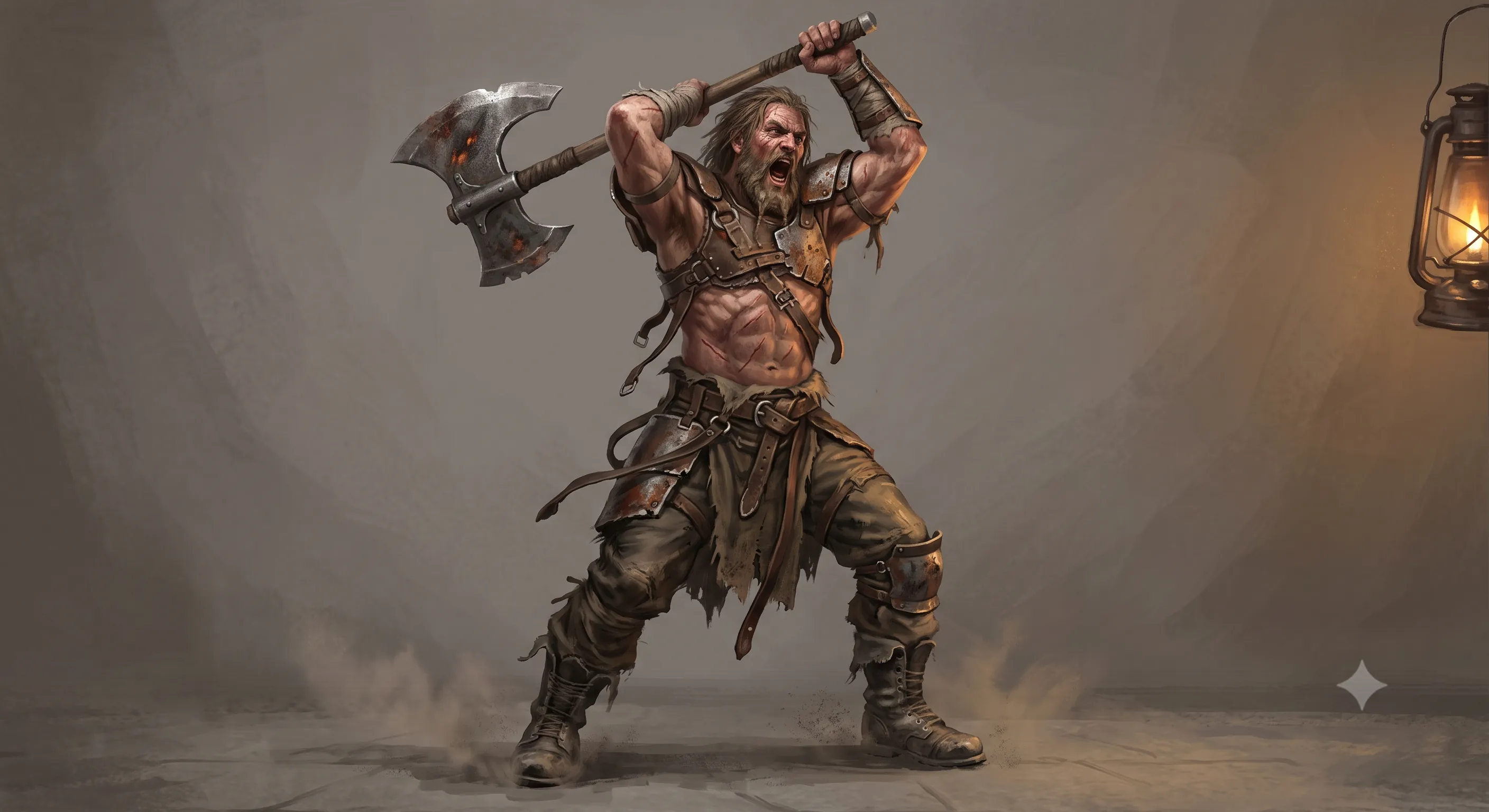
AC 13 (hide armor) · HP 90 (12d8 + 36) · Speed 30 ft.
Traits: Reckless — at the start of its turn, the berserker can choose to attack recklessly. Doing so gives it advantage on its melee attack rolls this turn, but attack rolls against it have advantage until the start of its next turn. Grit (1/Day) — the first time the berserker would be reduced to 0 hit points and isn’t killed outright, it drops to 1 hit point instead and stays on its feet. Sun-Forged Steel — the berserker’s scavenged great-axe was tempered in a buried-sun forge; it counts as magical and holds a low ember of heat that never fully cools.
Actions: Multiattack. The berserker makes two Sun-Forged Great-Axe attacks. Sun-Forged Great-Axe. Melee Attack Roll: +6, reach 5 ft., one target. Hit: 10 (1d12 + 4) Slashing damage plus 4 (1d8) Fire damage.
GM note: The frontier’s blunt instrument — a reaver who came out of the Waste swinging a dead man’s forge-marked axe and hasn’t stopped since. Reckless is the whole rhythm of the fight: it trades its own defense for near-guaranteed hits, hammering out real damage while handing the party advantage to hammer back, so the encounter becomes a race to drop it before it drops someone. Grit is the sting in the tail — the first killing blow only looks like a kill, and a table that turns its back after the axe-man falls gets one more furious round it wasn’t counting on, so make them confirm the body. The buried-sun axe is tempting loot; note for the table that it is forge-marked and OCTA-registered, and carrying a dead reaver’s registered steel into the capital is a conversation the party may not want to have. It is a person, not a Hollow thing — the Knowing reads a lifetime of frontier grievance behind the rage, and the Heart can seize that grievance and turn the charge into hesitation. No seam, no Binder, no Fray or Consecration anywhere in it; when it finally stays down, the matter is closed.
OCTA Inquisitor
Section titled “OCTA Inquisitor”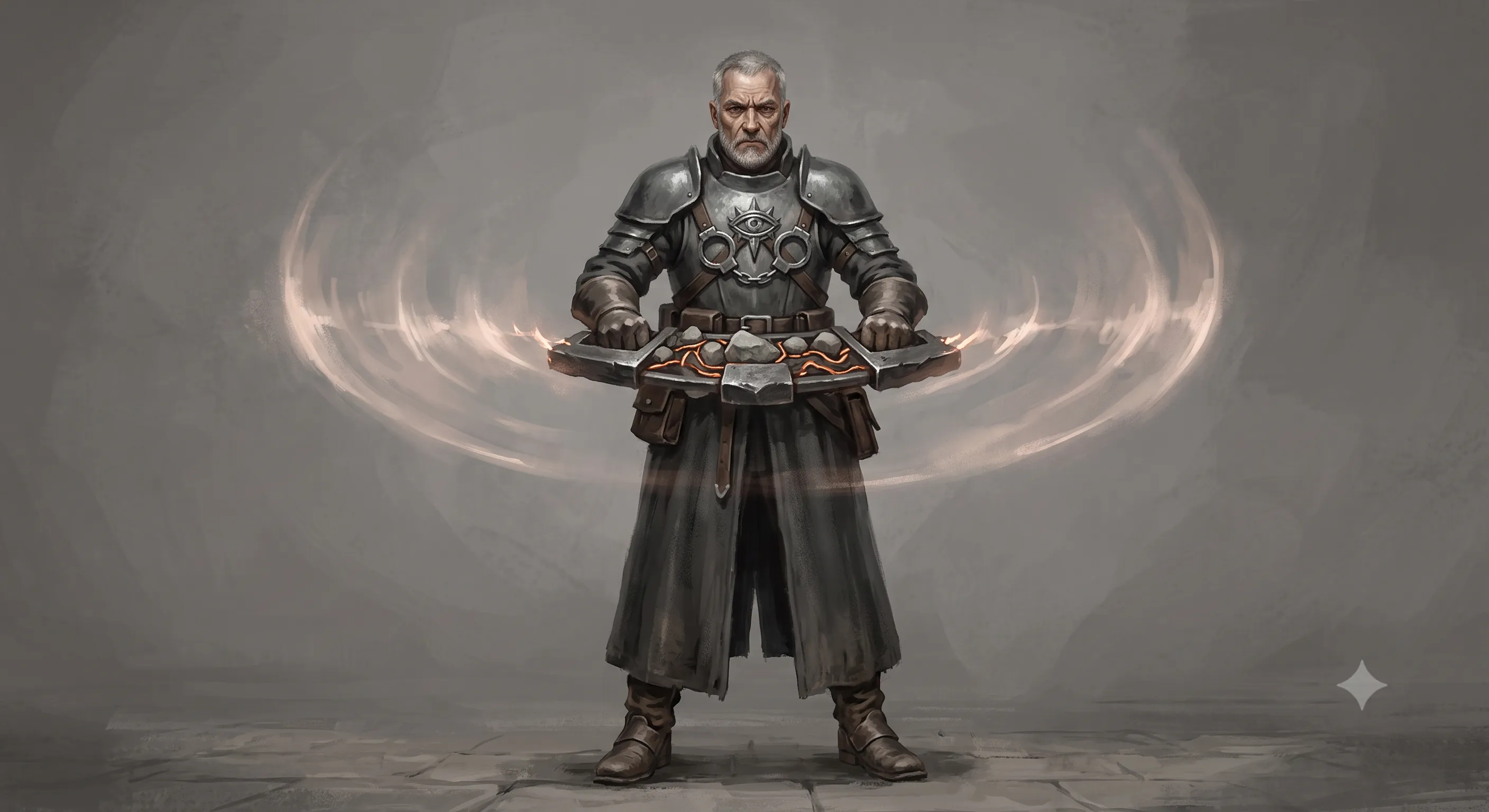
AC 18 (plate) · HP 119 (14d8+56) · Speed 30 ft.
Traits: Reader of the Reach — the Inquisitor names any caster’s discipline on sight from the eye-flash color, and can tell at a glance whether a focus-license is genuine; it is never fooled by a forged focus-stone. Warden’s Discipline — the Inquisitor has advantage on saving throws against spells and spell-like actions. It does not cast, and its eyes never flash a color — everything it does is stone, steel, and law.
Actions: Multiattack. The Inquisitor makes two attacks with its Warden’s Crossbow, or one Crossbow attack and one use of Focus-Stone Disruptor. Warden’s Crossbow. Ranged Attack Roll: +6, range 100/400 ft. Hit: 12 (2d8+3) Piercing damage. Focus-Stone Disruptor (Recharge 5–6). The Inquisitor levels a keening grey focus-stone; each creature of its choice in a 20-ft.-radius sphere centered on a point it can see within 60 ft. makes a Constitution Saving Throw: DC 15 (the stone’s rated field). Failure: Until the end of its next turn the target can’t reach any discipline — it can’t cast spells or use spell-like actions — and it takes 10 (3d6) psychic feedback as the stone jams the reach. Success: Half damage, and it can still cast. Oath-Manacles (utility). As an action, the Inquisitor clamps oath-manacles onto a creature that is Incapacitated, Grappled, or willing. While manacled, the creature has the Restrained condition and cannot reach any discipline; only the Inquisitor’s key, or a broken oath, releases them.
Bonus Actions: Warden’s Command — the Inquisitor directs one allied OCTA agent it can see within 30 ft. to immediately move up to its Speed and make one weapon attack as a Reaction.
GM note: The Field Agent two tiers down is correct and unstoppable against one caster; the Inquisitor is correct and unstoppable against your whole back line. The Disruptor is not a single-target lock anymore — it’s a 20-ft. bubble, so a clustered party of casters can lose the reach together on one bad round, and the Inquisitor plays to force exactly that clustering by pinning the front-liners with Warden’s Command while the crossbow bleeds whoever runs. Running tip: bait the Disruptor before it recharges by spreading your casters wide (it can only catch a 20-ft. sphere), and remember the Inquisitor commands other agents — kill or scatter the lessers first, because Warden’s Command is worthless with no one left to command. If your table murders a lawfully-warranted Inquisitor mid-arrest, the office logs it, and the next warrant has the party’s names on it.
Veteran Zar’ir Adept
Section titled “Veteran Zar’ir Adept”Medium humanoid (human), lawful good · Origin: Native — Faith devotee (Zar’ir, god-pair sworn)
AC 18 (plate) · HP 105 (14d8+42) · Speed 30 ft.
Traits: Sworn to a Pair — she serves a god-pair and reaches Faith on their sufferance; each casting flushes her eyes gold (the Faith tell). Unlike the Acolyte, she is a veteran — the mercy is real, the smite lands, and the courage is finally matched by the skill. Hollow Is the Enemy — she has advantage on saving throws against being Frightened by Hollow-origin creatures and the undead, and she will bodily place herself between them and anyone she is sworn to protect.
Actions: Multiattack. The Adept makes two Blessed Mace attacks; she can replace one of them with a use of Censure the Wound. Blessed Mace. Melee Attack Roll: +6, reach 5 ft. Hit: 6 (1d6+3) Bludgeoning damage, plus 7 (2d6) Radiant damage if the target is a Hollow-origin creature or undead. Radiant Smite (3/Day). When the Adept hits with Blessed Mace, her eyes flush gold and the blow carries 13 (3d8) extra Radiant damage — this rider works on any target, Hollow or not. Mercy Balm (3/Day). Her eyes flush gold as she lays a hand on herself or an ally within 5 ft.; that creature regains 18 (4d8) hit points. Censure the Wound (at-will). She points at one Hollow-origin creature or undead within 30 ft.; her eyes flare gold and it makes a Wisdom Saving Throw: DC 14. Failure: 14 (4d6) Radiant damage and it can’t take Reactions until the end of its next turn. Against anything that is neither Hollow nor undead, the censure does nothing — the gold light passes over a living person like sunlight.
GM note: She is the Zar’ir Acolyte grown up: same short, honest toolkit, but every tool now bites. The tactical read is that she is a sustain engine, not a striker — three Mercy Balms at 18 HP each can drag a losing warband back from the brink, so the fight gets shorter the sooner you break her concentration on healing (bloody her, threaten her wards, make her choose between smiting and mending). Running tip: watch which tool she reaches for — Radiant Smite lands on anyone, but if she levels Censure at a party member and it fizzles, that’s the table learning in real time that Faith reads Hollow-blight the ally doesn’t actually carry. She serves a god-pair and thinks she’s the hero of this scene; if the party can prove they hunt the Hollow too, she is far more valuable talked to a truce than dropped.
Cindermarch Firebrand-Adept
Section titled “Cindermarch Firebrand-Adept”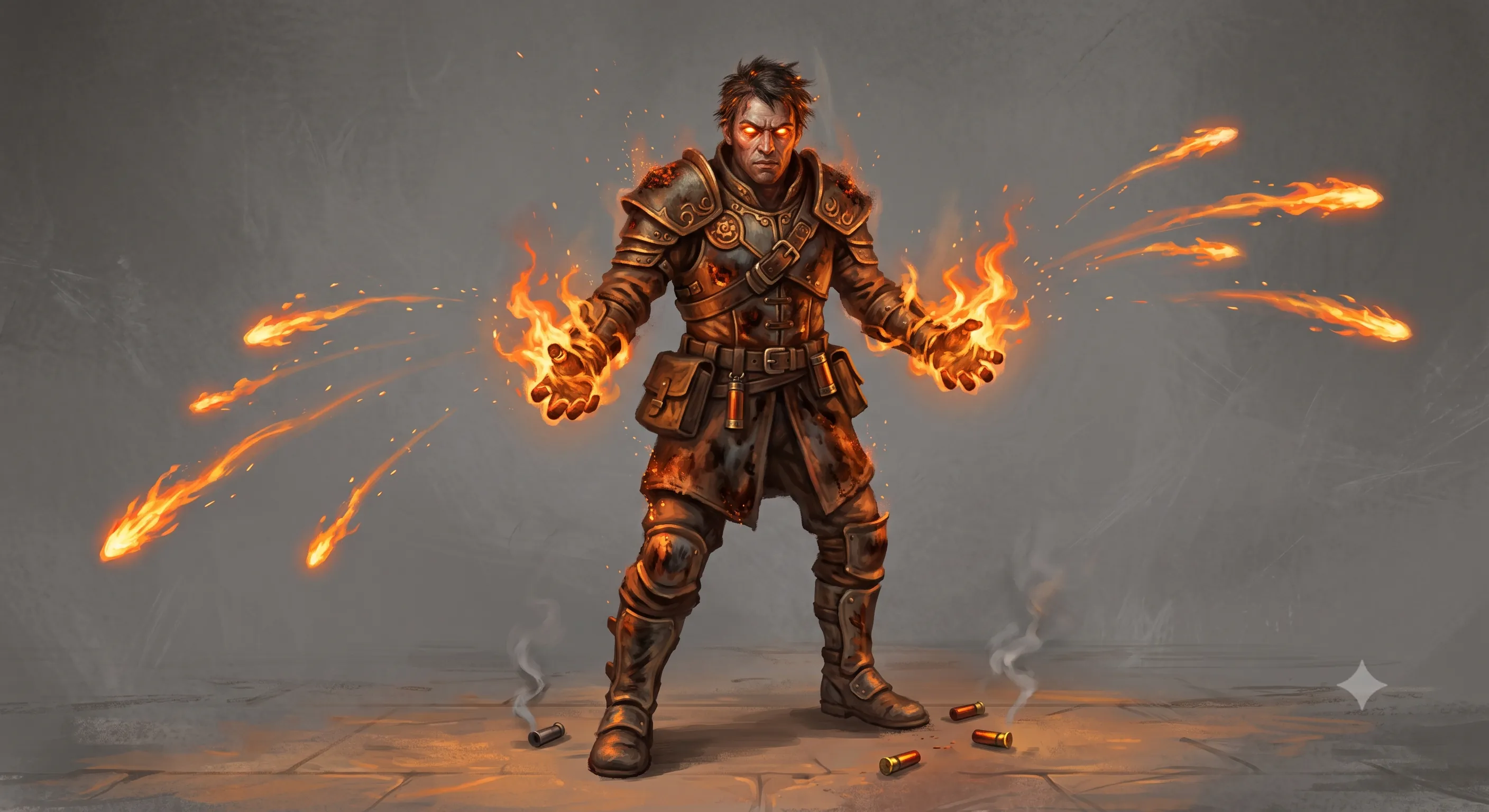
AC 15 (heat-warded) · HP 104 (16d8+32) · Speed 30 ft.
Traits: Ember-Blooded — his eyes flare a glowing ember-orange whenever he reaches Unmaking (the Order tell — Unmaking is an Order discipline, and it emits, not absorbs). The same heat that lets him throw fire cannot catch on him. Heat-Mantle — a visible shimmer of superheated air rolls off the Adept; any creature that hits him with a melee attack takes 5 (2d4) Fire damage, and he ignores difficult terrain caused by fire or heat.
Actions: Fire-Bolt Volley (at-will). Orange light guts up in the Adept’s eyes and he hurls three motes of fire at up to three creatures he can see within 120 ft. Make a separate Ranged Spell Attack: +6 for each. Hit: 9 (2d8) Fire damage. Searing Dagger. Melee or Ranged Attack Roll: +6, reach 5 ft. or range 20/60 ft. Hit: 5 (1d4+3) Piercing damage plus 3 (1d6) Fire damage. Backdraft (Recharge 5–6). His eyes blaze white-hot and superheated air floods a 30-ft. cone. Each creature there makes a Dexterity Saving Throw: DC 14. Failure: 28 (8d6) Fire damage, and flammable objects that aren’t worn or carried ignite. Success: Half damage.
GM note: The Street Firebrand was an angry kid with one trick; the Firebrand-Adept is what that kid becomes if OCTA never catches him — a genuine artillery piece. His whole shape is reach and reset: Fire-Bolt Volley lets him tag three targets from a full football-field away every round, and Backdraft is the haymaker he’s fishing to recharge, so he wants distance and a bunched-up party. Running tip: he is glass behind the shimmer (AC 15, and Heat-Mantle only punishes melee), so the counter is to close hard and spread out — deny Backdraft its cluster, eat the 5 fire per hit, and put him on the back foot where the Volley scatters into single soft hits. The ember-orange glow is a countdown in daylight: any OCTA agent in the ward has already clocked an unlicensed Unmaking caster of this grade, and reinforcements are a real clock on a long fight.
Thoughtplayer
Section titled “Thoughtplayer”
AC 14 · HP 91 (14d8+28) · Speed 30 ft.
Traits: Outlawed Reach — she reaches the Knowing, and when she does her eyes drink to a lightless, matte magenta (the Chaos tell — Knowing absorbs the light, it does not glow). Thoughtplaying is a capital crime; of every illegal caster, OCTA hunts her kind hardest, and she knows it. The Touch Is Always Felt — canon law of the Knowing: whenever she rides a creature’s attention or reads its mind, that creature always knows, instantly and exactly, that a mind has entered. There is no secret contact, ever — this is precisely why a thoughtplayer can never hide what she is, and why she is always running.
Actions: Mind-Spike (at-will). Ranged Spell Attack: +6, range 120 ft. Her eyes go matte magenta as a splinter of her attention drives into a mind. Hit: 14 (3d8) Psychic damage — and the target feels exactly whose touch it was. Attention-Ride (at-will). She settles onto one creature’s attention within 60 ft.; it feels her arrive and makes a Wisdom Saving Throw: DC 14. Failure: Until the end of her next turn she sees and hears through the target’s senses, it has the Charmed condition (toward her), it can’t take Reactions, and it takes 7 (2d6) Psychic damage. Compel Dread (Recharge 5–6). She floods a creature within 60 ft. with borrowed terror; it makes a Wisdom Saving Throw: DC 14. Failure: 14 (4d6) Psychic damage and it has the Frightened condition for 1 minute (repeat save at the end of each of its turns); while Frightened this way, on each of its turns it must use its movement to flee her if it can. Rip the Secret (2/Day). Her matte-magenta gaze fixes on a creature within 30 ft. and tears a guarded truth loose; it makes an Intelligence Saving Throw: DC 14. Failure: She learns the one secret it most wants hidden (GM’s call) and reads its resistances, immunities, and current intent; until the end of the encounter she and her allies have advantage on attack rolls against it. It takes 10 (3d6) Psychic damage.
GM note: She is the entry that will make a lawful party uneasy, because she is both the illegal thing OCTA exists to hunt and a living, terrified woman who bleeds and begs — mind and heart intact, killable like anyone. Play the canon hard: she cannot touch a mind in secret, so every ride is announced to its victim, which means she is not an assassin of thought — she is a cornered animal who telegraphs every attack and is running from the same Inquisitor your party might be working with. Running tip: her defense is thin (AC 14, 91 HP) and her whole game is Wisdom saves, so a party with good WIS shrugs her off and closes fast; a party of low-WIS bruisers gets its biggest hitter Charmed and turned into a lever. Ask, at the table, why she’s illegal here — because the honest answer is “she was born able to do a thing the OCTA made a crime,” and that should sit about as badly as the Hedge-Caster’s manacles.
Herald Acolyte
Section titled “Herald Acolyte”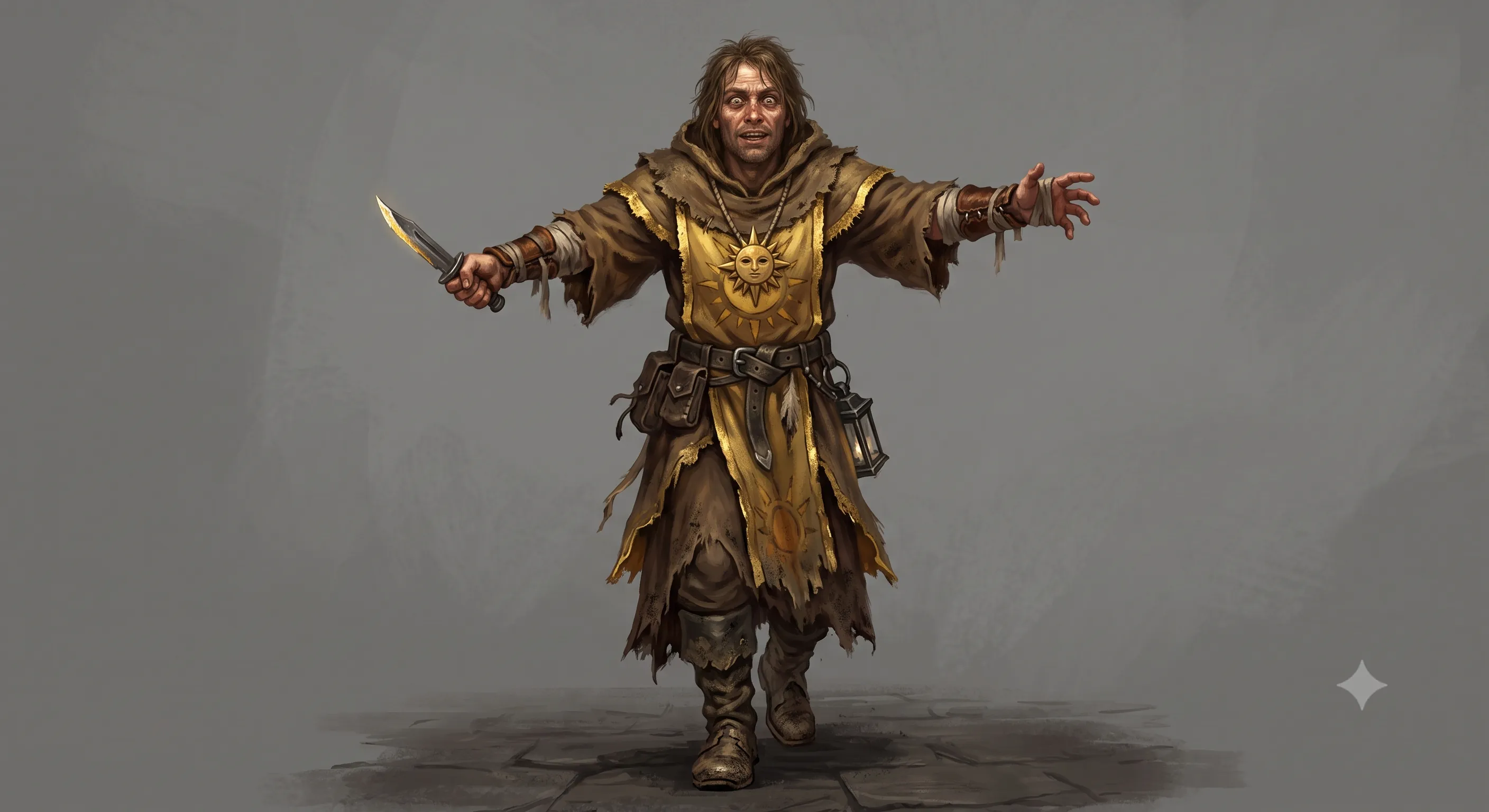
AC 13 (leather, buckler) · HP 27 (5d8+5) · Speed 30 ft.
Traits: Fervor of the Sunborn — the Acolyte has advantage on saving throws against being Frightened and Charmed; a mind this certain is a mind with nothing to grip. He does not cast, and his eyes do not flash — his only power is his belief. Reckless Devotion — at the start of his turn he may choose to attack recklessly, gaining advantage on his melee attacks this turn while attack rolls against him have advantage until the start of his next turn. He will make this choice almost every time; the Sunborn do not reward caution.
Actions: Multiattack. The Acolyte makes two Ritual Dagger attacks. Ritual Dagger. Melee or Ranged Attack Roll: +3, reach 5 ft. or range 20/60 ft. Hit: 3 (1d4+1) Piercing damage plus 2 (1d4) Radiant damage, as the star-etched blade drinks a little borrowed light.
Reactions: Throw Itself In — when an ally the Acolyte can see within 5 ft. is hit by an attack, the Acolyte can step into the blow and take the damage instead; there is no greater honor than a wound meant for the faithful.
GM note: This is cheap fanatic fodder, and it should die cheap — 27 HP, no tricks, one radiant-tinged knife — but it does not fight like fodder, and that’s the point. Reckless Devotion means it hands you advantage every round, so the martial who was told “the caster fights defensively” gets to feel like a god here; let them. The teeth are entirely in numbers and in Throw Itself In — six Acolytes bodyblocking hits meant for a Zealot or a Cell-Leader can keep the real threat alive two rounds longer than the math says, so a party that focus-fires the leader will find bodies flinging themselves into the path. Running tip: don’t roleplay these as cowards or thugs; roleplay ecstasy. A minion that wants to die for the Sunborn reframes the whole fight — the party isn’t scattering brigands, they’re feeding a faith.
Herald Zealot
Section titled “Herald Zealot”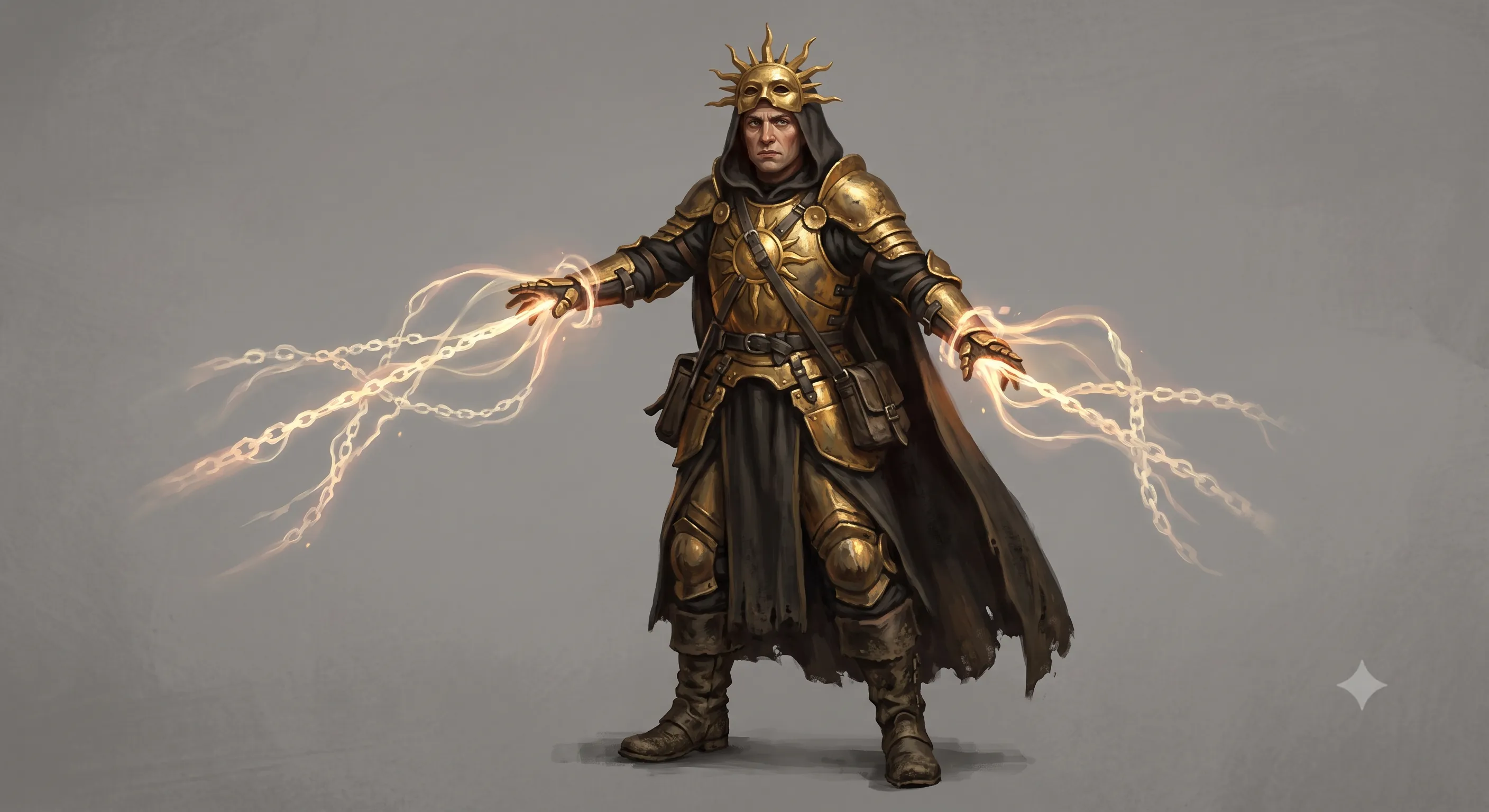
AC 16 (breastplate) · HP 58 (9d8+18) · Speed 30 ft.
Traits: Borrowed Working (Binding) — the Zealot was schooled to a single low Working before it was let off the leash; when it reaches, its eyes glow a hard Binding-yellow (the Order tell — Binding emits a steady light). Mark the color for the table: the cult claims it channels the Sunborn’s holy gold, but the tell is yellow, not gold — this is stolen Order-Binding wearing a halo, not true Faith, and any OCTA reader clocks the lie on sight. Undying Fervor — the first time the Zealot would drop to 0 hit points but is not killed outright (not by a critical hit, and not reduced past 0 by the same amount again), it instead drops to 1 hit point and may keep fighting. The faithful do not fall while the work is undone. It also has advantage on saving throws against being Frightened.
Actions: Multiattack. The Zealot makes two Consecrated Greatblade attacks. Consecrated Greatblade. Melee Attack Roll: +5, reach 5 ft. Hit: 10 (2d6+3) Slashing damage. Sunborn Shackles (Recharge 5–6) — the borrowed Working. The Zealot’s eyes glow Binding-yellow and chains of hard light snap around one creature it can see within 30 ft., which makes a Strength Saving Throw: DC 13. Failure: 7 (2d6) Force damage and the target has the Restrained condition (repeat save at the end of each of its turns to shatter the chains). Success: Half damage, no Restrain.
GM note: The Zealot is the cult’s line infantry with one good trick and a refusal to lie down. Sunborn Shackles is a control button, not a damage button — it’s how a Zealot pins your mobile skirmisher or your fleeing caster so the Acolytes can swarm, so treat a Restrained ally as a five-alarm fire and free them before the repeat-save whittles their turns away. Running tip: Undying Fervor is the fight’s rug-pull — the player who lands the “killing blow” and starts to relax watches the Zealot rise at 1 HP swinging, so warn no one and let it land; the second drop is real. The load-bearing canon detail is the eye-color: the Heralds market themselves as holy, but a Zealot’s yellow (not gold) glow is the crack in the cult’s story — a sharp party, or a friendly OCTA agent, can read “these people don’t have Faith, they have a stolen Order Working and a lie” straight off the tell.
Herald Cell-Leader
Section titled “Herald Cell-Leader”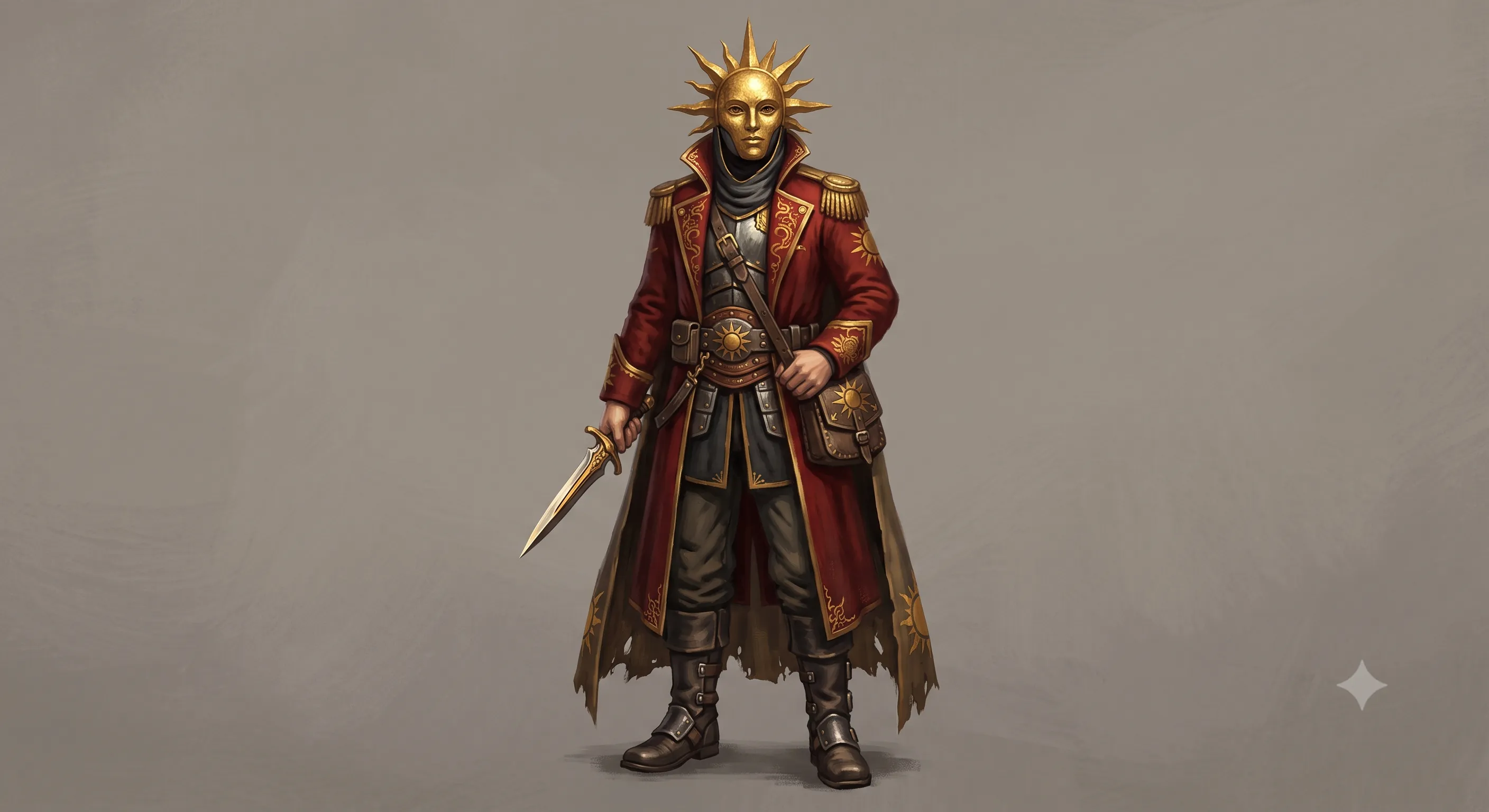
AC 18 (warded fine mail) · HP 136 (16d8+64) · Speed 30 ft.
Traits: Prescient — Reads the Fight — the Cell-Leader reads a room a half-second before it happens; it can take the Dodge action as a Bonus Action, and it is never Surprised. Coil-Bearer, Not Caster — its threat is a forbidden coil-weapon, a wound tool of humming brass and stored lightning; because it is a device and not a reach, the Cell-Leader’s eyes never flash a color — the deliberate advantage of a leader who has to walk past OCTA readers. (This is a generic cell-leader, not the named metal-armed Herald of book one; run it as the type, not the character.)
Actions: Multiattack. The Cell-Leader makes two Coil-Lance attacks, or one Coil-Lance attack and one use of Arc-Line. Coil-Lance. Melee Attack Roll: +6, reach 10 ft. Hit: 8 (1d10+3) Piercing damage plus 7 (2d6) Lightning damage as the coil dumps its charge. Arc-Line (Recharge 5–6). The Cell-Leader points the coil and lets it discharge in a 60-ft. line, 5 ft. wide; each creature there makes a Dexterity Saving Throw: DC 15. Failure: 27 (6d8) Lightning damage and it can’t take Reactions until the end of its next turn. Success: Half damage. Rally the Faithful (Recharges after a Short or Long Rest). For 1 minute, whenever a non-hostile creature the Cell-Leader can see within 30 ft. makes an attack roll or a saving throw, the Cell-Leader can shout a command as no action and that creature adds a d4 to the roll; it may command a different creature (or the same one) on each such roll.
Reactions: Read the Fight — when a creature the Cell-Leader can see makes an attack roll against it, the Cell-Leader can force that attacker to reroll and use the lower of the two results.
GM note: This is the book-one operative type — the professional who runs a Herald cell — and it is built to be the frustrating boss, not the burst-damage boss. Between Read the Fight (reroll your best swing into your worst), Prescient (free Dodge as a bonus action), AC 18 and 136 HP, it is genuinely hard to pin down, and that’s the intended feel: the party lands half of what it should while the Coil-Lance and Arc-Line grind them and Rally the Faithful upgrades a screen of Acolytes into something that actually hits. Running tip: the whole board is a boss-and-adds engine — kill the Rally by killing the leader, but you can’t reliably kill the leader while it Dodges and rerolls, so the answer is action economy and forced saves (Arc-Line is a Dex save it can’t reroll away, and neither can a shove or a grapple that ignores its Reaction). Flavor the coil-weapon as a tell of its own: a Herald leader who carries a lightning-device instead of casting is a leader built to pass an OCTA checkpoint — no eye-flash, nothing to read — which tells your players exactly how organized, and how patient, this cult actually is.