Chapter 10 — The Cast
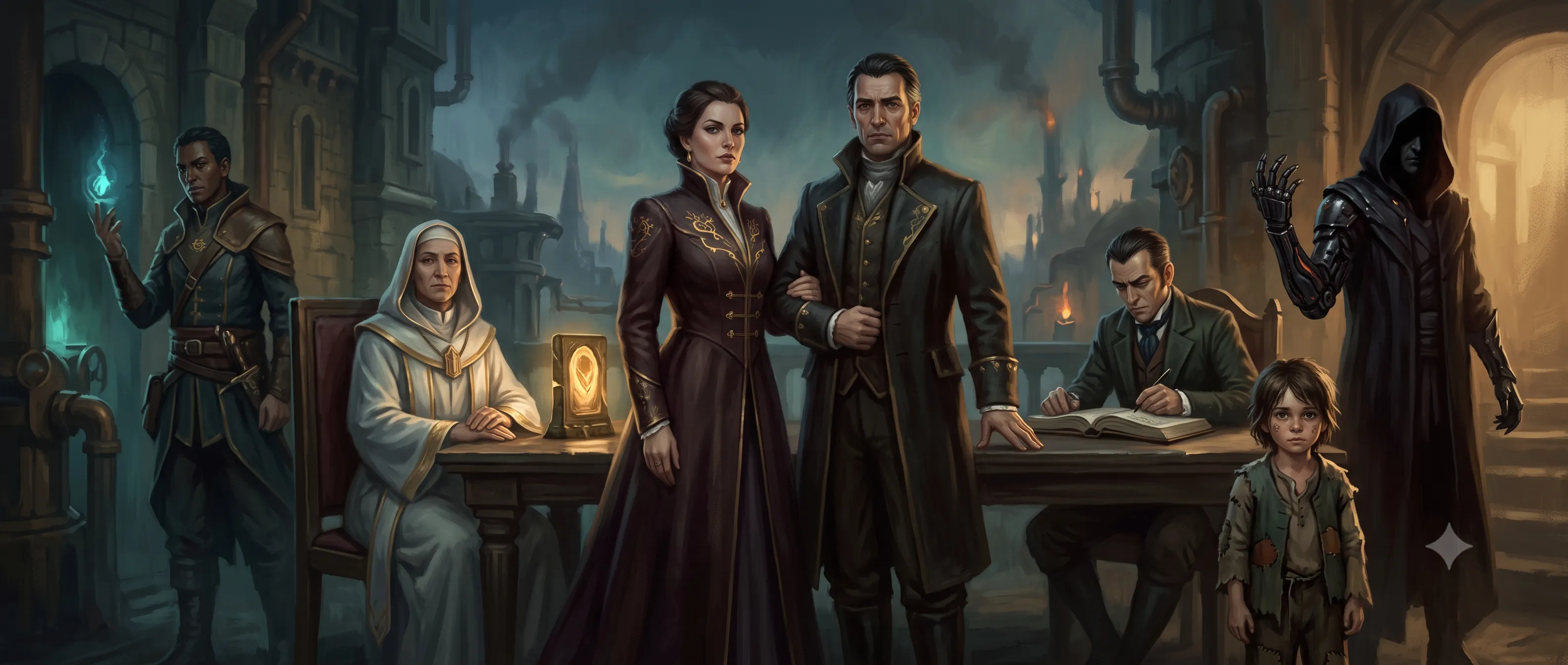
The people of Merretia are its best content, and the world bible holds them in depth. This chapter is how to use them: the figures who move the world, and how to build antagonists that belong to it.
The principle: NPCs are debts and oaths with faces
Section titled “The principle: NPCs are debts and oaths with faces”In a setting built on bonds, the most useful thing an NPC carries is not a stat block but a relationship under tension — who they owe, what they swore, whose bond they’re one bad night away from breaking. Give every recurring NPC one debt and one oath, and they will generate plot on their own. For their numbers, borrow and reskin a stat block from the bestiary or a standard NPC block; the mechanics matter far less than the leash.
The powers that move the world
Section titled “The powers that move the world”- The archons.Oen, archon of Order, who at full expression radiates pure white, and Cyl, archon of Chaos, the Key — the absorbing center. They are the twin centers of gravity of the wider saga, human-scaled but categorically beyond ordinary practice. Use them sparingly and enormously; a campaign more often lives in their shadow than at their side.
- The Fused Houses. The heads who bundle a guild, a Senate seat, and a Council seat — the real oligarchy. A Fused House overreaching, or a rival maneuvering to call an OCTA investigation, is the default engine of Sulamir intrigue. The ruling couples and lineages are in and.
- The Temple’s hand. Figures like Niska, who holds the Temple of the One’s Council seat through the inner teaching — her vows having suspended her House surname — sit closest to the hidden truth and outside the fusion’s capture. The Temple is where a GM plants a character who knows too much.
The antagonists
Section titled “The antagonists”The setting’s standing threat is the Heralds of the Sunborn, the Hollow cult operating under Valareth (the returned Zar Valareth behind the cult mask), whose deliberate seam-work beneath the Steam Tunnels opens the main saga. Their operational figure in Sulamir is the metal-armed prescient Herald. Against them run the Iosan Serpents, the undercover OCTA program hunting the cult — a counter-force whose operations a party’s investigation eventually crosses. This is a ready-made web of antagonists, counter-agents, and mistaken identities to draw on.
Building a villain that belongs here
Section titled “Building a villain that belongs here”The most dangerous antagonist in Merretia is rarely the thing that crosses a seam — it is the argument that opens one. The setting’s true villainy is the doctrine “severance is liberation” ( §Part Four), spoken in a living, sincere, often loving mouth. The type case is Aesen Corveliss: not a cackling cultist but a person who makes cutting a bond sound like freedom, and means it. Build your villains there:
- Give them a real grief and a real point. The doctrine has to be tempting — it should be right about the pain of a bond, and wrong only about the cure.
- Let them love someone. The tempter who genuinely loves is far more dangerous, and far more Merretian, than one who hates.
- Never let the absence itself monologue. The Hollow has no voice; the villainy is always in the person carrying the idea. A Hollow-possessed practitioner speaks only in ventriloquism — true things curdled — and never explains a plan.
Meanwhile the mundane antagonists — a foreclosing Iron Coin factor, a Red Octopus enforcer, a rival House’s Spider — carry no cosmic weight and are all the better for it; not every enemy is a metaphysical crisis, and the contrast keeps the real dread sharp.
The small and the good
Section titled “The small and the good”Don’t forget the people the players fight for. The Cold Lamp’s Pip — a child stealing to save his sister — is the register the whole setting protects: small, human, and worth more than any relic. A cast of likable and unlikable ordinary people is what makes the cosmology matter.